Knowledge Management in Software Engineering: A Systematic Review of Studied Concepts, Findings and Research Methods Used
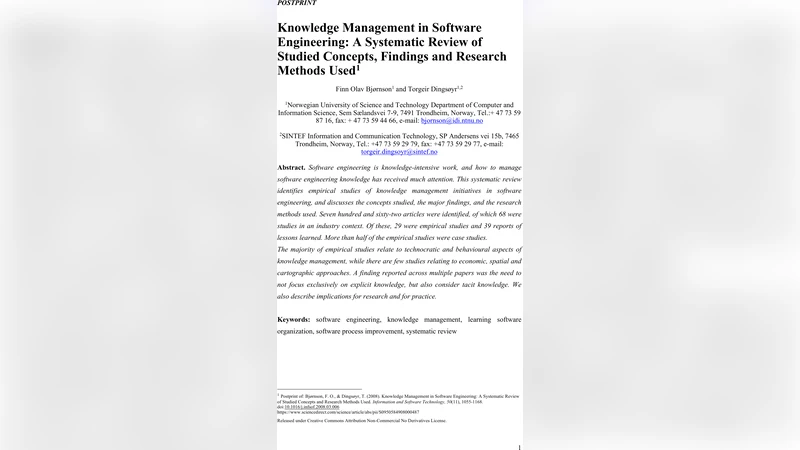
Software engineering is knowledge-intensive work, and how to manage software engineering knowledge has received much attention. This systematic review identifies empirical studies of knowledge management initiatives in software engineering, and discusses the concepts studied, the major findings, and the research methods used. Seven hundred and sixty-two articles were identified, of which 68 were studies in an industry context. Of these, 29 were empirical studies and 39 reports of lessons learned. More than half of the empirical studies were case studies. The majority of empirical studies relate to technocratic and behavioural aspects of knowledge management, while there are few studies relating to economic, spatial and cartographic approaches. A finding reported across multiple papers was the need to not focus exclusively on explicit knowledge, but also consider tacit knowledge. We also describe implications for research and for practice.
💡 Research Summary
This paper presents a systematic review of knowledge‑management (KM) initiatives that have been studied in the context of software engineering. Recognizing that software development is fundamentally a knowledge‑intensive activity, the authors set out to identify empirical investigations of KM practices, categorize the concepts examined, summarize the main findings, and evaluate the research methods employed.
The authors searched major bibliographic databases (IEEE Xplore, ACM Digital Library, Scopus, Web of Science) for the period 2000‑2020 using a combination of keywords such as “knowledge management,” “software engineering,” “knowledge sharing,” and “knowledge reuse.” The initial retrieval yielded 762 records. After screening titles, abstracts, and keywords, 68 papers were identified as reporting KM work conducted in an industrial setting. Of these, 29 were classified as empirical studies (the remainder were lessons‑learned reports).
Empirical work was dominated by case studies (17 papers), followed by surveys (6), controlled experiments (3), and mixed‑methods designs (3). The studies were further grouped according to the dimension of KM they addressed: technocratic (tools, repositories, processes), behavioral (culture, learning, collaboration), economic (cost‑benefit, ROI), spatial (knowledge flow across physical or virtual spaces), and cartographic (knowledge‑mapping techniques). The review found a strong bias toward technocratic and behavioral aspects; economic, spatial, and especially cartographic approaches were sparsely represented (only a handful of papers).
Key substantive findings include:
-
Explicit vs. Tacit Knowledge – Multiple papers warned against a narrow focus on explicit artifacts (documents, code, manuals). Effective KM must also capture, transfer, and sustain tacit knowledge such as expert experience, problem‑solving heuristics, and trust relationships. Practices like mentoring, pair programming, retrospectives, and informal communities of practice were repeatedly highlighted as essential for tacit‑knowledge diffusion.
-
Success Factors – Leadership endorsement, clear incentive structures, adequate technical infrastructure (e.g., searchable knowledge bases, integration with development environments), and an open, collaborative culture were consistently reported as enablers of successful KM.
-
Barriers – Knowledge silos, short‑term project contracts, resistance to tool adoption, and a lack of alignment between KM activities and business goals emerged as common obstacles.
-
Methodological Gaps – While case studies provide rich contextual insight, they often lack quantitative metrics (e.g., reuse rates, defect reduction percentages) that would support generalization. Moreover, the sample is skewed toward large enterprises; startups, open‑source communities, and distributed agile teams are under‑explored.
From a methodological standpoint, the predominance of qualitative case research reflects the complex, context‑dependent nature of software projects. However, the authors argue that future work should incorporate more mixed‑methods designs, longitudinal measurements, and statistical modeling to assess KM impact over time.
The discussion translates these observations into research and practice implications. For researchers, the authors call for:
- Development of integrated KM frameworks that incorporate economic, spatial, and cartographic dimensions, thereby moving beyond the current artifact‑centric view.
- Exploration of meta‑cognitive training programs and AI‑driven knowledge extraction or recommendation systems to support tacit‑knowledge capture.
- Comparative studies across diverse development settings (e.g., startups, open‑source, globally distributed teams) to test the external validity of existing findings.
For practitioners, the paper recommends:
- Designing KM strategies that explicitly address both explicit and tacit knowledge, embedding informal practices (mentoring, retrospectives) into formal processes.
- Investing in “knowledge‑mapping” tools that visualize knowledge flow, identify bottlenecks, and align knowledge assets with business objectives.
- Aligning incentive mechanisms with knowledge‑sharing behaviors and ensuring leadership visibly champions KM initiatives.
The authors acknowledge several limitations: the literature search was limited to English‑language sources and major databases, potentially omitting relevant gray literature; the heavy reliance on case studies limits the ability to generalize results; and emerging AI/ML‑based KM solutions have received little empirical scrutiny. They conclude by urging the community to address these gaps through more rigorous, mixed‑methods, and longitudinal research that can substantiate the long‑term benefits of knowledge management in software engineering.
Comments & Academic Discussion
Loading comments...
Leave a Comment