The Atiyah conjecture and Artinian rings
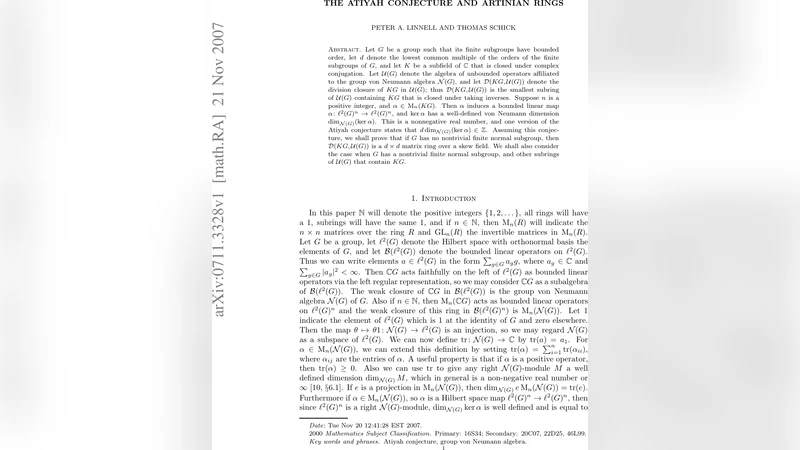
Let G be a group such that its finite subgroups have bounded order, let d denote the lowest common multiple of the orders of the finite subgroups of G, and let K be a subfield of C that is closed under complex conjugation. Let U(G) denote the algebra of unbounded operators affiliated to the group von Neumann algebra N(G), and let D(KG,U(G)) denote the division closure of KG in U(G); thus D(KG,U(G)) is the smallest subring of U(G) containing KG that is closed under taking inverses. Suppose n is a positive integer, and \alpha \in \Mat_n(KG). Then \alpha induces a bounded linear map \alpha: l^2(G)^n \to \l^2(G)^n, and \ker\alpha has a well-defined von Neumann dimension \dim_{N(G)} (\ker\alpha). This is a nonnegative real number, and one version of the Atiyah conjecture states that d \dim_{N(G)}(\ker\alpha) \in Z. Assuming this conjecture, we shall prove that if G has no nontrivial finite normal subgroup, then D(KG,U(G)) is a d \times d matrix ring over a skew field. We shall also consider the case when G has a nontrivial finite normal subgroup, and other subrings of U(G) that contain KG.
💡 Research Summary
The paper investigates the algebraic structure of the division closure of a group algebra inside the algebra of unbounded operators affiliated with the group von Neumann algebra. Let G be a discrete group whose finite subgroups have uniformly bounded order, and let d be the least common multiple of those orders. For a subfield K⊂ℂ closed under complex conjugation, the authors consider the group algebra KG, the von Neumann algebra N(G), and the affiliated operator algebra U(G). The division closure D(KG,U(G)) is defined as the smallest subring of U(G) containing KG and closed under taking inverses.
Assuming the Atiyah conjecture – namely that for every matrix α∈Mat_n(KG) the von Neumann dimension of its kernel satisfies d·dim_{N(G)}(ker α)∈ℤ – the authors prove a striking structural result. If G has no non‑trivial finite normal subgroup, then D(KG,U(G)) is a simple Artinian ring isomorphic to the full matrix ring M_d(F) for some skew field F. In other words, D is a d × d matrix algebra over a division ring, and the centre of D is precisely K. The proof proceeds by showing that any non‑zero two‑sided ideal in D would force a von Neumann dimension that violates the Atiyah integrality condition, thereby establishing simplicity. Wedderburn–Artin theory then yields the matrix‑over‑skew‑field description.
When G does contain a non‑trivial finite normal subgroup N, the situation becomes more nuanced. The authors decompose D relative to the normal subgroup: the subalgebra K
Comments & Academic Discussion
Loading comments...
Leave a Comment