Coarse topology, enlargeability, and essentialness
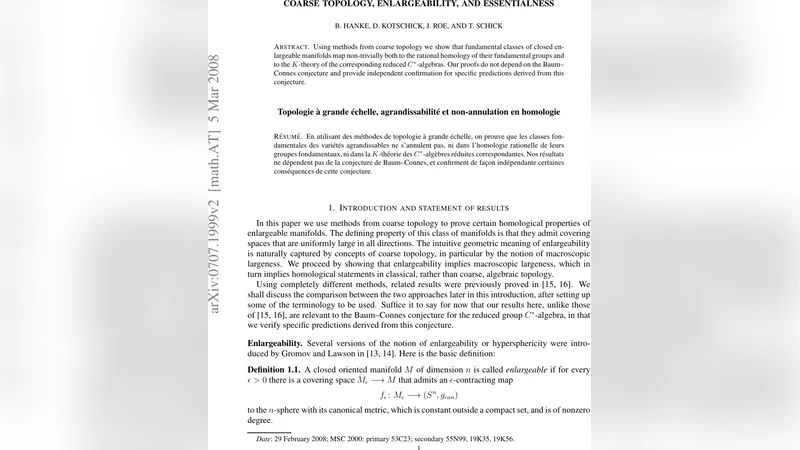
Using methods from coarse topology we show that fundamental classes of closed enlargeable manifolds map non-trivially both to the rational homology of their fundamental groups and to the K-theory of the corresponding reduced C*-algebras. Our proofs do not depend on the Baum–Connes conjecture and provide independent confirmation for specific predictions derived from this conjecture.
💡 Research Summary
The paper establishes, by means of coarse‑topological techniques, that the fundamental class of any closed enlargeable manifold maps non‑trivially both to the rational homology of its fundamental group and to the K‑theory of the reduced C*‑algebra of that group. The authors begin by recalling the notion of enlargeability introduced by Gromov and Lawson: a closed manifold M is enlargeable if for every ε>0 there exists a covering space \tilde M and an ε‑Lipschitz map of non‑zero degree from \tilde M to the sphere Sⁿ. This condition forces the existence of “large‑scale” geometric features that survive under arbitrary small metric distortions.
The first major result concerns the homological image. By treating the universal cover \tilde M as a coarse space, the ε‑Lipschitz maps give rise to coarse equivalences between \tilde M and the contractible space Eπ₁(M) on which the fundamental group acts freely. Passing to the quotient yields a map Bπ₁(M)←M that induces a homomorphism Hₙ(M;ℚ)→Hₙ(π₁(M);ℚ). Using the degree‑non‑zero property of the enlargeability maps, the authors prove that the image of the fundamental class
Comments & Academic Discussion
Loading comments...
Leave a Comment