Collective social behavior in a crowd controlled game
Despite many efforts, the behavior of a crowd is not fully understood. The advent of modern communication media has made it an even more challenging problem, as crowd dynamics could be driven by both human-to-human and human-technology interactions. Here, we study the dynamics of a crowd controlled game (Twitch Plays Pok'emon), in which nearly a million players participated during more than two weeks. We dissect the temporal evolution of the system dynamics along the two distinct phases that characterized the game. We find that players who do not follow the crowd average behavior are key to succeed in the game. The latter finding can be well explained by an n-$th$ order Markov model that reproduces the observed behavior. Secondly, we analyze a phase of the game in which players were able to decide between two different modes of playing, mimicking a voting system. Our results suggest that under some conditions, the collective dynamics can be better regarded as a swarm-like behavior instead of a crowd. Finally, we discuss our findings in the light of the social identity theory, which appears to describe well the observed dynamics.
💡 Research Summary
The paper investigates the dynamics of a massive online crowd‑controlled experiment known as “Twitch Plays Pokémon” (TPP), which ran for 17 days in February 2014 and attracted nearly one million participants. By treating the event as a natural laboratory, the authors dissect its evolution into two distinct phases and explore how collective behavior emerges when thousands of individuals simultaneously issue commands to a single video‑game avatar.
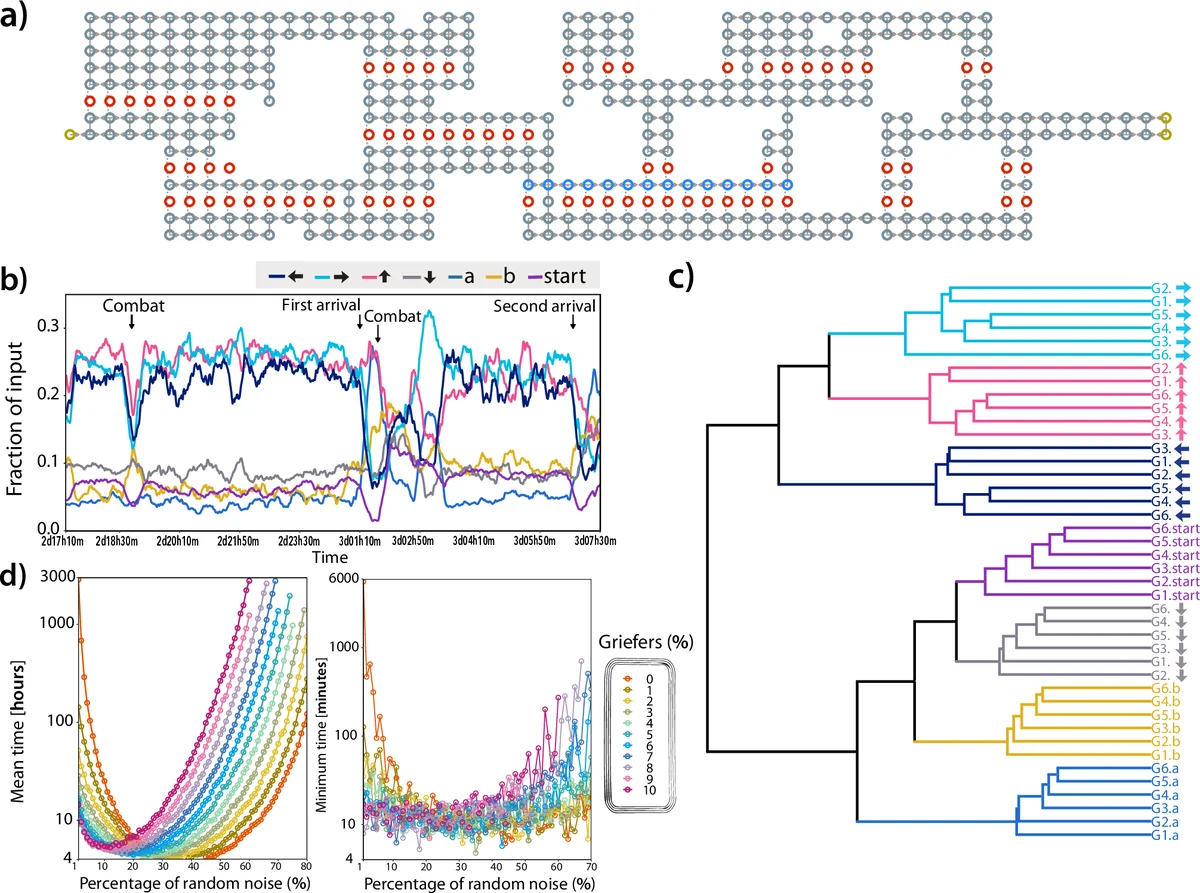
In the first phase, commands entered in the Twitch chat were forwarded almost immediately to the game, but because the emulator could process only one input at a time, many inputs were discarded. Statistical analysis of the command stream shows that the majority of users follow the most frequent command (the “average crowd” behavior), yet a small minority (roughly 5‑10 % of participants) consistently issued divergent inputs. These “non‑conformist” players acted as sources of perturbation that, in critical sections of the game (puzzles, boss battles, and navigation bottlenecks), produced the rare command sequences needed to progress. To capture this phenomenon, the authors construct an n‑th‑order Markov model in which the probability of the next command depends on the preceding n commands. By fitting the model to the empirical data, they find that values of n ≥ 3 reproduce the observed progression speed and the distribution of command bursts, indicating that participants do not react solely to the instantaneous crowd majority but retain a short memory of recent actions.
The second phase begins when the game developer modifies the system to introduce a “voting mode.” In this mode, every 5‑10 seconds the most voted command (or a compound command of up to nine elementary actions) is executed, and the previous immediate‑execution mechanism is disabled. This change dramatically slows progress and provokes a coordinated “riot” in which users flood the chat with the command “start9” to repeatedly open and close the menu, effectively sabotaging the voting process. Text‑analysis of the chat reveals spikes in frustration markers (e.g., elongated “nooo” and frequent use of the word “why”), confirming that many participants felt confused and powerless.
The voting regime also triggers a social split: two factions emerge—self‑identified “democrats” who support the majority‑rule voting system, and “anarchists” who oppose it and advocate a return to the original immediate‑execution mode. The authors interpret this polarization through Social Identity Theory, arguing that the emergence of in‑group/out‑group identities reshapes collective dynamics. When the voting system is temporarily withdrawn, the crowd reverts to a swarm‑like behavior where individual commands are instantly reflected in the game, and the overall movement becomes smoother and more coordinated.
By comparing the two regimes, the study demonstrates that TPP oscillates between a traditional “crowd” state (characterized by majority averaging, delayed feedback, and potential deadlock) and a “swarm” state (characterized by rapid feedback, local interaction, and emergent coordination). The authors argue that the presence of a small, non‑conforming minority is essential for breaking stalemates and that real‑time feedback loops can transform a crowd into a swarm, improving problem‑solving efficiency.
The paper situates these findings within the broader literature on crowd behavior. Classical theories such as Le Bon’s “irrational herd,” convergence theory, and emergent‑norm theory emphasize loss of individuality and often predict suboptimal outcomes. In contrast, the observed TPP dynamics align more closely with modern swarm intelligence concepts, where decentralized agents interact locally and collectively converge on solutions. Moreover, the study highlights that independence—a key assumption in the wisdom‑of‑crowds paradigm—is violated in TPP, yet the system still produces useful outcomes thanks to the interplay of conformity, memory, and minority innovation.
Finally, the authors discuss practical implications for the design of large‑scale online collaboration platforms. They suggest that deliberately preserving a minority of divergent contributors can prevent premature convergence and foster exploration of the solution space. Additionally, designers should consider adaptive feedback intervals: shorter intervals promote swarm‑like coordination, while longer intervals encourage deliberative voting but risk frustration and sabotage. Recognizing and managing emergent social identities can also mitigate conflict and sustain participation. In sum, the study provides a comprehensive, data‑driven account of how digital crowds can transition between crowd and swarm regimes, offering both theoretical insights and actionable guidance for future crowd‑sourced systems.
Comments & Academic Discussion
Loading comments...
Leave a Comment