Digital compensation of the side-band-rejection ratio in a fully analog 2SB sub-millimeter receiver
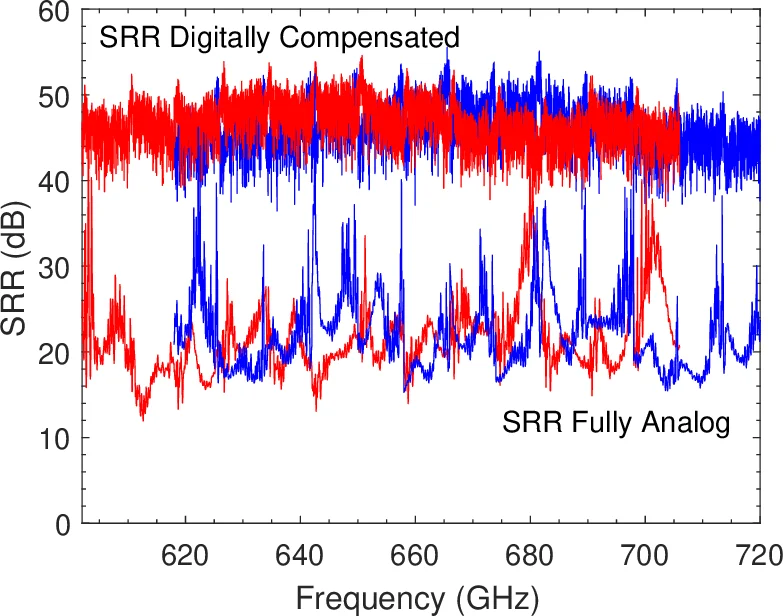
In observational radio astronomy, sideband-separating receivers are preferred, particularly under high atmospheric noise, which is usually the case in the sub-millimeter range. However, obtaining a good rejection ratio between the two sidebands is difficult since, unavoidably, imbalances in the different analog components appear. We describe a method to correct these imbalances without making any change in the analog part of the sideband-separating receiver, specifically, keeping the intermediate-frequency hybrid in place. This opens the possibility of implementing the method in any existing receiver. We have built hardware to demonstrate the validity of the method and tested it on a fully analog receiver operating between 600 and 720GHz. We have tested the stability of calibration and performance vs time and after full resets of the receiver. We have performed an error analysis to compare the digital compensation in two configurations of analog receivers, with and without intermediate frequency (IF) hybrid. An average compensated sideband rejection ratio of 46dB is obtained. Degradation of the compensated sideband rejection ratio on time and after several resets of the receiver is minimal. A receiver with an IF hybrid is more robust to systematic errors. Moreover, we have shown that the intrinsic random errors in calibration have the same impact for configuration without IF hybrid and for a configuration with IF hybrid with analog rejection ratio better than 10dB. Compensated rejection ratios above 40dB are obtained even in the presence of high analog rejection. The method is robust allowing its use under normal operational conditions at any telescope. We also demonstrate that a full analog receiver is more robust against systematic errors. Finally, the error bars associated to the compensated rejection ratio are almost independent of whether IF hybrid is present or not.
💡 Research Summary
The paper presents a practical method for digitally compensating the side‑band rejection ratio (SRR) of fully analog two‑sideband‑separating (2SB) receivers operating in the sub‑millimeter band (600–720 GHz). Traditional 2SB receivers rely on perfect amplitude and phase balance throughout the RF and IF chains; however, unavoidable component mismatches limit the analog SRR to typically 7–30 dB, especially in the demanding sub‑mm regime where atmospheric noise is high. Earlier digital‑only solutions achieved high SRR (>40 dB) by removing the analog IF hybrid and inserting a digital processor, but this required extensive hardware redesign, making it impractical for existing instruments.
The authors demonstrate that the analog IF hybrid can be retained while still achieving high‑performance digital compensation. The theoretical framework models the analog part as two output voltages (\hat v_1 = \hat g_{1U}\hat V_U + \hat g_{1L}\hat V_L) and (\hat v_2 = \hat g_{2U}\hat V_U + \hat g_{2L}\hat V_L). In the digital stage a linear combination (\hat v_{1c} = \hat c_1\hat v_1 + \hat c_2\hat v_2) and (\hat v_{2c} = \hat c_3\hat v_1 + \hat c_4\hat v_2) is performed. Perfect sideband separation is achieved when the calibration constants satisfy (\hat c_1\hat c_2 = -\hat g_{2L}\hat g_{1L}) and (\hat c_3\hat c_4 = -\hat g_{2U}\hat g_{1U}). The constants are obtained by injecting a well‑defined RF tone and measuring the complex ratios (\hat X_1 = \hat v_1/\hat v_2) (LSB) and (\hat X_2 = \hat v_2/\hat v_1) (USB).
Experimentally, the scheme was implemented on an ALMA Band‑9 prototype 2SB receiver that uses superconducting SIS mixers and a standard 4–12 GHz IF band. A FPGA‑based spectrometer provides the digital back‑end; because the spectrometer’s native bandwidth is 1 GHz, a second down‑conversion stage was added to bring the IF into the ADC range. Calibration constants were stored in the FPGA memory, and SRR was measured using the Kerr method (hot/cold load comparison).
Results show that, without compensation, the analog SRR varies between 7 and 30 dB across the band. After applying the digital correction, the SRR exceeds 40 dB over the entire 600–720 GHz range, with an average of 46 dB and a minimum of 40 dB. The authors also evaluated calibration stability. Over a 24‑hour period, the same calibration was used for 48 measurements taken every 30 minutes; SRR drift was less than 0.5 dB, and the worst case stayed above 40 dB. A separate test involved nine cycles of SIS de‑fluxing (magnetic flux removal) and demagnetization; each time the same calibration was applied, and the SRR degradation never exceeded 5 dB.
A detailed error analysis separates systematic and random contributions. Systematic errors arise from changes in the complex ratios (\hat X) between calibration and measurement (e.g., thermal drift, IF‑hybrid twisting). By assuming equal calibration and measurement ratios, analytical expressions (Eqs. 7 and 8) show that the presence of an IF hybrid makes the compensated SRR less sensitive to such errors, especially when the analog SRR (M_A) exceeds 10 dB. Contour plots of the permissible amplitude error (x) and phase error (\Delta\phi) confirm that a full analog receiver (with hybrid) tolerates larger deviations for a given target SRR.
Random errors stem from noise on the measured analog voltages and digitizer quantization. Propagation‑of‑uncertainty analysis yields expressions for the variance of the compensated SRR. The authors find that when the analog SRR is better than about 10 dB, the impact of random errors is essentially identical whether the IF hybrid is present or not.
In conclusion, the paper proves that high‑performance sideband separation can be achieved on existing analog 2SB receivers with minimal hardware changes—only a digital back‑end and calibration routine are required. Retaining the IF hybrid improves robustness against systematic drifts, making the technique suitable for routine astronomical observations. The method is software‑driven, allowing rapid deployment on current facilities such as ALMA, NOEMA, and future instruments like the SKA, thereby extending the usable bandwidth and improving sensitivity in the sub‑millimeter regime.
Comments & Academic Discussion
Loading comments...
Leave a Comment