Haptic Feedback Systems in Medical Education
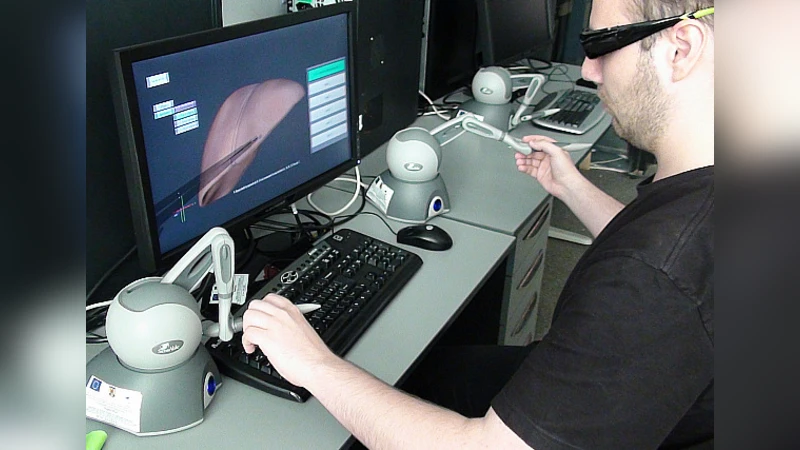
This paper brings into discussion some of the most relevant technological challenges involving haptic systems in medical education. One of these challenges is choosing the suitable haptic hardware, API or framework for developing a visuo-haptic e-Learning system. The decision is based on several criteria such as the multimodal resources needed by the software system, compatibility with haptic devices and the dynamic configuration of the scene. Another challenge is related to the software system reactivity in conjunction with the user’s actions. The immediate haptic feedback from the virtual models, together with the synchronization of the rendered haptic and visual cues seen by the users are essential for enhancing the user’s learning ability. Visuo-haptic simulation facilitates accurate training scenarios of medical protocols and surgical processes.
💡 Research Summary
The paper provides a comprehensive overview of the technical challenges and practical considerations involved in deploying haptic feedback systems for medical education. It begins by highlighting the pedagogical benefits of multimodal learning environments where tactile, visual, and auditory cues are combined, noting that recent reductions in hardware costs have opened new opportunities for widespread adoption.
A survey of existing medical training applications demonstrates the breadth of haptic use: cardiology simulations, prostate cancer diagnosis, injection and lumbar puncture training, various surgical procedures (including laparoscopy, angioplasty, bronchoscopy, orthopaedic drilling, and bone surgery), palpation‑based diagnosis, dental prosthesis preparation, venipuncture practice (Virtual Veins), and hand‑rehabilitation robotics. The authors argue that haptic feedback not only conveys realistic force information but also enhances learner engagement and emotional immersion, especially when coupled with speech input/output or mixed‑reality visualizations.
The hardware section compares the most common devices on the market. Low‑cost stylus‑based devices such as the Sensable PHANToM Omni/Desktop and the Novint Falcon are contrasted with high‑performance Force Dimension Omega series and emerging magnetic‑levitation platforms (e.g., Maglev 200™). Key performance metrics—degrees of freedom, work volume, position resolution, continuous and peak forces, maximum stiffness, update rate, and inertia—are discussed, and the trade‑offs between affordability, precision, and scalability are outlined. Magnetic levitation devices are praised for eliminating static friction and backlash, yet their commercial maturity remains limited.
Software frameworks are examined in depth. The now‑defunct ReachIn commercial API is mentioned for historical context, while current open‑source and vendor‑supported options are evaluated: SOFA (Simulation Open‑Framework Architecture), CHAI3D, H3D, GiPSi, and OpenHaptics. Each framework’s architecture, supported devices, real‑time physics capabilities, and scripting languages are described. SOFA’s multi‑view scene graph (dynamic, collision, visual) with mapping modules is highlighted for complex deformable‑object simulations. CHAI3D’s easy device driver integration and ODE‑based dynamics are noted, while H3D’s combination of X3D, OpenGL, C++, and Python enables rapid prototyping. GiPSi focuses on organ‑level surgical simulation, and OpenHaptics provides a mature SDK for Phantom devices. The authors stress that framework selection should be driven by the intended simulation complexity, development expertise, and need for extensibility.
A critical technical issue is the synchronization of haptic and visual loops. Haptic rendering typically requires a 1 kHz update rate, whereas graphics rendering runs at 30–60 Hz. This disparity can cause oscillations and numerical instability, especially when interacting with deformable objects. The paper recommends decoupling the two loops, using interpolation and hardware timers to minimize latency, and employing implicit integration with adaptive time‑step algorithms to preserve stability in force calculations.
The authors present two in‑house prototypes to illustrate their methodology. The “Virdent” system, developed in 2008, targets dental prosthesis training. It integrates a low‑cost haptic device with the SOFA and CHAI3D frameworks, providing real‑time force feedback, automatic performance assessment, and a teacher‑monitoring interface. The “HapticMed” project (2010) focuses on liver palpation diagnostics. It combines 3D organ models, real‑time deformation physics, and haptic rendering in a single pipeline, again using open‑source tools and inexpensive hardware. Both systems achieve functionality comparable to commercial simulators at a fraction of the cost (under 10 % of typical commercial prices) and have been positively evaluated by students and clinicians.
In the conclusion, the authors acknowledge that while affordable haptic hardware is now available, the bottleneck lies in software adaptability, extensibility, and the scarcity of developers trained in real‑time haptic programming. They advocate for community‑driven development of open‑source frameworks, standardized APIs, and educational curricula that teach real‑time system design. Their experience in Romania demonstrates that with expert involvement, low‑cost haptic prototypes can be built, validated, and deployed, paving the way for broader adoption of haptic‑based medical training worldwide.
Comments & Academic Discussion
Loading comments...
Leave a Comment