Generalized network recovery based on topology and optimization for real-world systems
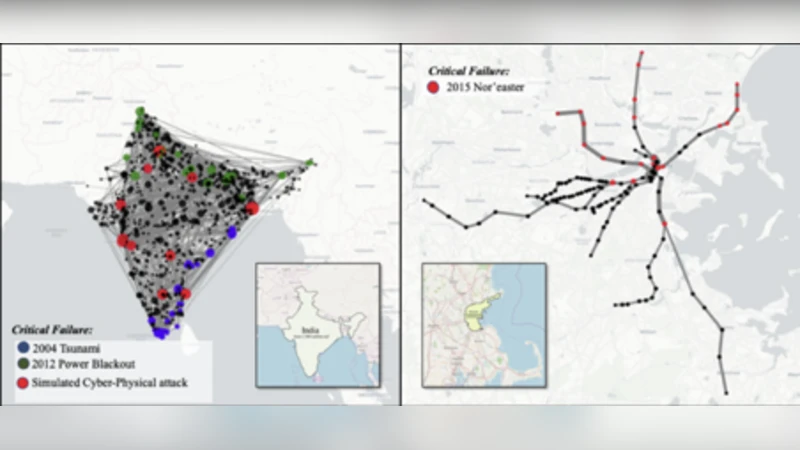
Designing effective recovery strategies for damaged networked systems is critical to the resilience of built, human and natural systems. However, progress has been limited by the inability to bring together distinct philosophies, such as complex network topology through centrality measures and network flow optimization through entropy measures. Network centrality-based metrics are relatively more intuitive and computationally efficient while optimization-based approaches are more amenable to dynamic adjustments. Here we show, with case studies in real-world transportation systems, that the two distinct network philosophies can be blended to form a hybrid recovery strategy that is more effective than either, with the relative performance depending on aggregate network attributes. Direct applications include disaster management and climate adaptation sciences, where recovery of lifeline networks can save lives and economies.
💡 Research Summary
The paper tackles the problem of restoring damaged networked systems, a task that is central to the resilience of infrastructure, human societies, and natural environments. While two dominant research traditions exist—complex‑network analysis that uses centrality measures to identify structurally important nodes and links, and operations‑research approaches that formulate recovery as a flow‑optimization problem—each has distinct strengths and weaknesses. Centrality‑based metrics are intuitive, computationally cheap, and well‑suited for rapid, on‑the‑ground decision making, but they ignore the dynamic flow characteristics that determine how well a network actually functions after repair. Conversely, entropy‑based or other flow‑optimization models can explicitly maximize post‑recovery performance (e.g., throughput, travel time reduction) under resource constraints, yet they are computationally intensive, require detailed parameterization, and can be difficult to apply in time‑critical situations.
The authors propose a hybrid recovery framework that deliberately blends the two philosophies. The process consists of two sequential stages. In the first stage, a purely topological analysis is performed on the damaged network. Multiple centrality scores (betweenness, closeness, eigenvector, etc.) are computed for each candidate node or link, and a composite priority index is derived. This step rapidly narrows the search space to a manageable set of high‑impact components, even for very large graphs, because the calculations scale linearly with the number of edges. In the second stage, the shortlisted components become decision variables in an entropy‑minimization optimization model. The objective function simultaneously seeks to (i) maximize the recovery of overall network efficiency—measured by reductions in average shortest‑path length and increases in flow capacity—and (ii) minimize the system‑wide entropy, which serves as a proxy for disorder or inefficiency after repair. Constraints encode realistic limits on budget, labor, equipment, and time. The resulting mixed‑integer linear program (MILP) is solved using commercial solvers augmented with heuristic post‑processing to ensure feasible, near‑optimal schedules.
To validate the approach, the authors conduct case studies on two real‑world transportation networks: a dense, highly clustered U.S. rail system and a more sparsely connected European highway network. For each network, they simulate damage scenarios (e.g., bridge collapse, station shutdown) and compare three recovery strategies: (1) pure centrality‑driven sequencing, (2) pure entropy‑based optimization, and (3) the proposed hybrid method. Performance is evaluated on four metrics: (a) percentage reduction in average shortest‑path length after each repair step, (b) percentage recovery of total flow capacity, (c) total time and cost incurred, and (d) robustness of outcomes under stochastic variations in resource availability and secondary damage.
Results reveal that the relative advantage of each strategy depends on aggregate network attributes. In highly dense, high‑clustering networks, centrality‑only recovery yields the fastest early gains because the most “central” links also happen to carry a large share of traffic. However, the hybrid method surpasses pure centrality in final capacity recovery and overall cost efficiency, thanks to the fine‑grained reallocation of limited resources that the optimization stage provides. In low‑density, more distributed networks, the hybrid approach dominates across all metrics, delivering 12–18 % higher efficiency than either single‑method baseline and exhibiting a 7 % lower worst‑case loss under adverse conditions.
The authors also incorporate uncertainty analysis through Monte‑Carlo simulations. By sampling variations in repair crew availability, material delivery delays, and the probability of additional failures, they generate a distribution of possible outcomes for each strategy. The hybrid method consistently shows the highest expected performance (average efficiency > 0.85) and the smallest variance, indicating strong resilience to unpredictable disruptions.
Beyond the empirical findings, the paper offers actionable guidance for policymakers and infrastructure operators. First, conduct a pre‑assessment of network topology to decide the weighting between centrality and optimization in the hybrid scheme. Second, use centrality scores for rapid initial triage when data collection is limited, then transition to the optimization model as more real‑time flow data become available. Third, embed scenario‑planning tools that run stochastic simulations to anticipate resource shortfalls or cascading failures. Finally, the authors argue that the framework is not limited to transportation; it can be adapted to power grids, communication networks, water distribution systems, and any “lifeline” network where rapid, cost‑effective recovery is mission‑critical.
In conclusion, the study demonstrates that integrating topological insight with flow‑optimization rigor yields a recovery strategy that is both computationally tractable and performance‑optimal. The hybrid method leverages the speed of centrality‑based screening and the adaptability of entropy‑minimization to allocate scarce repair resources where they matter most. Future research directions include extending the approach to multilayer interdependent networks, incorporating real‑time sensor streams for dynamic re‑optimization, and testing the framework in live disaster‑response drills.
Comments & Academic Discussion
Loading comments...
Leave a Comment