A Self-Learning Information Diffusion Model for Smart Social Networks
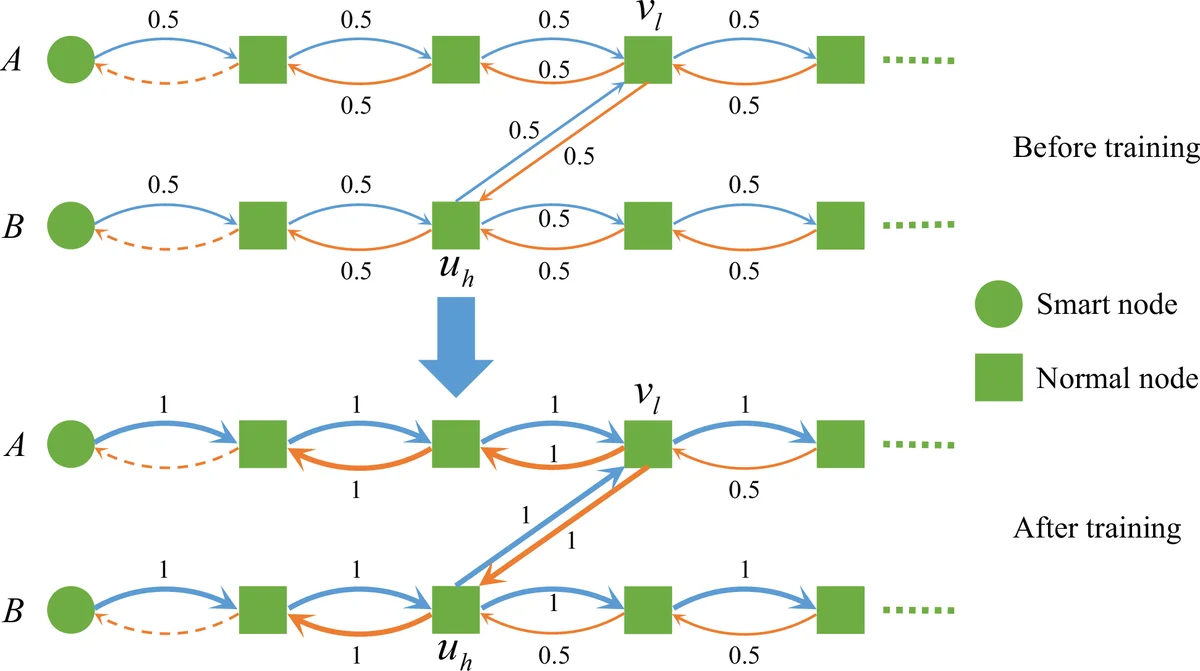
In this big data era, more and more social activities are digitized thereby becoming traceable, and thus the studies of social networks attract increasing attention from academia. It is widely believed that social networks play important role in the process of information diffusion. However, the opposite question, i.e., how does information diffusion process rebuild social networks, has been largely ignored. In this paper, we propose a new framework for understanding this reversing effect. Specifically, we first introduce a novel information diffusion model on social networks, by considering two types of individuals, i.e., smart and normal individuals, and two kinds of messages, true and false messages. Since social networks consist of human individuals, who have self-learning ability, in such a way that the trust of an individual to one of its neighbors increases (or decreases) if this individual received a true (or false) message from that neighbor. Based on such a simple self-learning mechanism, we prove that a social network can indeed become smarter, in terms of better distinguishing the true message from the false one. Moreover, we observe the emergence of social stratification based on the new model, i.e., the true messages initially posted by an individual closer to the smart one can be forwarded by more others, which is enhanced by the self-learning mechanism. We also find the crossover advantage, i.e., interconnection between two chain networks can make the related individuals possessing higher social influences, i.e., their messages can be forwarded by relatively more others. We obtained these results theoretically and validated them by simulations, which help better understand the reciprocity between social networks and information diffusion.
💡 Research Summary
The paper tackles the often‑overlooked reverse problem of how information diffusion reshapes the underlying social network. It introduces a novel diffusion framework that distinguishes both node types and message types. Nodes are divided into “smart” agents, capable of perfectly identifying whether a received message is true (1) or false (0), and “normal” agents, which cannot make this distinction. Messages are likewise binary: true or false.
In the basic cascading process, a randomly chosen source node initiates a message. If the source is smart, it always emits a true message; if it is normal, it emits a true or false message with equal probability. When a node receives a message, it randomly selects one incoming neighbor as the reference. A smart node forwards a true message with probability η (the natural forwarding rate) and never forwards a false one. A normal node forwards any received message with probability η · w_{jk}, where w_{jk}∈
Comments & Academic Discussion
Loading comments...
Leave a Comment