Promising Accurate Prefix Boosting for sequence-to-sequence ASR
In this paper, we present promising accurate prefix boosting (PAPB), a discriminative training technique for attention based sequence-to-sequence (seq2seq) ASR. PAPB is devised to unify the training and testing scheme in an effective manner. The trai…
Authors: Murali Karthick Baskar, Lukav{s} Burget, Shinji Watanabe
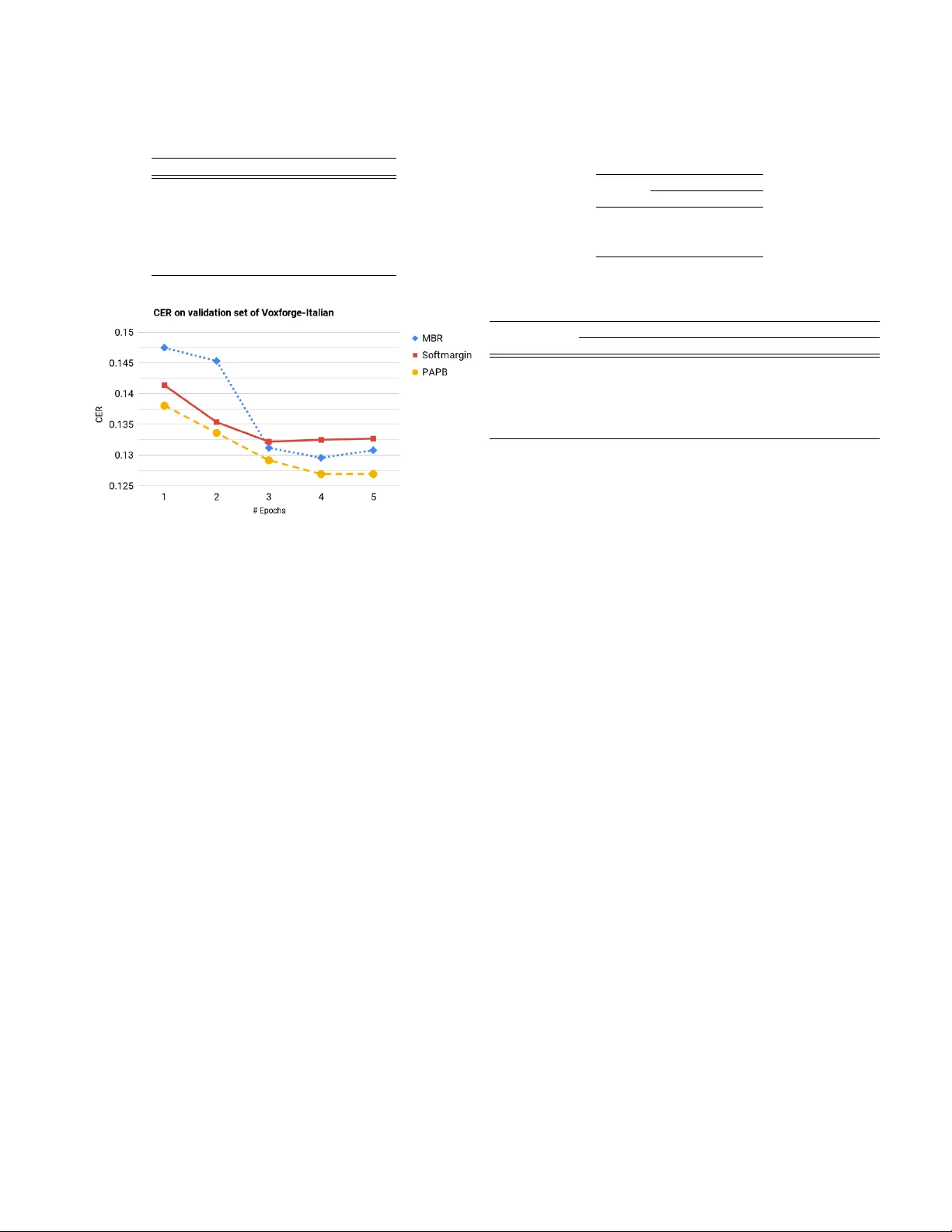
PR OMISING A CCURA TE PREFIX BOOSTING FOR SEQUENCE-T O-SEQUENCE ASR Murali Karthic k Baskar φ , Luk ´ a ˇ s Bur get φ , Shinji W atanabe π , Martin Karafi ´ at φ , T akaaki Hori † , J an “Honza” ˇ Cernock ´ y φ φ Brno Uni versity of T echnology , π Johns Hopkins Uni versity , † Mitsubishi Electric Research Laboratories (MERL) { baskar,burget,karafiat,cernocky } @fit.vutbr.cz,shinjiw@jhu.edu,thori@merl.com ABSTRA CT In this paper , we present promising accurate prefix boosting (P APB), a discriminativ e training technique for attention based sequence-to- sequence (seq2seq) ASR. P APB is de vised to unify the training and testing scheme in an effecti ve manner . The training proce- dure in volves maximizing the score of each partial correct sequence obtained during beam search compared to other hypotheses. The training objective also includes minimization of token (character) error rate. P APB sho ws its efficac y by achieving 10.8% and 3.8% WER with and without RNNLM respecti vely on W all Street Journal dataset. Index T erms — Beam search training, sequence learning, dis- criminativ e training, Attention models, softmax-margin 1. INTR ODUCTION Sequence-to-sequence (seq2seq) modeling provides a simple frame- work to perform complex mapping between input and output se- quence. In the original work, where seq2seq [1, 2] model was ap- plied to machine translation task, the model contains an encoder neu- ral network with recurrent layers, to encode the entire input sequence (i.e the message in a source) into a internal fixed-length vector rep- resentation. This v ector is an input to the decoder – another set of recurrent layers with final softmax layer , which, in each recurrent iterations, predicts probabilities for the next symbol of the output se- quence (i.e. the message in the target). This work deals with the task of automatic speech recognition (ASR), where the seq2seq model is used to map a sequence of speech features into a sequence of characters. In particular , we use attention based seq2seq model [2], where the encoder encodes an input sequence into another internal The work reported here was carried out during the 2018 Jelinek Memo- rial Summer W orkshop on Speech and Language T echnologies, supported by Johns Hopkins Uni versity via gifts from Microsoft, Amazon, Google, Facebook, and MERL/Mitsubishi Electric. All the authors from Brno uni- versity of T echnology was supported by Czech Ministry of Education, Y outh and Sports from the National Programme of Sustainability (NPU II) project ”IT4Innov ations excellence in science - LQ1602” and by the Office of the Director of National Intelligence (ODNI), Intelligence Adv anced Research Projects Acti vity (IARP A) MA TERIAL program, via Air F orce Research Laboratory (AFRL) contract # F A8650-17-C-9118. The views and conclu- sions contained herein are those of the authors and should not be interpreted as necessarily representing the official policies, either expressed or implied, of ODNI, IARP A, AFRL or the U.S. Government. Part of computing hard- ware was pro vided by Facebook within the F AIR GPU Partnership Program. W e thank Ruizhi Li, for finding the hyper-parameters to obtain best base- line in WSJ. W e also thank Hiroshi Seki, for providing the batch-wise beam search decoding implementation in ESPnet. sequence of the same length. The attention mechanism [2], then focuses on the rele vant portion of the internal sequence in order to predict each next output symbol using the decoder . The seq2seq are typically trained to maximize the conditional likelihood (or mini- mize cross-entropy) of the correct output symbols. For predicting a current character, the previous character (e.g. its one-hot encoding) from ground truth sequence is typically fed as an auxiliary input to decoder during training. This so-called teacher-forcing [3] helped the decoder to learn an internal language model (LM) for the output sequences. During normal decoding, the last predicted character is fed back instead of the unav ailable ground truth. Using such train- ing strategy , attention [4] based seq2seq model has shown to absorb and jointly learn all the components of a traditional ASR system (i.e. acoustic model, lexicon and language model. T w o major drawbacks hav e been, ho wev er , identified with the training strategy described abov e: • Exposur e bias : The seq2seq training uses teacher forcing, where each output character is conditioned on the previous true character . Howe ver during testing, the model needs to rely on its own pre vious predictions. This mismatch between training and testing leads to poor generalization and is re- ferred to as exposure bias [5, 6]. • Err or criterion mismatch : Another potential issue is mis- match in error criterion between training and testing [7, 8]. ASR, uses character error rate (CER) or word error rate (WER) to validate the decoded output while the training ob- jectiv e is the conditional maximum lik elihood (cross entropy) maximizing the probability of the correct sequence. In this work, we first experiment with training objecti ves that better matches the CER or WER metric, namely minimum Bayes risk (MBR) [8] and softmax margin [9]. W e show that such choice of training objectiv e makes teacher-forcing strategy unnecessary and therefore effecti vely addresses both the aforementioned problems. Both MBR and softmax margin objective needs to consider al- ternativ e sequences (hypotheses) besides the ground truth sequence. Unfortunately , seq2seq model does not make Marko v assumptions and the alternative sequences cannot be efficiently represented with a lattice. Instead, we perform beam search to generate an (approx- imate) N-best list of alternati ve sequences. Howev er , with the lim- ited capacity of the N-best representation, some of the important h y- potheses (i.e. sequences with a low error rate) can be easily pruned out by the beam search, which might result in less ef fective training. T o address this problem, we propose a new training strategy , which we call pr omising accurate prefix boosting (P APB) : The beam search keeps list of N promising prefixes (partial sequences) of the output sequence, which get extended by one character at each decoding iter- ation. In each iteration, we update parameters of the seq2seq model to boost probabilities of such promising prefixes that are also accu- rate (i.e. partial sequences with low edit distance to partial ground truth). This is accomplished by using the softmax margin objective (and updates) not only for the whole sequences, b ut also for all the partial sequence obtained during the decoding. There are existing works addressing the exposure bias or the er- ror criterion mismatch problem with seq2seq models applied to nat- ural language processing (NLP) problem. For example, scheduled sampling [6] and SEARN [5] handle the exposure bias by choos- ing either the model predictions or the true labels as the feedback to the decoder . The error criterion mismatch is handled using task loss minimization [10] using an edit-distance, RNN transducer [11] based expected error rate minimization, and minimum risk crite- rion based recurrent neural aligner [7]. Few works consider both the problems simultaneously: learning from character sampled from the model using reinforcement learning [12] and actor -critic algo- rithm [13]. Our work is mostly inspired by beam search optimiza- tion (BSO) [14], where max-margin loss is used as sequence-le vel objectiv e [15] for the machine translation task. All the mentioned works were applied to NLP problems, while the focus of this work is ASR. Also, none of the works considered the prefixes (partial se- quences) during training. A recent work on seq2seq based ASR was trained with MBR objecti ve [8] using N-best hypotheses obtained from a beam search. Howe ver , this work also did not consider the prefixes. Finally , optimal completion distillation [16] technique fo- cuses on prefix learning, but it uses complex learning methods such as policy distillation and imitation learning. 2. ENCODER-DECODER W ith the attention based Encoder -Decoder [4] architecture, the en- coder H = enc ( X ) neural network provides an internal representa- tions H = { h t } T t =1 of an input sequence X = { x t } T t =1 , where T is the number of frames in an utterance. In this work, the encoder is a recurrent network with bi-directional long short-term memory (BLSTM) layers [17, 18]. T o predict the l -th output symbol, the at- tention component takes the sequence H and the previous hidden state of the decoder q l − 1 as the input and produces per-frame atten- tion weights { a lt } T t =1 = Attention ( q l − 1 , H ) . (1) In this w ork, we use location aware attention [19]. The attention weights are expected to have high v alues for the frames that we need to pay attention to for predicting the current output and are typically normalized to sum-up to one over frames. Using such weights, the weighted average of the internal sequence H serves as an attention summary vector r l = X t a lt h t . (2) The decoder is a recurrent network with LSTM layers, which re- ceiv es r l along with the previous predicted output character y l − 1 (e.g. its one-hot encodding) as the input and estimates the hidden state vector q l = dec ( r l , q l − 1 , y l − 1 ) . (3) This vector is further subject to an affine transformation (LinB) and Softmax non-linearity to obtain the probabilies for the current output symbol y l : s l = LinB ( q l ) (4) p ( y l | y 1: l − 1 , X ) = Softmax ( s l ) (5) The probability of a whole sequence y = { y l } L l =1 is p ( y | X ) = L Y l p ( y l | y 1: l − 1 , X ) (6) T o decode the output sequence, simple greedy search can be per - formed, where the most likely symbol is chosen according to (5) in each decoding iteration until the dedicated end-of-sentence symbol is decoded. This procedure, ho wev er , does not guarantee in finding the most likely sequence according to (6). T o find the optimal se- quence, multiple hypotheses explored by beam search usually pro- vides better results. Note, ho wev er , that each partial hypothesis in the beam search has its own hidden state (3) as it depends on the previously predicted symbols y l in that hypothesis. During training, model parameters are typically updated to min- imize cross-entropy (CE) loss for correct output y ∗ : L C E = − log p ( y ∗ | X ) = − X l =1 log p ( y ∗ l | y ∗ 1: l − 1 , X ) . (7) This is particularly easy with the teacher forcing, when the symbol from the ground truth sequence is always used in (3) as the pre vi- ously predicted symbol y l − 1 and, therefore, no alternative hypothe- ses needs to be considered. 3. TRAINING CRITERION W e compare our proposed P APB approach with two other objec- tiv e functions that serves as our baseline. Namely , we use minimum Bayes risk criterion and softmax margin loss, which both perform sequence le vel discriminative training. Both objectives need to es- timate character error rate (CER) for alternati ve hypotheses, which are explored using beam search. In the following equations, the sym- bol cer ( y ∗ , y ) denotes the edit distance between the ground truth se- quence y ∗ and hypothesized sequence y . 3.1. Minimum Bayes risk (MBR) In minimum Bayes risk [20, 21, 22, 23], the expectation of character error rates cer ( y ∗ , y ) is taken w .r .t model distribution p ( y | X ) : L M BR = E p ( y | X ) [ cer ( y ∗ , y )] = X yY p ( y | X ) cer ( y ∗ , y ) , (8) In practice, the total set of hypotheses Y generated is reduced to N - best hypotheses Y N for computational efficiency . MBR training ob- jectiv e ef fectively performs sequence level discriminativ e training in ASR [22] and provides substantial gains when used as secondary ob- jectiv e after performing cross-entropy loss based optimization [20]. 3.2. Softmax margin loss (SM) Softmax margin loss [9] f alls under the cate gory of maximum- margin [24] classification technique. It is a generalization of boosted maximum mutual information (b-MMI) [21]. L S M = − s ( y ∗ , X ) + log X yY exp ( s ( y, X ) + α cer ( y ∗ , y )) ! , (9) where α is a tunable margin factor ( α = 1 ) and the un-normalized score of a chosen sequence, s ( y , X ) = L X l s l (10) is the sum of the pre-softmax outputs s l from (4). Note the depen- dence of the scores s l on the chosen hypothesis y through the pre- dictions fed back to decoder in (3), which is not explicitly denoted in our notation. The function aims to boost the score of the true se- quence, s ( y ∗ , X ) , to stay abo ve the other hypotheses s ( y , X ) with a margin defined by CER of the alternati ve hypotheses. 4. PR OMISING A CCURA TE PREFIX BOOSTING (P APB) In P APB, we perform training at prefix le vel in similar fashion to de- coding, by incorporating an appropriate training objecti ve with beam search. The primary motiv ation to carry out prefix level training is because, seq2seq models predict a sequence, character by character . MBR aims to improv es the score of the completed hypothesis with less error , but it might get pruned out during the beam search. How- ev er , in our approach, the model will be exposed to all prefixes y 1: l obtained from N-best as generated by beam search and optimized to maximize the scores of true hypothesis y ∗ 1: l . In brief, we consider not only the fully completed hypotheses, b ut also prefixes so that the promising prefixes with lo w error keep scoring high and therefore are likely to survive the pruning. The L P AP B loss is computed for each prefix by modifying the softmax margin loss L S M as: L P AP B = L X l =1 − s ( y ∗ 1: l , X ) + log X yY N { exp [ s ( y 1: l , X ) + B ] } (11) where B = cer ( y ∗ 1: l , y 1: l ) and Y N denotes the N -best set hypothe- sis obtained using beam search. In equation (11), the prefix scores of predicted hypotheses s ( y 1: l , X ) and true hypothesis s ( y ∗ 1: l , X ) are computed by summing the scores s l giv en by (4) from 1 to l , while, in the standard sequence objective L S M , the summation is performed only across a whole sequence as noted in (10). The con- tributions of our proposed approach are as follo ws: • The output scores s ( y l , X ) (as in (4)) are computed for each character conditioned on the previous character from the corresponding explored hypothesis (i.e. no teacher -forcing used). • In our experiments , we select the hypothesis from N-best that obtains the lowest CER as the pseudo-true hypothesis y ∗ 1: l to compute the score s ( y ∗ 1: l , X ) , instead of using the true hy- pothesis. This is to avoid harmful effects during model train- ing by abruptly including the true sequence y 1: l into the beam, which might have very small score. Defining the true hypoth- esis with a pseudo-true hypothesis brings our objectiv e anal- ogous to MBR criterion where v ery unlikely hypotheses do not affect model parameter updates. • The cer ( y ∗ 1: l , y 1: l ) is calculated using edit-distance between the prefixes y ∗ 1: l and y 1: l . Here, the number of characters are kept equal between true prefix y ∗ 1: l and prefix hypothesis y 1: l , which, according to our assumption, should contribute to re- duction of insertion and deletion errors. 5. EXPERIMENT AL SETUP Database details : V oxforge-Italian [25] and W all Street Jour- nal (WSJ) [26] corpora were used for our experimental analysis. V oxforge-Italian is a broadband speech corpus (16 hours) and is split into 80%, 10% and 10% to training, development, and ev alua- tion sets by ensuring that no sentence was repeated in any of the sets. WSJ with 284 speakers comprising 37,416 utterances (82 hours of speech) is used for training, and e val92 test set is used for decoding. T raining : Filter-bank features containing 83 dimensional (80 Mel-filter bank coef ficients plus 3 pitch features) coefficients are used as input. In this work, the encoder -decoder model is aligned and trained using attention based approach. Location aware atten- tion [19] is used in our experiments. For WSJ experiments, the en- coder comprises 3 bi-directional LSTM layers [18, 17] each with 1024 units and the decoder comprises 2 (uni-directional) LSTM lay- ers with 1024 units. For V oxForge experiments, the encoder com- prises 3 bi-directional LSTM layers with 320 units and the decoder contains one LSTM layer with 320 units. The CE training is op- timized using AdaDelta [27] optimizer with an initial learning rate set to 1 . 0 . The training batch size is 30 and the number of train- ing epochs is 20. The learning rate decay is based on the validation performance computed using the character error rate (min. edit dis- tance). ESPnet [28] is used to implement and ex ecute all our experi- ments. The MBR, softmax margin and prefix training configuration has initial learning rate 0 . 01 , the number of training epochs is set to 10 and the batch-size to 10. The beam-size for training and testing is set to 10. The model weights are initialized with pre-trained CE model. The rest of configuration is kept the same as for CE training. In our experiments, we use a modified MBR objecti ve: L 0 M BR = L M BR + λ L C E , (12) which is a weighted combination of the original MBR objective (8) and CE objectiv e (12). Adding the CE objectiv e is analogous to f- smoothing [20] and provides gains when applied for seq2seq models [8]. Similarly , we also use a modified prefix boosting objectiv e L 0 P AP B = L P AP B + λ L C E (13) where λ is the CE objecti ve weight empirically set to 0 . 001 for both MBR (also noted in [8]) and prefix training experiments. Altering the λ did not sho w much difference in performance. External language model for WSJ: Beside the internal language train by the decoder, we ha ve e xperimented with an e xternal RNN language model (RNNLM) [29] is trained on the text used for seq2seq training along with additional text data accounting to 1.6 million utterances from WSJ corpus. Both character and word-level language models are used in our experiments. The v ocabulary size is 50 for character LM and 65k for word LM. The word lev el RNNLM is trained using 1 recurrent layer of 1000 units, 300 batch size and SGD optimizer . The character lev el RNNLM configuration contains 2 recurrent layers of 650 units, 1024 batch size and uses Adam [30] optimizer . 6. RESUL TS AND DISCUSSION W e started our initial in vestigation with V oxforge-Italian dataset and later tested our method on WSJ. 6.1. Comparison with scheduled sampling (SS) Our best performing CE baseline model is with 50% SS (which de- notes 50 % true labels) as mentioned in the first row in T able 1. The SS-50% model is compared with SS-0% (0% true labels) to inv esti- gate the impact of only feeding model predictions. The second row shows that WER of SS-0% degrades by 8.2 % on test set and by 5% on de v set compared to SS-50% model. The SS-0% re-trained using T able 1 . Comparison of recognition performance between sched- uled sampling (SS), MPE and P APB on V oxforge-Italian %WER T est Dev SS-50% (from random init.) 50.9 52.3 SS-0% (from random init.) 59.1 57.3 SS-0% (fine-tuned from SS-50%) 52.9 52.5 MBR 49.9 50.8 Softmargin 50.1 50.4 P APB 47.4 47.7 Fig. 1 . Changes in character error rate (CER) during training with different criterion’ s on dev set of V oxforge-Italian dataset. The plot shows, P APB improves ov er both softmax margin loss and MBR objectiv es weights initialized from SS-50% model (acts as prior), still resulted in performance degradation but the gap got reduced to 2.0% on test set and 2.2% on dev set. These results highlight the limitation of using scheduled sampling with 0% true labels (or 100% model pre- dictions) as it lead to loss in recognition performance. Thus, a need to use a specific objecti ve which can train only with model predic- tions is necessary and justifies the focus of this paper . 6.2. Comparison of P APB with MBR T able 1 shows that the performance of both MBR and softmax mar- gin loss objecti ves are comparable to each other . While MBR and softmax margin loss pro vide considerable gains o ver scheduled sam- pling, they do not consider the prefixes (partial sequences generated during beam search) for training. In the follo wing experiment, we show that the performance of P APB justify our intuition to use pre- fix information by providing improv ement from 49.9 % to 47.4 % WER on test set and from 50.8 % to 47.7 % WER on dev set com- pared to MBR objective. P APB shows an impro vement of 2.7 % WER for both test and dev sets compared to softmax margin loss. Figure 1 also shows a similar effect of P APB noticed during training, by gaining better CER ov er MBR and softmax margin objecti ves. 6.3. Effect of varying beam-size during training and testing Further analysis on prefix training method is performed to under - stand the impact of beam-size used during training and testing. The beam-size decides the number of hypotheses to retain during beam search and is denoted as N-best. The results obtained by varying this hyper-parameter showcases the importance of using multiple hy- T able 2 . Comparison of recognition performance between different beam sizes obtained during training N tr and decoding N de for prefix training on V oxforge-Italian. % WER N de N tr 2 5 10 2 50.4 51.1 51.5 5 50.8 49.3 48.8 10 51.3 47.9 47.4 T able 3 . % CER and %WER on WSJ corpus for test set with and without LM. LM LM CE MBR P APB weight type %CER %WER %CER %WER %CER %WER 0 - 4.6 12.9 4.3 11.5 4.0 10.8 0.1 char . 4.6 11.2 4.3 10.1 4.0 9.9 0.2 char . 4.5 10.9 4.1 9.9 3.9 9.1 1.0 char . 2.5 5.8 2.5 5.4 2.1 4.5 1.0 word 2.0 4.8 2.1 4.3 2.0 3.8 potheses in the loss objective. T able 2 introduces the ef fect of retain- ing best paths (2,5, and 10) during training N tr and testing N de . A noticeable pattern observed in our experiments is that increasing the beam-size led to significant improv ement in performance. Further, increase in beam-size did not provide considerable gains. 6.4. Results on WSJ The results in T able 3 sho wcase the importance of using charac- ter lev el, word level RNNLM ov er no RNNLM. For decoding with RNNLM, we use look-ahead w ord LM decoding procedure recently introduced in [31] to integrate the word based RNNLM and the character RNNLM is decoded by following the procedure in [32]. The LM weight is optimized to show the impact of language model across CE, MBR and our proposed P APB models. The T able 3 also show that results of P APB and MBR shows complementary effect with both word and character LM. State-of-the-art results on WSJ : W ithout using external LM deep CNN [33] achie ves 10.5% WER and 9.6% WER using OCD [16]. OCD’ s nice performance is the resultant effect of their strong base- line with 10.6% WER. 4.1% WER are obtained with word RNNLM using end-to-end LF-MMI [34]. 7. CONCLUSION In this paper, we proposed P APB, a strategy to train on N -best par- tial sequences generated using beam search. This method suggests that improving the hypothesis at prefix level can attain better model predictions for refining the feed back to predict next character . The softmax margin loss function is inherited in our approach to serve this purpose. The e xperimental results sho ws the ef ficacy of the pro- posed approach compared to CE and MBR objectives with consis- tent gains across two datasets. The P APB also has its drawbacks in-terms of time complexity , as it consumes 20% more training time compared to CE training. This work can be further extended to use complete set of lattices instead of N-best list by exploiting the capa- bilities of GPU for improving time comple xity . Also, modified MBR training objectiv e in-place of softmax margin objectiv e can be used to learn prefixes. 8. REFERENCES [1] I. Sutskev er , O. V inyals, and Q. V . Le, “Sequence to sequence learning with neural networks, ” in Advances in neural infor- mation pr ocessing systems , pp. 3104–3112, 2014. [2] D. Bahdanau, K. Cho, and Y . Bengio, “Neural machine trans- lation by jointly learning to align and translate, ” arXiv pr eprint arXiv:1409.0473 , 2014. [3] R. J. W illiams and D. Zipser , “ A learning algorithm for contin- ually running fully recurrent neural networks, ” Neural compu- tation , vol. 1, no. 2, pp. 270–280, 1989. [4] J. Chorowski, D. Bahdanau, K. Cho, and Y . Bengio, “End-to- end continuous speech recognition using attention-based recur- rent NN: first results, ” arXiv pr eprint arXiv:1412.1602 , 2014. [5] H. D. III, J. Langford, and D. Marcu, “Search-based structured prediction, ” CoRR , vol. abs/0907.0786, 2009. [6] S. Bengio, O. V inyals, N. Jaitly , and N. Shazeer, “Scheduled sampling for sequence prediction with recurrent neural net- works, ” in Advances in Neural Information Processing Sys- tems , pp. 1171–1179, 2015. [7] H. Sak, M. Shannon, K. Rao, and F . Beaufays, “Recurrent neu- ral aligner: An encoder-decoder neural network model for se- quence to sequence mapping, ” in Pr oc. Interspeech , pp. 1298– 1302, 2017. [8] R. Prabhav alkar , T . N. Sainath, Y . W u, P . Nguyen, Z. Chen, C.- C. Chiu, and A. Kannan, “Minimum word error rate training for attention-based sequence-to-sequence models, ” in ICASSP , 2018 , pp. 4839–4843, IEEE, 2018. [9] K. Gimpel and N. A. Smith, “Softmax-margin training for structured log-linear models, ” 2010. [10] D. Bahdanau, D. Serdyuk, P . Brakel, N. R. Ke, J. Chorowski, A. Courville, and Y . Bengio, “T ask loss estimation for se- quence prediction, ” arXiv pr eprint arXiv:1511.06456 , 2015. [11] A. Gra ves and N. Jaitly , “T owards end-to-end speech recog- nition with recurrent neural netw orks., ” in ICML , vol. 14, pp. 1764–1772, 2014. [12] M. Ranzato, S. Chopra, M. Auli, and W . Zaremba, “Sequence lev el training with recurrent neural networks, ” arXiv preprint arXiv:1511.06732 , 2015. [13] D. Bahdanau, P . Brakel, K. Xu, A. Goyal, R. Lowe, J. Pineau, A. Courville, and Y . Bengio, “ An actor-critic algorithm for se- quence prediction, ” arXiv pr eprint arXiv:1607.07086 , 2016. [14] S. W iseman and A. M. Rush, “Sequence-to-sequence learning as beam-search optimization, ” arXiv pr eprint arXiv:1606.02960 , 2016. [15] I. Tsochantaridis, T . Joachims, T . Hofmann, and Y . Altun, “Large margin methods for structured and interdependent out- put variables, ” Journal of machine learning resear ch , vol. 6, no. Sep, pp. 1453–1484, 2005. [16] S. Sabour , W . Chan, and M. Norouzi, “Optimal com- pletion distillation for sequence learning, ” arXiv preprint arXiv:1810.01398 , 2018. [17] S. Hochreiter and J. Schmidhuber , “Long short-term memory , ” Neural computation , v ol. 9, no. 8, pp. 1735–1780, 1997. [18] M. Schuster and K. K. Paliw al, “Bidirectional recurrent neural networks, ” IEEE T ransactions on Signal Pr ocessing , vol. 45, no. 11, pp. 2673–2681, 1997. [19] D. Bahdanau, J. Chorowski, D. Serdyuk, P . Brak el, and Y . Ben- gio, “End-to-end attention-based large vocabulary speech recognition, ” in ICASSP , 2016 , pp. 4945–4949, IEEE, 2016. [20] D. Po vey and P . C. W oodland, “Minimum phone error and i- smoothing for improved discriminative training, ” in ICASSP , 2002 , vol. 1, pp. I–105, IEEE, 2002. [21] D. Pov ey , D. Kanevsky , B. Kingsbury , B. Ramabhadran, G. Saon, and K. V isweswariah, “Boosted MMI for model and feature-space discriminati ve training, ” in IEEE Interna- tional Confer ence on Acoustics, Speec h and Signal Pr ocessing (ICASSP) , pp. 4057–4060, IEEE, 2008. [22] K. V esel ` y, A. Ghoshal, L. Burget, and D. Pove y , “Sequence- discriminativ e training of deep neural networks., ” in INTER- SPEECH , pp. 2345–2349, 2013. [23] H. Su, G. Li, D. Y u, and F . Seide, “Error back propagation for sequence training of context-dependent deep netw orks for con- versational speech transcription, ” in ICASSP , 2013 , pp. 6664– 6668, IEEE, 2013. [24] C. H. Lampert, “Maximum margin multi-label structured pre- diction, ” in Advances in Neural Information Pr ocessing Sys- tems 24 (J. Shawe-T aylor , R. S. Zemel, P . L. Bartlett, F . Pereira, and K. Q. W einberger , eds.), pp. 289–297, Curran Associates, Inc., 2011. [25] “V oxforge.org, ”Free speech recognition”. ” http://www. voxforge.org/ . Accessed: 2014-06-25. [26] D. B. Paul and J. M. Bak er , “The design for the Wall Street Journal-based CSR corpus, ” in Pr oc. of the workshop on Speech and Natural Language , pp. 357–362, Association for Computational Linguistics, 1992. [27] M. D. Zeiler , “ADADEL T A: an adaptiv e learning rate method, ” CoRR , vol. abs/1212.5701, 2012. [28] S. W atanabe, T . Hori, S. Karita, T . Hayashi, J. Nishitoba, Y . Unno, N. E. Y . Soplin, J. Heymann, M. W iesner , N. Chen, et al. , “Espnet: End-to-end speech processing toolkit, ” arXiv pr eprint arXiv:1804.00015 , 2018. [29] T . Mikolov , M. Karafi ´ at, L. Burget, J. ˇ Cernock ` y, and S. Khu- danpur , “Recurrent neural network based language model, ” in Eleventh Annual Confer ence of the International Speec h Com- munication Association , 2010. [30] D. P . Kingma and J. Ba, “ Adam: A method for stochastic opti- mization, ” CoRR , vol. abs/1412.6980, 2014. [31] T . Hori, J. Cho, and S. W atanabe, “End-to-end speech recogni- tion with word-based RNN language models, ” arXiv pr eprint arXiv:1808.02608 , 2018. [32] S. W atanabe, T . Hori, S. Kim, J. R. Hershe y , and T . Hayashi, “Hybrid CTC/attention architecture for end-to-end speech recognition, ” IEEE J ournal of Selected T opics in Signal Pr o- cessing , vol. 11, no. 8, pp. 1240–1253, 2017. [33] Y . Zhang, W . Chan, and N. Jaitly , “V ery deep con volutional networks for end-to-end speech recognition, ” in ICASSP , 2017 , pp. 4845–4849, IEEE, 2017. [34] H. Hadian, H. Sameti, D. Pove y , and S. Khudanpur , “End-to- end speech recognition using lattice-free MMI, ” Pr oc. Inter- speech 2018 , pp. 12–16, 2018.
Original Paper
Loading high-quality paper...
Comments & Academic Discussion
Loading comments...
Leave a Comment