Modeling IoT-aware Business Processes - A State of the Art Report
This research report presents an analysis of the state of the art of modeling Internet of Things (IoT)-aware business processes. IOT links the physical world to the digital world. Traditionally, we would find information about events and processes in the physical world in the digital world entered by humans and humans using this information to control the physical world. In the IoT paradigm, the physical world is equipped with sensors and actuators to create a direct link with the digital world. Business processes are used to coordinate a complex environment including multiple actors for a common goal, typically in the context of administrative work. In the past few years, we have seen research efforts on the possibilities to model IoT- aware business processes, extending process coordination to real world entities directly. This set of research efforts is relatively small when compared to the overall research effort into the IoT and much of the work is still in the early research stage. To create a basis for a bridge between IoT and BPM, the goal of this report is to collect and analyze the state of the art of existing frameworks for modeling IoT-aware business processes.
💡 Research Summary
The paper presents a comprehensive state‑of‑the‑art review on modeling business processes that are aware of the Internet of Things (IoT). It begins by highlighting the fundamental shift introduced by IoT: physical entities are equipped with sensors and actuators, allowing direct, real‑time data capture and control without human intermediaries. This shift creates a need to integrate IoT events and devices into Business Process Management (BPM) so that processes can coordinate multiple “things” toward organizational goals.
Four major application domains are examined—logistics and freight transport, healthcare, manufacturing, and mobility. In logistics, the authors discuss real‑time container tracking, smart routing, and end‑to‑end synchronization of the supply chain. In healthcare, they illustrate remote patient monitoring, automated emergency response, and hospital equipment tracking. Manufacturing examples focus on human‑robot collaboration, safety constraints, and dynamic task allocation. Mobility scenarios address vehicle‑to‑infrastructure and pedestrian interactions based on location. These domains demonstrate the breadth of IoT‑enabled process requirements.
The core of the report is a systematic analysis of functional and non‑functional requirements for IoT‑aware process modeling. Functional needs include sensing tasks (data acquisition), actuating tasks (device control), real‑time event handling, and location‑ or time‑based constraints. Non‑functional concerns cover data quality (accuracy, timeliness, reliability), security (authentication, integrity, privacy), scalability (support for thousands of devices), and strict real‑time performance. The authors organize these requirements in tables and map each to modeling constructs.
BPMN 2.0 is selected as the baseline modeling language because of its wide adoption and tool support. However, the authors argue that standard BPMN lacks constructs to express IoT‑specific aspects. Consequently, they propose a set of extensions:
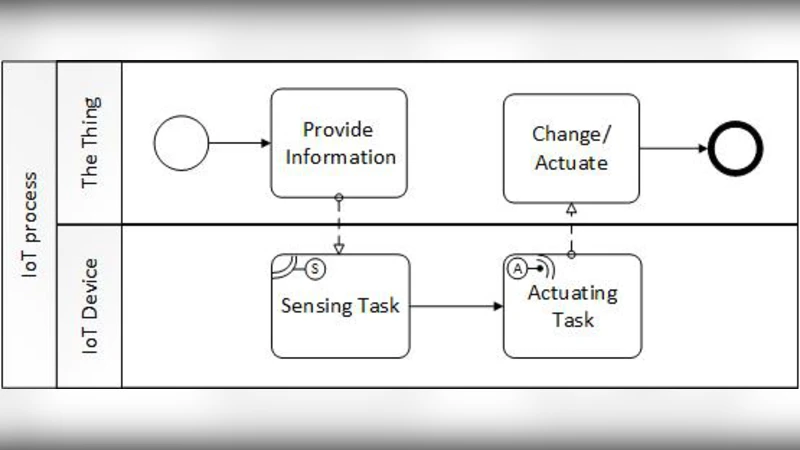
- Sensing Task – a task node enriched with sensor type, sampling rate, and location attributes.
- Actuating Task – a task node that issues commands to actuators, with parameters for target device and action.
- Location‑Based Event – events triggered by entering, exiting, or dwelling within a geographic area.
- Temporal Constraint Event – events that must occur within a deadline or after a specified interval, including timeout handling.
- Data Quality Metric – annotations attached to data objects or events indicating confidence, freshness, or error bounds.
- Security Annotations – markers specifying required authentication, encryption, or access‑control policies for a task or data flow.
These extensions preserve compatibility with existing BPMN tools while enabling precise representation of IoT dynamics. The paper further details control‑flow adaptations: sensing and actuating tasks are distinguished, event‑stream processing units (ESPU) are introduced to map high‑volume sensor streams to process instances, and event‑driven gateways are used to react instantly to sensor triggers.
Participant modeling is refined by distinguishing three categories: Physical Entities (the “things” themselves), IoT Devices (the hardware that hosts sensors/actuators), and the IoT‑aware Business Process (the logical orchestration). This taxonomy clarifies responsibilities and interaction points.
Data handling is explored in depth. The authors discuss real‑time data ingestion, edge versus cloud storage, data quality monitoring, and security goals. They propose embedding quality metrics into BPMN events so that a process can automatically select alternative paths when data reliability falls below a threshold.
Location and mobility are treated as first‑class concerns. The paper defines location events (enter, exit, stay) and models mobile IoT networks where connectivity changes dynamically as devices move. Timing aspects are addressed through extensions for task duration, interval constraints, and explicit timeout events, enabling precise scheduling required in safety‑critical or latency‑sensitive IoT scenarios.
Related work is surveyed, covering Web of Things, Cyber‑Physical Systems, uBPMN, Event Stream Processing Units, and Wireless Sensor Networks. While these works focus on communication protocols, data processing, or low‑level integration, the present report uniquely concentrates on the process‑level modeling, execution semantics, and the full set of functional and non‑functional requirements.
In conclusion, the authors acknowledge that research on IoT‑aware BPM is still in its infancy. They call for standardization of the proposed BPMN extensions, development of execution engines that can directly interact with heterogeneous IoT devices, and comprehensive security and privacy frameworks tailored to process‑centric IoT deployments. The paper thus provides both a theoretical foundation and practical guidance for researchers and practitioners aiming to bridge the gap between the physical IoT world and digital business process management.
Comments & Academic Discussion
Loading comments...
Leave a Comment