BlockReduce: Scaling Blockchain to Human Commerce
Blockchains have shown great promise as peer-to-peer digital currency systems over the past 10 years. However, with increased popularity, the demand for processing transactions has also grown leading to increased costs, confirmation times, and limited blockchain utility. There have been a number of proposals on how to scale blockchains, such as Plasma, Polkadot, Elastico, RapidChain, Bitcoin-NG, and OmniLedger. These solutions all propose the segmentation of every function of a blockchain, namely consensus, permanent data storage, transaction processing, and consistency, which significantly increases the complexity and difficulty of implementation. BlockReduce is a new blockchain structure which only segments consistency, allowing it to scale to handle tens of thousands of transactions per second without impacting fault tolerance or decentralization. Moreover, BlockReduce will significantly decrease node bandwidth requirements and network latency through incentives while simultaneously minimizing other resource demands in order to prevent centralization of nodes.
💡 Research Summary
The paper introduces BlockReduce, a novel blockchain architecture aimed at achieving massive scalability—targeting tens of thousands of transactions per second—while preserving fault tolerance and decentralization. Unlike existing scaling proposals (Plasma, Lightning, Polkadot, Elastico, etc.) that shard or separate all core blockchain functions (consensus, data storage, transaction processing, and consistency), BlockReduce isolates only consistency for hierarchical segmentation. The authors define consistency as a state where a subset of nodes agree on a set of pending transactions by performing sufficient proof‑of‑work, without having reached global consensus.
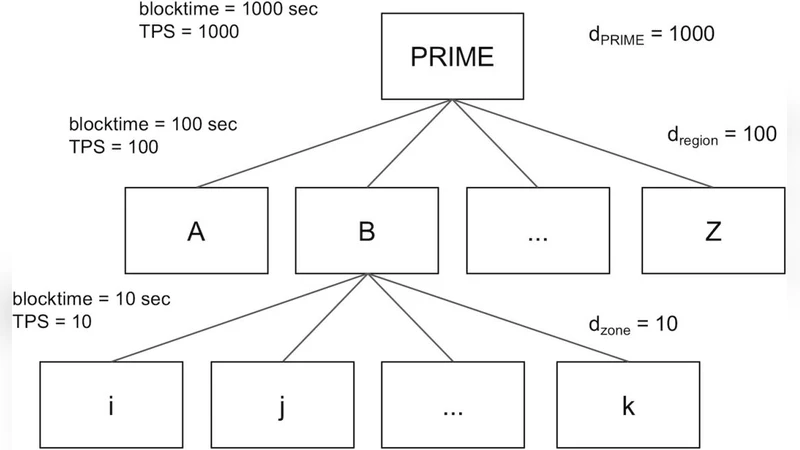
BlockReduce builds a three‑level hierarchy: Zones, Regions, and a top‑level Prime chain. Each Zone operates like a conventional blockchain (≈10 seconds block time, ~10 TPS). Ten Zones form a Region, and ten Regions form the Prime chain. Nodes simultaneously mine blocks at all three levels using merge‑mining: the same PoW effort contributes to a Zone block, a Region block, and a Prime block. Difficulty is scaled so that many Zone blocks are found within each Region block, and many Region blocks within each Prime block (e.g., Prime difficulty 1000, Region 100, Zone 10). This preserves the total network hash power on the Prime chain while allowing local consistency to be reached quickly.
A key contribution is the bandwidth reduction strategy. Instead of broadcasting every individual transaction to all peers (as in Bitcoin, where bandwidth overhead can be 100‑300× the block payload), BlockReduce groups transactions within a zone and first exchanges only their hashes. Peers can determine whether they need the full data by comparing hashes, dramatically cutting the amount of data transmitted. The authors present a comparative table showing that BlockReduce’s bandwidth scaling factor (k + N/100) is an order of magnitude lower than Bitcoin’s linear factor N.
The incentive model extends the traditional block reward: miners are paid not only for PoW but also for achieving local consistency. This encourages nodes to aggregate transactions within their zone, validate them, and propagate the resulting zone block upward, thereby aligning economic incentives with the hierarchical design.
Performance estimates assume each zone behaves like an Ethereum‑style chain (≈10 TPS, 100‑byte transactions). With a 10‑by‑10 hierarchy the system can process ~1,000 TPS; scaling to 70 zones per region and 70 regions yields ≥50,000 TPS while requiring roughly 8 TB of annual storage and substantially lower network bandwidth.
The paper argues that BlockReduce maintains Byzantine fault tolerance because the overall PoW security remains anchored in the Prime chain; an attacker would still need to control a majority of the total hash power. Decentralization is preserved because no single hierarchy level introduces a privileged committee or authority.
However, several critical issues remain under‑explored:
-
Difficulty Adjustment – The method for dynamically setting Region and Zone difficulties relative to the Prime difficulty is described only qualitatively. Without a robust algorithm, an adversary could manipulate difficulty ratios to concentrate mining power or create “weak” zones.
-
Incentive Quantification – The reward split between PoW and consistency is not formalized. Game‑theoretic analysis is needed to ensure miners will not ignore consistency or attempt to game the system by withholding transactions.
-
Finality Latency – Since consistency is achieved locally before global consensus, transaction finality may be delayed until the corresponding Region and Prime blocks are mined. This could be problematic for time‑sensitive applications.
-
Energy Efficiency – Merge‑mining multiple chains simultaneously may increase overall power consumption compared to single‑chain PoW, raising environmental concerns.
-
Security Proofs – The paper lacks formal security proofs showing that the hierarchical consistency mechanism does not introduce new attack vectors (e.g., zone‑level eclipse attacks, cross‑zone replay attacks).
In summary, BlockReduce presents an innovative approach that isolates consistency for hierarchical scaling, offering impressive theoretical throughput and bandwidth savings while retaining PoW‑based security. To move from concept to deployment, future work must provide rigorous difficulty‑adjustment algorithms, detailed incentive modeling, latency analysis, and formal security proofs, as well as empirical validation through test‑net or simulation. Only then can BlockReduce be considered a viable foundation for “human‑scale” commerce on blockchain.
Comments & Academic Discussion
Loading comments...
Leave a Comment