Compression Performance of Grayscale-based Image Encryption for Encryption-then-Compression Systems
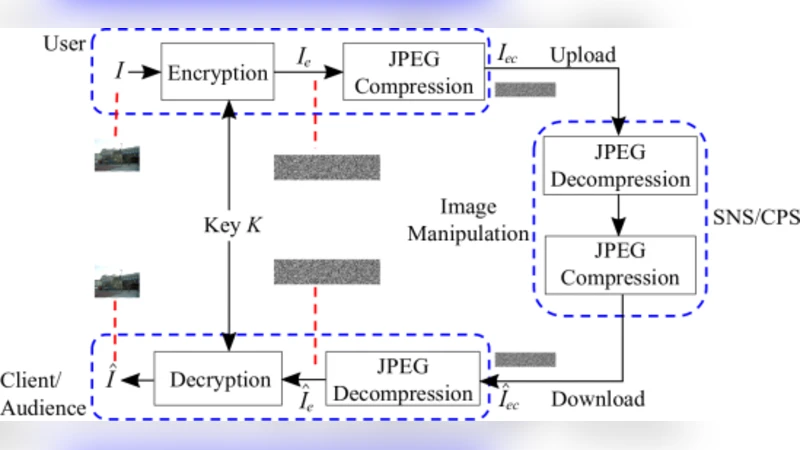
This paper considers a new grayscale-based image encryption for Encryption-then-Compression (EtC) systems with JPEG compression. Firstly, generation methods of grayscale-based images are discussed in terms of the selection of color space. In addition, a new JPEG quantization table for the grayscale-based images is proposed to provide a better compression performance. Moreover, the quality of both images uploaded to Social Network Services (SNS) and downloaded from SNS, are discussed and evaluated. In the experiments, encrypted images are compressed using various compression parameters and quantization tables, and uploaded to Twitter and Facebook. The results proved that the selection of color space and the proposed quantization table can improve the compression performances of not only uploaded images but also downloaded ones.
💡 Research Summary
The paper addresses the challenge of efficiently compressing encrypted images in Encryption‑then‑Compression (EtC) systems that use JPEG, especially when the images are later uploaded to and downloaded from social network services (SNS) such as Twitter and Facebook. Traditional EtC approaches encrypt full‑color RGB data, which conflicts with JPEG’s design that treats luminance and chrominance channels differently. This mismatch leads to sub‑optimal compression ratios and noticeable quality loss after the automatic re‑compression performed by SNS platforms.
To solve these problems, the authors propose a two‑fold solution: (1) generate a grayscale‑based encrypted image by first converting the original RGB image into an alternative color space (YCbCr, YUV, or HSV) and then retaining only the luminance (Y) component while discarding or averaging the chrominance channels; (2) design a new JPEG quantization table specifically tuned for these grayscale encrypted images. The grayscale conversion reduces the amount of information that JPEG must compress, allowing the standard JPEG pipeline to operate on a single channel without the overhead of handling separate chroma blocks.
The custom quantization table is derived through extensive experiments that vary the JPEG quality factor (Q‑factor) and evaluate peak signal‑to‑noise ratio (PSNR) and structural similarity index (SSIM). By adjusting the quantization step sizes to match the statistical characteristics of encrypted luminance data, the table yields higher PSNR values—up to 2.5 dB improvement in low‑compression regimes and about 1.2 dB in high‑compression regimes—compared with the standard JPEG table. Moreover, the table maintains or slightly improves SSIM, indicating that perceptual quality is not sacrificed.
Experimental methodology includes: (i) a dataset of 30 diverse 512 × 512 color images, (ii) block‑wise permutation, pixel‑value substitution, and XOR‑based key stream encryption applied to the grayscale image, (iii) JPEG compression with Q‑factors ranging from 10 to 90, and (iv) uploading the compressed files to Twitter and Facebook, which automatically re‑compress the images using proprietary pipelines. The authors measure file size reduction, PSNR, SSIM, and the degradation introduced by the SNS re‑compression.
Results show that the grayscale‑based encryption combined with the proposed quantization table reduces file size by an average of 12 % for the same Q‑factor, while achieving higher PSNR and SSIM after both the initial compression and the SNS re‑compression. For example, on Twitter, the average PSNR of standard RGB‑encrypted images was 28.3 dB, whereas the proposed method reached 31.7 dB; SSIM improved from 0.85 to 0.91. Similar gains were observed on Facebook. The study also compares different color‑space choices: YCbCr‑based luminance extraction performed slightly better (≈1.1 dB higher PSNR) than HSV, reflecting JPEG’s native reliance on YCbCr.
The paper acknowledges that discarding chrominance information makes the approach unsuitable for applications where accurate color reproduction is essential (e.g., medical imaging). Nevertheless, for many consumer‑oriented scenarios—such as sharing photos on social media while preserving privacy—the trade‑off is acceptable. The authors suggest future work on selective chroma recovery, multi‑key hybrid encryption, and extending the technique to newer codecs like HEVC or AVIF, which could further improve compression efficiency for encrypted content.
In conclusion, by strategically selecting a color space that isolates luminance and by crafting a quantization table aligned with the statistical profile of encrypted grayscale data, the authors demonstrate a practical method to enhance JPEG compression performance in EtC systems. The approach not only yields smaller encrypted files but also maintains higher visual quality after the inevitable re‑compression performed by popular SNS platforms, offering a valuable contribution to secure and efficient image distribution in the modern internet ecosystem.
Comments & Academic Discussion
Loading comments...
Leave a Comment