Kinetics of 2D-constrained orbitally-shaken particles
We present an experimental study of the kinetics of orbitally-shaken macroscopic particles confined to a two-dimensional bounded domain. Discounting the forcing action of the external periodic actuation, the particles show translational velocities and diffusivity consistent with a confined random walk model. Such experimental system may therefore represent a suitable macroscopic analog to investigate aspects of molecular dynamics and self-assembly.
💡 Research Summary
This paper presents an experimental investigation of the kinetic behavior of macroscopic particles that are confined to a two‑dimensional circular arena and driven by an orbital shaker. The authors fabricated 7 mm‑thick, 45°‑sector‑shaped particles using selective laser sintering of polyamide and placed either a single particle or three particles inside a 25 cm‑diameter acrylic reactor. The shaker provided a circular motion with an orbit diameter of 2.5 ± 0.1 cm at a frequency of 5.00 ± 0.02 Hz (≈300 rpm). Particle positions and orientations were recorded with an overhead camera at 20 fps for 10 000 frames (≈8 min 20 s). Image processing extracted the centre of mass and the angular orientation of each particle in every frame.
A crucial step in the analysis was the removal of the deterministic component imposed by the shaker. By transforming the x‑ and y‑coordinates of the trajectories into the frequency domain, the authors applied a rectangular band‑stop filter centred at 5 Hz with a width of about 2 Hz, then performed an inverse FFT to obtain filtered trajectories. The filtered data retained only low‑frequency components, while the high‑frequency orbital motion was suppressed. Cross‑correlation between the filtered x‑ and y‑velocity components was weak (‑0.16 to ‑0.04), indicating that relative particle motions—due to collisions, boundary interactions, and local surface heterogeneities—dominate the dynamics.
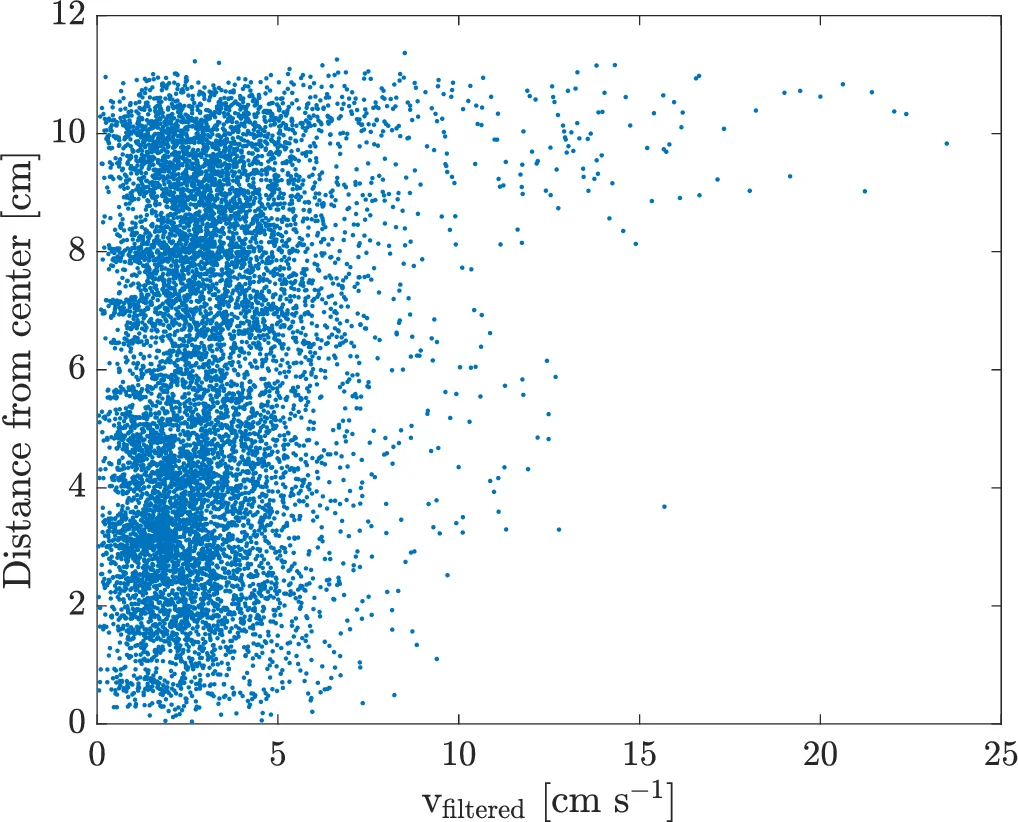
The velocity statistics were examined in detail. The magnitude of the two‑dimensional velocity vector follows a Rayleigh distribution, as expected for a χ₂ distribution in two dimensions. A Kolmogorov‑Smirnov test, however, yielded very low significance levels, revealing a modest but systematic deviation: the experimental tail is slightly heavier, especially for particles near the reactor wall where collisions inject extra kinetic energy. One‑dimensional projections of velocity (vₓ, vᵧ) are well described by Gaussian (χ₁) distributions, consistent with the χₖ family of distributions for k = 2. In the three‑particle experiments the deviations become more pronounced, likely because inter‑particle collisions perturb the ideal random‑walk statistics.
Diffusive behavior was quantified via the mean‑square displacement (MSD). By segmenting each filtered trajectory into equal‑length sub‑trajectories, the authors computed the MSD as a function of elapsed time. The MSD curve exhibits three regimes: (i) an initial ballistic regime (t < 0.5 s) where MSD ∝ t², (ii) an intermediate linear regime (0.5 s ≲ t ≲ 4 s) where MSD ∝ t, and (iii) a saturation regime (t > 4 s) where MSD plateaus due to confinement. Linear‑regime slopes correspond to diffusion coefficients D ranging from 0.5 to 5 cm² s⁻¹, depending on particle number and proximity to the boundary. Double‑logarithmic plots confirm the ballistic exponent ≈ 2 at short times and the diffusive exponent ≈ 1 at longer times. Varying the filter width showed that the diffusion regime is robust for filter widths up to ≈2 Hz, whereas the ballistic exponent is sensitive to residual 5 Hz components; removing them restores the expected t² scaling.
Rotational diffusion was also measured. The mean absolute angular displacement grows roughly linearly with time, allowing an estimate of a rotational diffusion coefficient Dᵣ. A weak coupling between translational and rotational motions is observed, attributable to the anisotropic shape of the sectors and the frictional interaction with the rough reactor floor.
Overall, despite being driven by a deterministic periodic actuator, the filtered motion of the macroscopic particles mimics stochastic Brownian dynamics. The velocity distributions, MSD scaling, and transition to confinement‑induced saturation all align with a confined random‑walk model. The authors argue that such a tabletop system provides a valuable macroscopic analogue for studying molecular diffusion, self‑assembly, and population dynamics, offering direct visual access and controllable parameters (particle geometry, surface roughness, boundary conditions) that are difficult to manipulate at the microscopic scale. Future work could explore systematic variations of these parameters, introduce programmable interaction potentials, or couple multiple reactors to investigate collective self‑assembly phenomena in a fully observable setting.
Comments & Academic Discussion
Loading comments...
Leave a Comment