A Distributed Epigenetic Shape Formation and Regeneration Algorithm for a Swarm of Robots
Living cells exhibit both growth and regeneration of body tissues. Epigenetic Tracking (ET), models this growth and regenerative qualities of living cells and has been used to generate complex 2D and 3D shapes. In this paper, we present an ET based algorithm that aids a swarm of identically-programmed robots to form arbitrary shapes and regenerate them when cut. The algorithm works in a distributed manner using only local interactions and computations without any central control and aids the robots to form the shape in a triangular lattice structure. In case of damage or splitting of the shape, it helps each set of the remaining robots to regenerate and position themselves to build scaled down versions of the original shape. The paper presents the shapes formed and regenerated by the algorithm using the Kilombo simulator.
💡 Research Summary
The paper introduces a novel distributed algorithm for shape formation and regeneration in a swarm of identical, low‑cost robots, inspired by the biological concept of Epigenetic Tracking (ET). ET models how a single cell can develop into a complex organism through mitosis and apoptosis, guided by a “gene” that encodes positional and neighbor‑count information. The authors adapt this idea to a robotic context: a binary bitmap representing the desired 2‑D shape is first transformed into a skewed, triangular lattice so that every robot’s neighbors are equidistant. From this lattice a gene is generated for each occupied pixel, consisting of three fields – a tag (X,Y coordinates), a flag indicating whether the pixel belongs to the shape, and the required number of nearest neighbors (NN) ranging from 0 to 6.
Each robot stores the complete gene locally and operates as a finite‑state automaton with eight states: Queued, Search, Inactive, Active, Quasi, Stable, Danger, and Leader. The formation process begins with three seed robots placed at the vertices of an equilateral triangle; one seed is set to Active (Timestep TS = 1) and the other two to Inactive (TS = 2). All other robots start in the Queued state. A robot in the Queued state transitions to Search, where it scans its local neighborhood for an empty lattice position that satisfies the NN requirement of a neighboring Active robot with the smallest TS value. Upon finding such a spot, the robot moves there, adopts the Active state, and records its own TS (the order of insertion). This TS‑based gradient guarantees that earlier‑placed robots have priority in satisfying neighbor constraints, preventing holes and ensuring a compact, hole‑free shape.
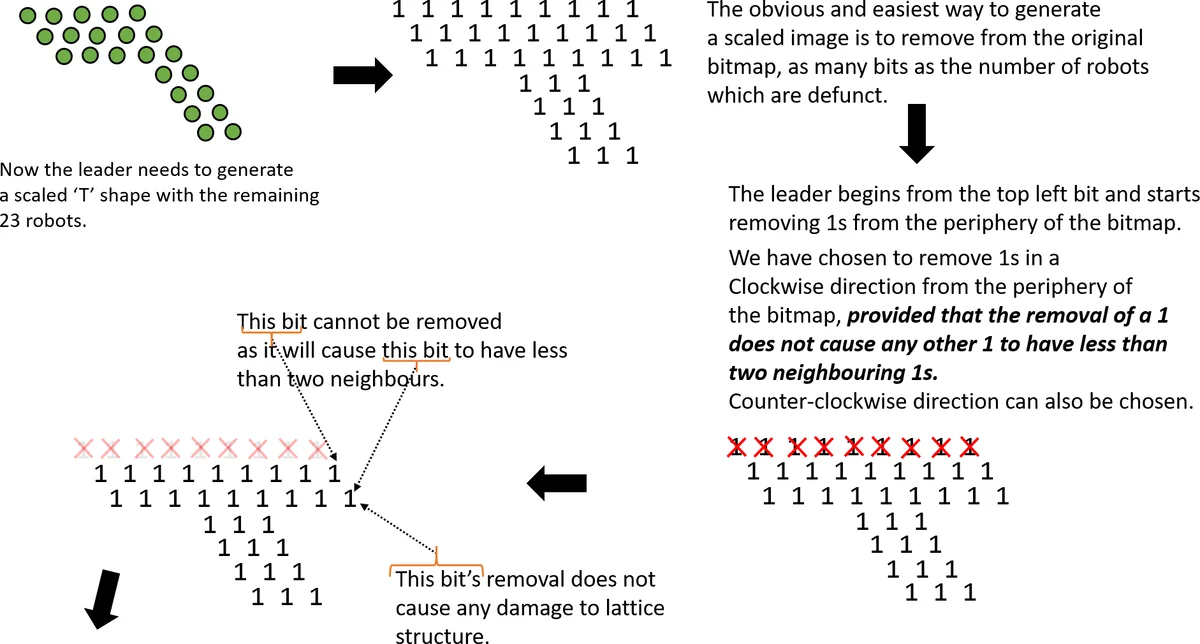
After the shape is assembled, each robot continuously monitors the count of its actual neighbors. If the count drops below the NN value stored in the gene, the robot enters the Danger state, indicating damage. The damaged cluster elects a Leader robot, which computes a scaling factor based on the remaining number of robots and regenerates a new, smaller gene that represents a proportionally reduced version of the original shape. The regeneration phase re‑uses the same TS‑guided search and placement logic, allowing the remaining robots to autonomously reorganize into the scaled‑down shape without any external intervention.
The algorithm was evaluated using the Kilombo simulator, which emulates Kilobots – small, infrared‑communicating robots with very limited computation and sensing capabilities. Experiments covered several arbitrary shapes (e.g., the letters “T”, “U”, and more complex silhouettes) and multiple damage scenarios, including straight cuts and random robot failures. In all cases, the swarm successfully formed the target shape and, after damage, each fragment autonomously regenerated a smaller, correctly proportioned version of the shape. The results demonstrate that the proposed ET‑based approach can achieve complex self‑organization, robust damage detection, and self‑healing using only local interactions and minimal hardware.
Key contributions of the work are: (1) a method to encode a global shape into a compact gene that can be stored on each robot; (2) the use of a skewed triangular lattice combined with a Timestep gradient to guarantee orderly, gap‑free assembly; (3) a fully decentralized damage‑aware regeneration mechanism that scales the shape according to the surviving robot count; and (4) a lightweight protocol that runs on extremely resource‑constrained platforms. By bridging biological development principles with swarm robotics, the paper opens a pathway toward autonomous construction and repair of complex structures in real‑world robotic swarms.
Comments & Academic Discussion
Loading comments...
Leave a Comment