Post-prognostics decision in Cyber-Physical Systems
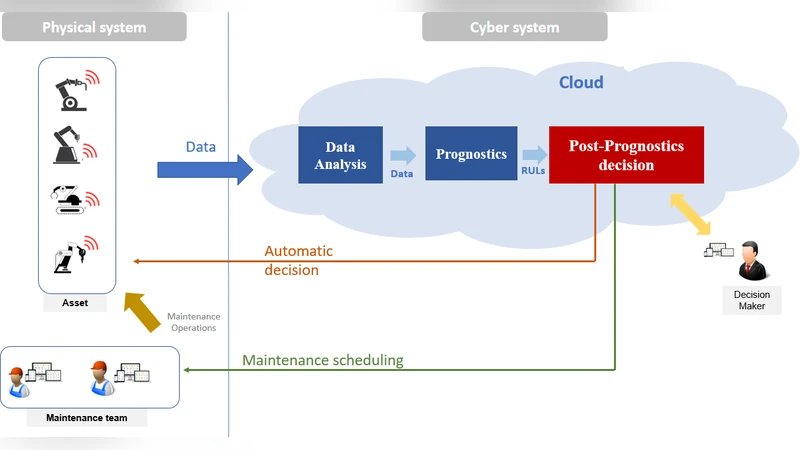
Prognostics and Health Management (PHM) offers several benefits for predictive maintenance. It predicts the future behavior of a system as well as its Remaining Useful Life (RUL). This RUL is used to planned the maintenance operation to avoid the failure, the stop time and optimize the cost of the maintenance and failure. However, with the development of the industry the assets are nowadays distributed this is why the PHM needs to be developed using the new IT. In our work we propose a PHM solution based on Cyber physical system where the physical side is connected to the analyze process of the PHM which are developed in the cloud to be shared and to benefit of the cloud characteristics
💡 Research Summary
The paper presents a comprehensive framework that integrates Cyber‑Physical Systems (CPS), Internet of Things (IoT), and cloud computing to support the post‑prognostics decision stage of Predictive Maintenance (PHM). While traditional PHM focuses on fault prediction and Remaining Useful Life (RUL) estimation, the authors argue that the critical step for industry is the translation of RUL information into concrete maintenance actions—what to do, when to do it, and who should perform it. To address this, they propose a three‑layer architecture: (1) a physical layer where distributed assets are instrumented with sensors and IoT gateways that collect, synchronize, and transmit data in real time; (2) a cyber layer that hosts a cloud‑based data pipeline, storing heterogeneous sensor streams in a data lake and providing metadata services for knowledge reuse; and (3) a cloud services layer that implements both RUL prediction engines and post‑prognostics decision modules.
The RUL prediction engine is offered as a suite of services (SaaS/PaaS/IaaS) and can automatically select among models such as Gaussian‑Mixture Hidden Markov Models, deep neural networks, or Bayesian networks based on data characteristics, delivering point estimates and confidence intervals. The decision module consumes the predicted RUL together with cost parameters (labor, spare parts) and logistical constraints (travel distance, resource availability). For the specific problem of minimizing travel distance of a maintenance crew that must visit all assets before their individual RUL expires, the authors employ a Genetic Algorithm (GA). The GA uses a random initial population, uniform partially matched crossover, uniform mutation, and tournament selection, converging to near‑optimal routes within 30 generations for a population size of 100. Experimental results show a clear reduction in the objective cost and illustrate the robustness of the stochastic search.
Service delivery is further refined into three cloud models: PHM‑SaaS provides ready‑to‑use applications that can be deployed within hours; PHM‑PaaS supplies operating systems, middleware, and development environments for researchers to prototype new algorithms; PHM‑IaaS offers virtualized compute, storage, and networking resources for scalable deployment. This stratification enables flexible adoption across different industrial partners while ensuring security, low latency, and cost‑effectiveness compared with traditional on‑premise solutions.
A case study on a fleet of wind turbines demonstrates practical benefits. Each turbine’s geographic coordinates and RUL are stored in the cloud; a central maintenance hub dispatches a crew that must service all turbines before their predicted failures. The GA‑based routing reduces total travel distance by more than 25 % relative to naïve approaches, leading to significant savings in labor and fuel costs and improving overall asset availability. Moreover, the early warning provided by RUL prediction allows maintenance to be performed proactively, further enhancing reliability.
In conclusion, the authors validate that a CPS‑enabled, cloud‑backed PHM platform can effectively close the loop between prognostics and maintenance execution, delivering measurable reductions in operational cost and downtime for distributed industrial assets. The paper suggests future extensions such as stronger cybersecurity measures, real‑time streaming analytics, and multi‑objective optimization to broaden applicability to smart factories, energy grids, and other complex systems.
Comments & Academic Discussion
Loading comments...
Leave a Comment