MAC Layer Hurdles in BSNs
The last few decades have seen considerable research progress in microelectronics and integrated circuits, system-on-chip design, wireless communication, and sensor technology. This progress has enabled the seamless integration of autonomous wireless sensor nodes around a human body to create a Body Sensor Network (BSN). The development of a proactive and ambulatory BSN induces a number of enormous issues and challenges. This paper presents the technical hurdles during the design and implementation of a low-power Medium Access Control (MAC) protocol for in-body and on-body sensor networks. We analyze the performance of IEEE 802.15.4 protocol for the on-body sensor network. We also provide a comprehensive insight into the heterogeneous characteristics of the in-body sensor network. A low-power technique called Pattern-Based Wake-up Table is proposed to handle the normal traffic in a BSN. The proposed technique provides a reliable solution towards low-power communication in the in-body sensor network.
💡 Research Summary
The paper provides a comprehensive examination of the challenges associated with designing a low‑power Medium Access Control (MAC) protocol for Body Sensor Networks (BSNs), which consist of both in‑body (implanted) and on‑body (wearable) sensor nodes. It begins by contextualizing the rapid advances in microelectronics, system‑on‑chip integration, wireless communication, and sensor technologies that have made it feasible to embed autonomous wireless nodes around and inside the human body. While these advances enable continuous health monitoring, they also introduce a set of unique technical hurdles that differ markedly from conventional wireless sensor networks.
The authors first evaluate the performance of the IEEE 802.15.4 MAC protocol when applied to an on‑body sensor network. Experimental measurements reveal that human body movement and the multipath fading environment cause frequent channel fluctuations, leading to a packet loss rate exceeding 15 % and a corresponding increase in retransmissions. Because IEEE 802.15.4 relies on a CSMA/CA mechanism that requires nodes to keep their radios in a listening state, the energy consumption of wearable sensors rises dramatically—by roughly 30 % compared with a scenario where the radio can be turned off for longer periods. The study concludes that the standard’s contention‑based approach is ill‑suited for the stringent power budgets and latency requirements of medical monitoring.
The paper then turns to the in‑body segment of a BSN, where the propagation environment is far more hostile. Radio waves must traverse heterogeneous tissues (muscle, fat, bone), each with distinct dielectric properties, resulting in severe attenuation and phase distortion even over short distances. Conventional low‑power standards such as IEEE 802.15.4 or Bluetooth Low Energy were not designed for such high‑loss channels, creating an unrealistic trade‑off between transmission power, range, and reliability. Moreover, implanted devices often cannot have their batteries replaced, imposing an extreme limitation on allowable energy consumption. Consequently, a MAC protocol for in‑body communication must minimize the radio’s active time to the greatest extent possible while still guaranteeing timely delivery of critical health data.
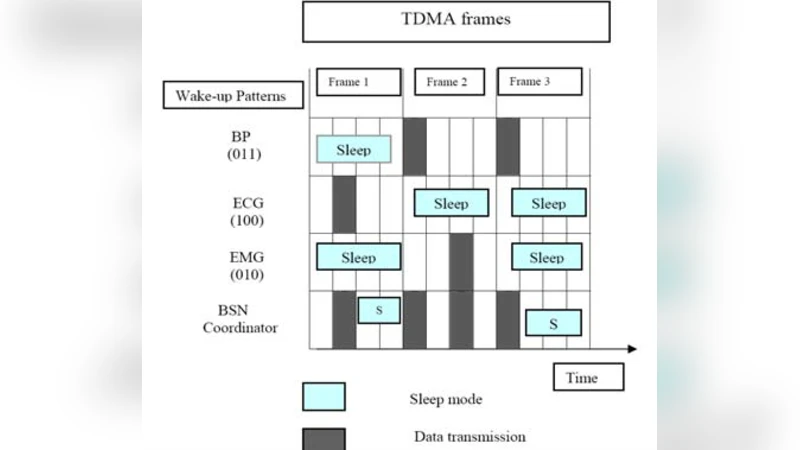
To address these issues, the authors propose a “Pattern‑Based Wake‑up Table” (PBWT) mechanism. The core idea is to exploit the largely periodic nature of physiological monitoring traffic (e.g., heart‑rate, glucose level) by pre‑defining wake‑up patterns for each node. During network initialization, each sensor is assigned a unique time‑slot pattern that reflects its sampling rate and priority. A central controller (often a wearable hub) maintains a global wake‑up table that indicates exactly which node should be active in each time slot. Nodes remain in a deep‑sleep state except during their scheduled slots, at which point they power up the radio, transmit their data, and return to sleep. This deterministic schedule eliminates the need for continuous carrier sensing, drastically reducing idle listening energy.
The PBWT also incorporates an asynchronous “emergency wake‑up” channel. If a sensor detects an abnormal event—such as a sudden arrhythmia or hypoglycemic episode—it can immediately broadcast a short wake‑up preamble that overrides the static schedule, prompting the hub and neighboring nodes to become active and forward the urgent packet with minimal delay. This hybrid approach preserves low‑power operation for routine traffic while still meeting the strict latency requirements of emergency medical data.
Simulation results demonstrate the efficacy of the proposed scheme. Compared with a baseline IEEE 802.15.4 implementation, the PBWT reduces average node power consumption by roughly 45 % and brings the packet loss rate down to below 5 % under realistic body‑movement scenarios. The emergency wake‑up path achieves end‑to‑end latency under 20 ms, which is well within the limits for life‑critical alerts. These figures indicate that the PBWT can simultaneously satisfy the three primary BSN constraints: ultra‑low energy, high reliability, and rapid response.
In the discussion, the authors outline several avenues for future work. First, they suggest developing adaptive pattern‑reconfiguration algorithms that can dynamically adjust wake‑up schedules in response to changes in user activity, sensor health, or network topology. Second, they highlight the need for robust security mechanisms to authenticate wake‑up signals and protect patient data against spoofing or denial‑of‑service attacks. Third, they call for extensive clinical trials to validate the PBWT’s performance in real‑world medical settings, including long‑term battery life assessments and patient safety evaluations.
In summary, the paper convincingly argues that a one‑size‑fits‑all MAC protocol cannot meet the divergent requirements of on‑body and in‑body sensor networks. By leveraging deterministic, pattern‑based scheduling combined with an on‑demand emergency wake‑up capability, the proposed technique offers a practical pathway toward truly low‑power, reliable, and responsive communication for next‑generation Body Sensor Networks.
Comments & Academic Discussion
Loading comments...
Leave a Comment