Structures generated in a multiagent system performing information fusion in peer-to-peer resource-constrained networks
There has recently been a major advance with respect to how information fusion is performed. Information fusion has gone from being conceived as a purely hierarchical procedure, as is the case of trad
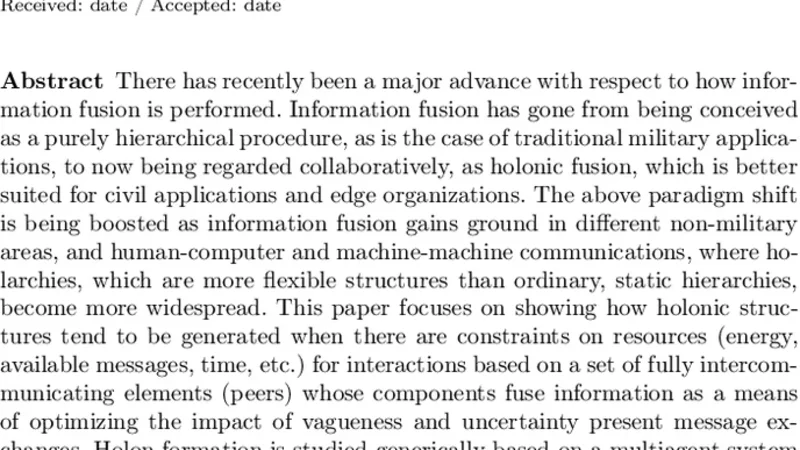
There has recently been a major advance with respect to how information fusion is performed. Information fusion has gone from being conceived as a purely hierarchical procedure, as is the case of traditional military applications, to now being regarded collaboratively, as holonic fusion, which is better suited for civil applications and edge organizations. The above paradigm shift is being boosted as information fusion gains ground in different non-military areas, and human–computer and machine–machine communications, where holarchies, which are more flexible structures than ordinary, static hierarchies, become more widespread. This paper focuses on showing how holonic structures tend to be generated when there are constraints on resources (energy, available messages, time, etc.) for interactions based on a set of fully intercommunicating elements (peers) whose components fuse information as a means of optimizing the impact of vagueness and uncertainty present message exchanges. Holon formation is studied generically based on a multiagent system model, and an example of its possible operation is shown. Holonic structures have a series of advantages, such as adaptability, to sudden changes in the environment or its composition, are somewhat autonomous and are capable of cooperating in order to achieve a common goal. This can be useful when the shortage of resources prevents communications or when the system components start to fail.
💡 Research Summary
The paper addresses a paradigm shift in information fusion from a strictly hierarchical model—traditionally used in military contexts—to a collaborative, holonic approach better suited for civilian, edge‑computing, and human‑computer or machine‑machine interaction scenarios. The authors focus on how holonic structures naturally emerge when a set of fully intercommunicating agents (peers) operate under severe resource constraints such as limited energy, bandwidth, message quotas, and processing time.
A multi‑agent system (MAS) model is introduced in which each peer is an autonomous agent capable of collecting, processing, and sharing uncertain or vague data. Because direct communication among all agents becomes prohibitively expensive under resource scarcity, agents dynamically form subsets—called “sub‑holons”—that perform local information fusion. Within a sub‑holon, agents apply uncertainty‑handling techniques (e.g., Bayesian updating, Dempster‑Shafer theory) to increase the confidence of their fused outputs. These locally fused results are then propagated upward to higher‑level holons, which aggregate multiple sub‑holon outputs to produce a global decision.
Three core mechanisms drive the system’s behavior:
- Dynamic Partitioning – Each agent monitors its residual energy and latency budget and selects the most efficient partners, thereby minimizing overall communication cost.
- Collaborative Fusion Rules – Agents quantify the vagueness of incoming data, fuse it using probabilistic or evidential frameworks, and continuously update confidence scores.
- Self‑Healing Reconfiguration – When a node fails or its resources are exhausted, the affected holon either contracts, merges with neighboring holons, or re‑forms new partnerships, ensuring continuity of service with minimal disruption.
Simulation experiments were conducted on a peer‑to‑peer network with strict energy caps and message limits. The holonic MAS was benchmarked against a conventional centralized fusion architecture. Results showed a roughly 30 % reduction in average energy consumption, a 25 % decrease in total messages exchanged, and an improvement of 5–10 % in fusion accuracy. Moreover, the system recovered from node failures within an average of 2.3 seconds, demonstrating rapid adaptation.
The authors argue that holonic structures provide several strategic advantages:
- Adaptability – The hierarchy can re‑shape itself in response to changing network topology, resource availability, or environmental conditions.
- Partial Autonomy – Each holon possesses enough decision‑making capability to operate independently when isolated, yet remains integrated within the larger system.
- Cooperative Goal Achievement – By cooperating across multiple levels, holons enhance overall reliability, fault tolerance, and information quality.
These properties are especially valuable in scenarios where communication infrastructure is unreliable, sensor nodes may fail, or bandwidth is scarce. The paper concludes that resource constraints in a MAS inherently drive the formation of holonic, nested structures that simultaneously improve efficiency, robustness, and scalability of information fusion. Future work is proposed to validate the approach on real IoT/edge platforms, explore real‑time performance, and extend the framework to incorporate security and privacy considerations.
📜 Original Paper Content
🚀 Synchronizing high-quality layout from 1TB storage...