Recovery of Saturated $gamma$ Signal Waveforms by Artificial Neural Networks
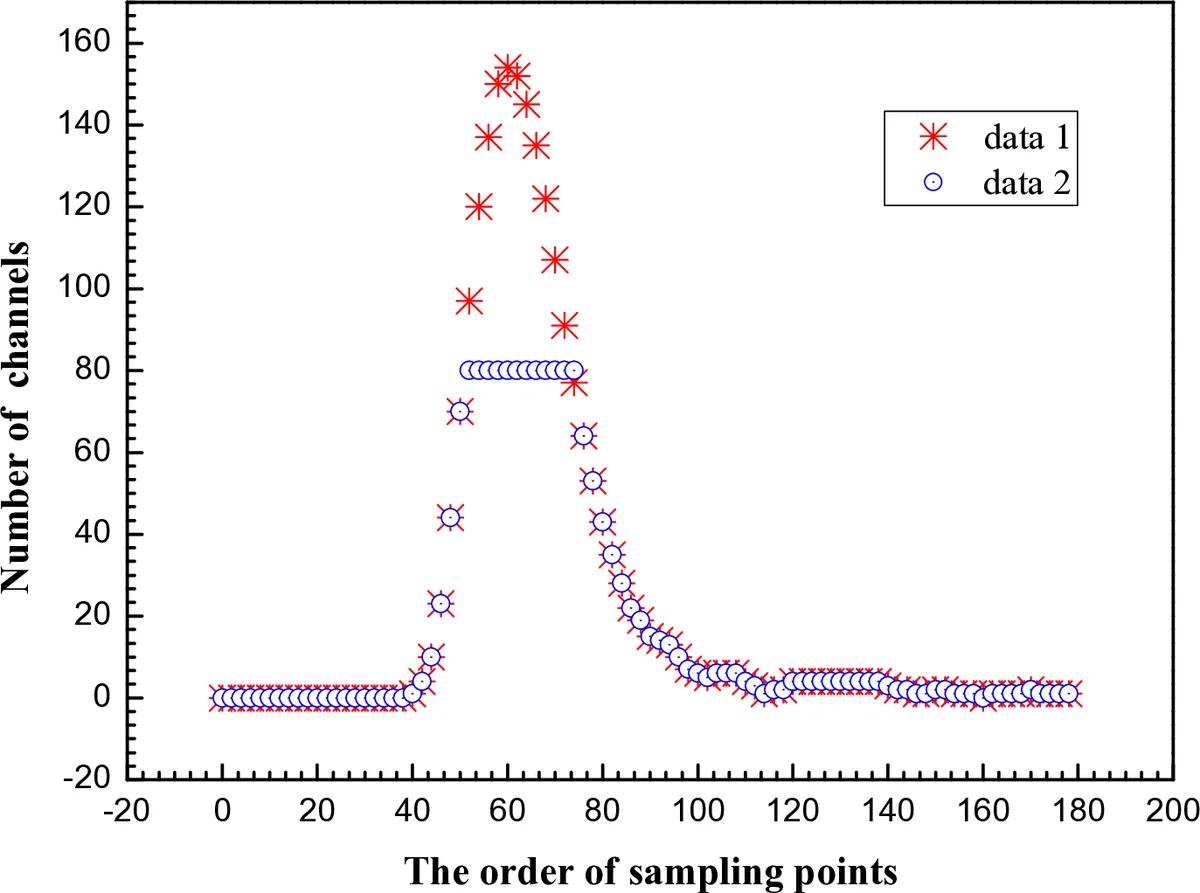
Particle may sometimes have energy outside the range of radiation detection hardware so that the signal is saturated and useful information is lost. We have therefore investigated the possibility of using an Artificial Neural Network (ANN) to restore the saturated waveforms of $\gamma$ signals. Several ANNs were tested, namely the Back Propagation (BP), Simple Recurrent (Elman), Radical Basis Function (RBF) and Generalized Radial Basis Function (GRBF) neural networks (NNs) and compared with the fitting method based on the Marrone model. The GBRFNN was found to perform best.
💡 Research Summary
The paper addresses the problem of saturated gamma‑ray signal waveforms recorded by liquid scintillation detectors, where the detector’s dynamic range is exceeded and the peak of the waveform is clipped, causing loss of valuable energy information. Traditional analytical approaches, such as fitting the Marrone model (a sum of two exponential terms), fail to capture the non‑linear deformation of the waveform that occurs at higher energies, making simple scaling or model‑based reconstruction ineffective.
To overcome this limitation, the authors propose a data‑driven reconstruction method based on artificial neural networks (ANNs). They first acquire a large set of unsaturated gamma waveforms spanning a range of energies (40–240 channels). Because the true saturated waveforms are not available for training, they simulate saturation by truncating the peak region of each normal waveform and replacing it with a flat, horizontal segment (the “saturation value”). This creates paired data: the simulated saturated waveform as input and the original unsaturated waveform as the desired output. The training set is built from lower‑energy waveforms, while the test set contains higher‑energy waveforms, ensuring that the network must generalize to unseen energy regimes. Saturation levels are randomly chosen between 4 % and 99 % to mimic a wide variety of possible clipping scenarios.
Four ANN architectures are evaluated:
-
Back‑Propagation Neural Network (BP) – a conventional multilayer feed‑forward network trained with gradient descent. The BP network produced outputs with discontinuities, random fluctuations, and significant distortion near the peak, indicating difficulty in learning the highly non‑linear mapping.
-
Elman Recurrent Neural Network – adds a context layer that feeds back the hidden state, providing limited temporal memory. It performed better than BP but still exhibited irregularities, especially around the maximum, and required extensive manual tuning. Convergence was relatively slow.
-
Radial Basis Function Neural Network (RBF) – uses Gaussian kernels centered on training samples. Although RBF networks converge quickly and are robust to noise, they failed to reproduce the correct waveform shape; the reconstructed signals were markedly different from the originals.
-
Generalized Radial Basis Function Neural Network (GRBF) – an enhanced version of RBF that reduces computational load, avoids local minima during training, and achieves higher modeling accuracy. The GRBF network delivered the most faithful reconstruction: the recovered waveforms matched the original shapes almost perfectly, with a maximum‑value error typically below 5 % (the only systematic deviation being a slight overshoot of the peak). The error distribution was narrow and approximately Gaussian, confirming consistent performance across a range of saturation levels.
Performance was quantified using a simple relative error metric:
( \text{Error} = \frac{\text{Max}{\text{orig}} - \text{Max}{\text{out}}}{\text{Max}_{\text{orig}}} ).
GRBF achieved the lowest average error among all tested networks.
The authors discuss the implications of these findings. The success of GRBF demonstrates that a global, non‑linear function approximator can effectively learn the mapping from a clipped waveform to its full‑amplitude counterpart, even when the underlying physics introduces energy‑dependent shape changes. By training on simulated saturation, the network acquires a generalized inversion capability that can be applied to real saturated data, provided that the simulated training set adequately captures the detector’s response characteristics.
Limitations are acknowledged: the current study uses artificially generated saturated waveforms; real experimental data may contain additional complexities such as electronic noise, baseline drift, and detector non‑linearities not fully represented in the simulation. Future work will involve constructing a training set from genuine unsaturated waveforms, using their truncated versions as inputs, and then applying the trained GRBF model to truly saturated measurements. Validation will focus on whether the reconstructed energy spectra and pulse‑shape characteristics align with expectations from independent calibration sources.
In conclusion, the paper provides a comprehensive comparative analysis of several ANN architectures for the specific task of saturated gamma‑ray waveform recovery. While BP, Elman, and standard RBF networks proved inadequate, the Generalized Radial Basis Function Neural Network emerged as a robust and accurate tool. This approach offers a practical pathway to extend the effective dynamic range of existing scintillation detectors without hardware modifications, thereby enhancing the fidelity of high‑energy gamma‑ray measurements in applications such as dark‑matter searches, nuclear spectroscopy, and radiation monitoring.
Comments & Academic Discussion
Loading comments...
Leave a Comment