{E}tude pour lanalyse et loptimisation du transport des personnes en situation de handicap
From 2010, the medical transport has become one of the top ten priorities of the risk management plan in France because of the increase in the cost. For social and medico-social institutions (MSI), this cost represents the second after that of the wages. In this context, the project NOMAd aims an overall improvement of the daily transport of people between their home and their (MSI). To this end, we propose the sharing of transport between several ESMS. This mutualization of transport makes possible to gather and optimize routes in a certain geographical area. The challenge is to improve economic performance while maintaining economic, social and environmental goals. From a scientific point of view, the studied problem is called the Time-Consistent-Dial-a-Ride Problem and aims to find a compromise between the objectives of the cost of transport and the consistency of the service. Given the complexity of the problem, we seek, first of all, to solve the problem for half a day. Then we consider the whole week. To solve these problems, we use the Large Neighborhood Search meta-heuristic and a master problem based on the Set Covering Problem.
💡 Research Summary
This paper addresses the escalating cost of medical and social‑care transport in France, which for establishments and services for the socially and medically vulnerable (ESMS) ranks second only to personnel expenses. Recognizing that transport for persons with disabilities (PSH) is not merely a logistical task but a critical component of their autonomy and inclusion, the authors propose a joint‑optimization framework that simultaneously reduces costs, improves service quality, and lowers environmental impact.
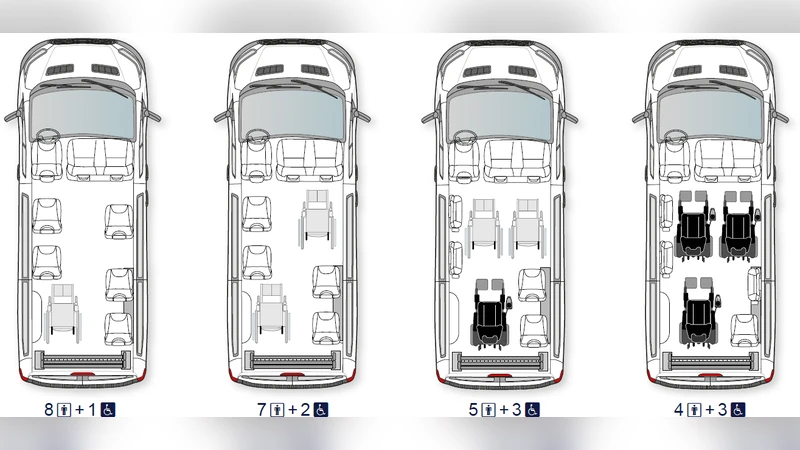
The core scientific contribution is the formulation of the “Time‑Consistent Dial‑a‑Ride Problem” (TC‑DARP). Building on the classic Dial‑a‑Ride Problem (DARP), TC‑DARP adds two novel dimensions: (1) a multi‑period horizon (half‑day to full‑week) with a “time‑consistency” constraint that seeks to keep each user’s departure/arrival windows as uniform as possible across days (windows within 15 minutes are considered the same class, and the ideal solution gives each user a single class), and (2) the possibility of reconfigurable vehicles whose interior seating can be altered during the day to accommodate varying mixes of wheelchair users and ambulatory passengers. This reflects the real‑world fleet of the GIHP Service Adapté partner, which can fold or unfold seats on the fly.
To tackle the problem’s combinatorial complexity, the authors decompose it into two hierarchical sub‑problems. The first level optimizes a single half‑day schedule. They employ a Large Neighborhood Search (LNS) meta‑heuristic that iteratively destroys and rebuilds large portions of a solution, exploring moves such as customer swaps, route merges/splits, and vehicle‑reconfiguration decisions. The objective function combines total operational cost (vehicle depreciation, driver/assistant wages, kilometre‑based fuel costs) with penalties for violating time windows and for creating multiple time‑class assignments per user.
The second level assembles a weekly plan from the set of half‑day solutions generated by LNS. This is modeled as a Set Covering Problem (SCP): each feasible half‑day route becomes a column, and the master integer program selects a subset of columns that covers every user at least once during the week while minimizing a weighted sum of total cost and the number of distinct time classes across the week. This master problem enforces global consistency that cannot be captured by solving each half‑day in isolation.
A thorough literature review shows that prior work has examined single‑period DARP, driver‑consistency, or time‑consistent vehicle routing with homogeneous fleets, but no study has combined multi‑period time‑consistency with reconfigurable heterogeneous fleets. Hence TC‑DARP constitutes a new research class.
The paper also presents an empirical needs analysis conducted in 2017 with 30 ESMS directors in the Auvergne‑Rhône‑Alpes region. The survey highlights a highly dispersed demand geography, long travel distances, heavy staff involvement in transport coordination, and a strong desire for better communication among the three stakeholder groups (operators, PSH, and institutions). Respondents identified three priority objectives for any optimization effort: cost control, service quality (especially regularity of schedules), and improved coordination/communication.
The project “NUMÉRIQUE ET OPTIMISATION POUR UNE MOBILITÉ ADAPTÉE” (NOMAd) – funded by the EU and FEDER – provides the practical context. Its partners include Ressourcial, a non‑profit IT consortium for the social‑care sector, and GIHP Service Adapté, which transports up to 1 500 persons per half‑day in the Lyon area. NOMAd aims to (i) reduce kilometres and fleet size, (ii) shorten travel times and increase schedule regularity, and (iii) cut CO₂ emissions.
Methodologically, the authors first generate half‑day routes using LNS, respecting vehicle capacity, reconfiguration limits, user time windows, and maximum ride times. The resulting routes are fed into the SCP master, which selects a weekly combination that minimizes total cost while keeping each user’s schedule within a single time class whenever possible. The approach balances the trade‑off between cost efficiency (fewer vehicles, shorter routes) and service quality (stable daily pick‑up times).
Although detailed computational results are not presented in the excerpt, the proposed framework promises substantial savings: reconfigurable vehicles can accommodate mixed passenger types in a single tour, reducing the number of required trips; mutualisation across multiple ESMS leverages geographic dispersion to create denser, more efficient routes; and the weekly SCP ensures that the cost‑saving half‑day solutions do not produce erratic daily schedules for users.
In conclusion, the study introduces a novel, multi‑objective, multi‑period vehicle routing model tailored to the specific needs of disabled persons’ transport in France. By integrating large‑scale neighborhood search with a set‑covering master problem and by grounding the model in real‑world stakeholder requirements, the authors provide a viable decision‑support tool for ESMS and transport operators. Future work is suggested to include real‑time re‑optimization for unexpected events, explicit modeling of reconfiguration costs, and extensive field trials to validate the theoretical gains.
Comments & Academic Discussion
Loading comments...
Leave a Comment