Openness and Impact of Leading Scientific Countries
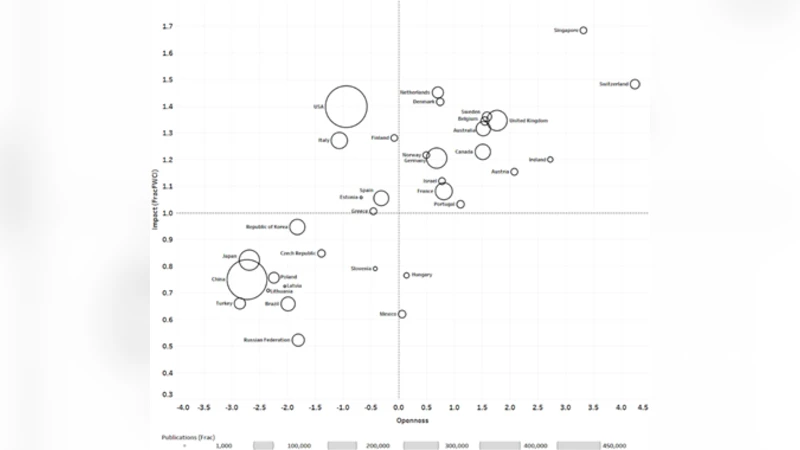
The rapid rise of international collaboration over the past three decades, demonstrated in coauthorship of scientific articles, raises the question of whether countries benefit from cooperative science and how this might be measured. We develop and compare measures to ask this question. For all source publications in 2013, we obtained from Elsevier national level full and fractional paper counts as well as accompanying field-weighted citation counts. Then we collected information from Elsevier on the percent of all internationally coauthored papers for each country, as well as Organization for Economic Cooperation and Development measures of the international mobility of the scientific workforce in 2013, and conducted a principle component analysis that produced an openness index. We added data from the OECD on government budget allocation on research and development for 2011 to tie in the public spending that contributed to the 2013 output. We found that openness among advanced science systems is strongly correlated with impact: the more internationally engaged a nation is in terms of coauthorships and researcher mobility, the higher the impact of scientific work. The results have important implications for policy making around investment, as well as the flows of students, researchers, and technical workers.
💡 Research Summary
The paper investigates whether and how a nation’s openness to international scientific collaboration translates into higher research impact. Using a comprehensive dataset for the year 2013, the authors extracted from Elsevier’s Scopus database the full and fractional counts of publications for 35 advanced economies, together with the field‑weighted citation impact (FWCI) for each country. Fractional counting assigns each paper a share of credit proportional to the number of authors from each country, thereby avoiding double‑counting of internationally co‑authored articles. In parallel, OECD statistics on researcher mobility for 2013 were incorporated, capturing the inflow and outflow of scientists across borders. Public R&D spending was represented by the Government Budget Allocation for R&D (GBARD) figures from 2011, providing a measure of national investment in science.
To synthesize the three dimensions of openness—(1) share of internationally co‑authored papers, (2) researcher mobility, and (3) public R&D expenditure—the authors performed a principal component analysis (PCA). The first principal component explained 68 % of the variance and was taken as a composite “openness index.” Subsequent regression analyses revealed a strong positive correlation between the openness index and FWCI (Pearson r ≈ 0.73, p < 0.001), indicating that countries more engaged in cross‑border collaboration and scientist exchange tend to produce papers that are cited well above the world average. A moderate positive correlation (r ≈ 0.45) also emerged between GBARD and both openness and impact, suggesting that higher public investment facilitates openness, which in turn boosts citation performance.
The literature review confirms earlier findings that internationally co‑authored articles receive 30 %–50 % more citations than domestic ones and that mobility (“brain circulation”) enhances individual researchers’ citation records. The authors argue that these effects are not merely additive; rather, mobility amplifies the benefits of collaboration by creating transnational networks that persist beyond single projects.
The study acknowledges several limitations. The sample is restricted to 35 high‑income nations, representing about 92 % of publicly funded research but limiting the generalizability to developing economies. The temporal mismatch between the 2011 GBARD data and the 2013 publication data may obscure causal directionality. Moreover, the analysis cannot directly attribute a monetary value to the cost of international collaboration, as most national budgets lack line items for such activities.
Future research directions include expanding the dataset to incorporate emerging economies, employing longitudinal panel methods to track changes over time, and developing more granular accounting of international project funding. Such extensions would allow a clearer assessment of causality and the economic returns of openness.
In conclusion, the paper provides robust empirical evidence that openness—measured through international co‑authorship and researcher mobility—is strongly associated with higher scientific impact, and that public R&D spending plays a facilitating role. The findings have clear policy implications: governments seeking to enhance national scientific performance should invest not only in domestic research capacity but also in mechanisms that promote cross‑border collaboration and the free movement of scholars.
Comments & Academic Discussion
Loading comments...
Leave a Comment