Developing Design Guidelines for Precision Oncology Reports
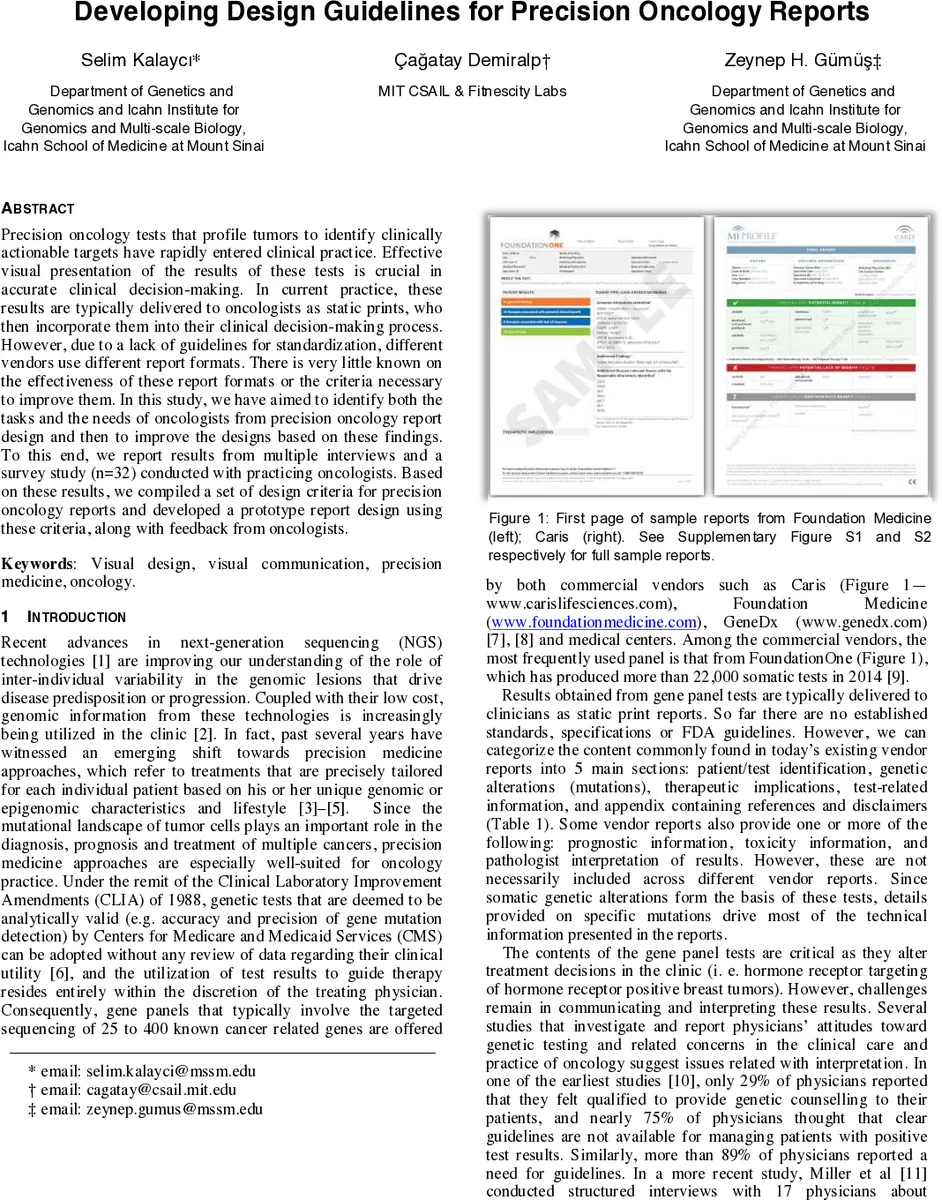
Precision oncology tests that profile tumors to identify clinically actionable targets have rapidly entered clinical practice. Effective visual presentation of the results of these tests is crucial in accurate clinical decision-making. In current practice, these results are typically delivered to oncologists as static prints, who then incorporate them into their clinical decision-making process. However, due to a lack of guidelines for standardization, different vendors use different report formats. There is very little known on the effectiveness of these report formats or the criteria necessary to improve them. In this study, we have aimed to identify both the tasks and the needs of oncologists from precision oncology report design and then to improve the designs based on these findings. To this end, we report results from multiple interviews and a survey study (n=32) conducted with practicing oncologists. Based on these results, we compiled a set of design criteria for precision oncology reports and developed a prototype report design using these criteria, along with feedback from oncologists.
💡 Research Summary
Precision oncology tests that sequence tumor DNA have become a routine part of modern cancer care, yet the reports that convey these results to clinicians are still delivered as static, vendor‑specific PDFs with no industry‑wide standards. This paper investigates the usability problems oncologists face when interpreting such reports and proposes a set of design guidelines to improve them.
The authors began with informal interviews of several oncologists at the Mount Sinai Health System to gather qualitative insights about current reporting practices. Based on these discussions they drafted a survey, refined it after multiple rounds of feedback, and administered it to 32 practicing oncologists during a Hematology/Medical Oncology Grand Rounds session in April 2016. The respondent pool was predominantly male medical oncologists with a wide range of post‑medical‑school experience and clinical focus (blood cancers, hematology, breast cancer, etc.).
Survey results revealed that the most important information oncologists seek is the list of genetic alterations (84% of respondents). Finding actionable alterations was reported as the most time‑consuming task (57%), followed by locating clinical‑trial information (29%) and therapy options (21%). Respondents complained about excessive verbosity and clutter, stating that concise reports are preferred and that the “verbosity of technical information” was the biggest obstacle (59%). Layout and visual encoding were identified as the most problematic aspects (61%). None of the participants were satisfied with current reports, 58% called for standardization, and 50% suggested adding visual summaries.
From these findings the authors distilled six design goals (DG‑1 to DG‑6):
- DG‑1 – Present genetic alteration (biomarker) data in the clearest, most concise way.
- DG‑2 – Separate clinically relevant information from non‑essential technical details.
- DG‑3 – Make actionable summary results easily discoverable.
- DG‑4 – Align presentation with oncologists’ natural workflow and expectations.
- DG‑5 – Preserve compatibility with existing vendor reports to aid standardization.
- DG‑6 – Incorporate appropriate visual summaries (color‑coding, icons, charts) where useful.
Using an iterative design process, the team created several prototype layouts, experimenting with visual encodings such as shapes, colors, scaling, bold fonts, shading, and contrasting elements. Two oncologists reviewed each iteration, providing feedback that guided refinements. The final prototype (Figure 2 in the paper) follows the six goals closely. The top of the page contains patient and test identification information, as is customary (DG‑4). Directly below, a “Results Summary” table occupies the left half of the page, using simple visual cues (DG‑6) to highlight actionable mutations and associated therapies. The right half lists all detected alterations in a tabular format, with disease‑relevant non‑detected alterations also shown; visual consistency is maintained across sections. The therapeutic implications section spans the full page width, mirroring the layout used by the widely‑adopted FoundationOne reports (DG‑5) but adding color‑encoded rows to indicate whether each genomic alteration is clinically actionable. Overall, the layout groups clinically important data together, separates it from technical footnotes, and uses visual hierarchy to reduce cognitive load.
The paper acknowledges that the prototype has not yet undergone quantitative usability testing. Future work will involve controlled user studies comparing the new design with existing vendor reports to measure speed, accuracy, and satisfaction. The authors also propose extending the design to patient‑facing reports and exploring interactive, web‑based versions that could allow clinicians to drill down into data dynamically.
In summary, this study provides a data‑driven, user‑centered framework for redesigning precision oncology reports. By grounding design decisions in oncologists’ real‑world tasks and preferences, the authors deliver concrete guidelines and a functional prototype that promise to enhance report readability, accelerate clinical decision‑making, and lay groundwork for future standardization across the rapidly expanding field of genomic oncology.
Comments & Academic Discussion
Loading comments...
Leave a Comment