Coupling geologically consistent geostatistical history matching with parameter uncertainty quantification
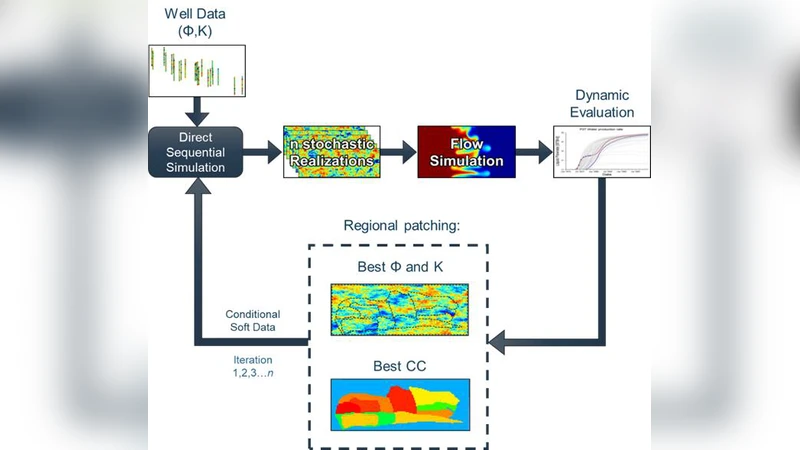
Iterative geostatistical history matching uses stochastic sequential simulation to generate and perturb subsurface Earth models to match historical production data. The areas of influence around each well are one of the key factors in assimilating model perturbation at each iteration. The resulting petrophysical model properties are conditioned to well data with respect to large-scale geological parameters such as spatial continuity patterns and their probability distribution functions. The objective of this work is twofold: (i) to identify geological and fluid flow consistent areas of influence for geostatistical assimilation; and (ii) to infer large-scale geological uncertainty along with the uncertainty in the reservoir engineering parameters through history matching. The proposed method is applied to the semi-synthetic Watt field. The results show better match of the historical production data using the proposed regionalization approach when compared against a standard geometric regionalization approach. Tuning large-scale geological and engineering parameters, as represented by variogram ranges, property distributions and fault transmissibilities, improves the production match and provides an assessment over the uncertainty and impact of each parameter in the production of the field.
💡 Research Summary
The paper introduces a novel two‑stage workflow that couples geologically and dynamically consistent regionalization with adaptive stochastic sampling to perform iterative geostatistical history matching (GHM) while simultaneously quantifying uncertainty in large‑scale geological and engineering parameters. Traditional GHM approaches often rely on purely geometric definitions of well influence zones (e.g., Voronoi polygons), which can ignore important structural features and flow dynamics, leading to models that match production data but are geologically implausible.
In the first stage, multiple realizations of porosity (Φ) and permeability (K) are generated using Direct Sequential Simulation (DSS) and co‑simulation. The reservoir is partitioned into regions of influence that are defined by a combination of fault geometry and production streamline analysis, thereby embedding both geological structure and dynamic flow behavior into the regionalization. For each region, the pair of Φ‑K realizations that yields the smallest misfit between simulated and observed production (using a least‑squares objective) is selected, and these selected patches are assembled into a “patchwork” model. This patchwork model serves as soft conditioning data for the next co‑simulation iteration.
A key innovation is the computation of a local correlation coefficient for each region and each time step, derived from the magnitude of the production misfit. Regions with large errors receive low correlation values, allowing greater variability in subsequent simulations; well‑matched regions receive high correlation values, constraining further changes. This adaptive soft‑conditioning accelerates convergence toward models that satisfy both production and geological constraints.
The second stage addresses uncertainty at the larger scale. Parameters that define the variogram (range, anisotropy), the global histograms of Φ and K, and fault transmissibilities are treated as stochastic variables. Particle Swarm Optimization (PSO) samples these parameters, evaluates the overall production misfit, and updates the parameter set to minimize the objective function. The optimized large‑scale parameters are fed back into the first stage, closing the loop. The process repeats until a predefined number of iterations is reached or the misfit falls below a target threshold.
The methodology is applied to the semi‑synthetic Watt field, a braided‑river depositional model previously used as a benchmark. Compared with a conventional GHM that uses geometric Voronoi regionalization, the proposed approach achieves a markedly better match to historical oil rate, water cut, and bottom‑hole pressure data. Moreover, the framework provides quantitative sensitivity of the production response to each uncertain parameter, revealing, for example, that variogram range uncertainties dominate early‑time oil rate predictions, while fault transmissibility uncertainties have a larger impact on late‑time water breakthrough.
Overall, the study demonstrates that (1) incorporating geological structures and flow‑derived streamlines into the definition of well influence zones yields more geologically realistic and dynamically consistent models, and (2) coupling this regionalization with adaptive stochastic sampling (PSO) enables simultaneous calibration of both small‑scale petrophysical fields and large‑scale geological/engineering parameters. The combined approach mitigates the non‑uniqueness inherent in history matching, improves predictive reliability, and offers a practical pathway for integrating uncertainty quantification into routine reservoir model updating workflows.
Comments & Academic Discussion
Loading comments...
Leave a Comment