Implementing the Lexicographic Maxmin Bargaining Solution
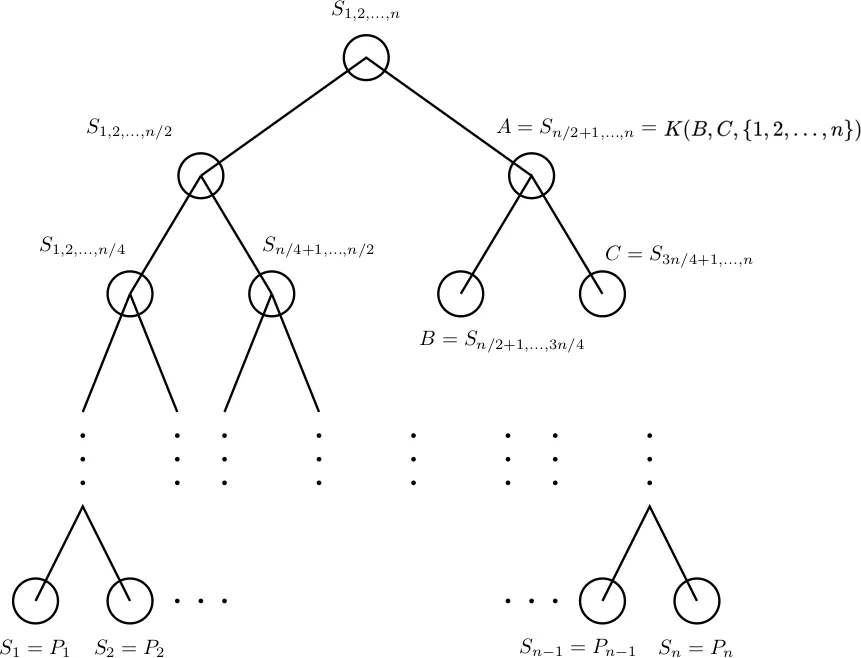
There has been much work on exhibiting mechanisms that implement various bargaining solutions, in particular, the Kalai-Smorodinsky solution \cite{moulin1984implementing} and the Nash Bargaining solution. Another well-known and axiomatically well-studied solution is the lexicographic maxmin solution. However, there is no mechanism known for its implementation. To fill this gap, we construct a mechanism that implements the lexicographic maxmin solution as the unique subgame perfect equilibrium outcome in the n-player setting. As is standard in the literature on implementation of bargaining solutions, we use the assumption that any player can grab the entire surplus. Our mechanism consists of a binary game tree, with each node corresponding to a subgame where the players are allowed to choose between two outcomes. We characterize novel combinatorial properties of the lexicographic maxmin solution which are crucial to the design of our mechanism.
💡 Research Summary
The paper addresses a long‑standing gap in bargaining theory: the implementation of the lexicographic max‑min solution (also known as the Rawlsian or Sen solution) in an n‑player setting with complete information. While Nash, Kalai‑Smorodinsky, and many other bargaining solutions have been successfully implemented via mechanisms that maximize a convex function of utilities, the lexicographic max‑min solution is defined by a sequential max‑min criterion and does not arise from a single convex optimization problem. Consequently, existing implementation techniques cannot be directly applied.
The authors first formalize the bargaining model. There is a finite set of alternatives A, and lotteries over A constitute the outcome space P(A). Each player i has von‑Neumann‑Morgenstern utilities u_i, normalized so that the disagreement point s* yields zero utility and the best feasible utility equals one. A crucial standing assumption (Assumption 1) states that each player’s most preferred feasible outcome gives the entire surplus to that player while all others receive only the disagreement payoff. This “single‑player dominance” assumption is standard in the literature and holds in natural settings such as cake‑cutting with hungry agents or wireless relay power allocation.
The lexicographic max‑min solution u* is defined as the outcome that first maximizes the utility of the worst‑off player, then among those maximizes the utility of the second‑worst, and so on. To distinguish u* from any other feasible outcome, the authors introduce a novel binary relation called disagreement dominance (≻_D). For two utility vectors u and v, one first projects u onto the set of players who strictly prefer v, and vice‑versa; the projected vectors are then compared lexicographically. The key property proved is that u* disagreement‑dominates every other feasible outcome.
Using this relation, the paper builds a “knock‑out” sub‑mechanism. In a simple two‑outcome game, the players are offered a choice between u* and any other outcome u. If any player deviates to u, the others can immediately enforce a continuation that yields a strictly better payoff for them, making u* the unique subgame‑perfect equilibrium (SPE) of this sub‑game. This sub‑mechanism requires only one round and no knowledge of the actual utility numbers, only the ordering implied by disagreement dominance.
The full implementation is then constructed by arranging many knock‑out sub‑games in a binary tree. Each internal node presents two candidate outcomes; the winner of the lower‑level sub‑games proceeds upward. Because the tree has depth ⌈log₂ n⌉, the equilibrium path reaches the root in logarithmic steps, and the total number of rounds is O(n² log n), substantially improving on earlier mechanisms (e.g., Howard’s implementation of the Nash solution, which would need O(n³) rounds). The root outcome is precisely the lexicographic max‑min solution, making it the unique SPE of the entire game.
The authors compare their work with prior literature. A repeated arbitration procedure by Bossert and Tan also converges to the lexicographic max‑min outcome, but it assumes the designer knows each player’s utility function—a strong requirement the present mechanism avoids. The paper also notes that for piecewise‑uniform cake‑cutting utilities, an existing truthful mechanism implicitly implements the lexicographic max‑min solution, whereas for piecewise‑linear utilities no truthful implementation is known. The presented mechanism is not coalition‑proof and relies on the single‑player dominance assumption; extending the result to settings where no player can capture the whole surplus remains an open problem.
In summary, the paper makes three major technical contributions: (1) the definition and analysis of disagreement dominance, a relation that uniquely characterizes the lexicographic max‑min outcome; (2) the design of a one‑shot knock‑out sub‑game that implements the lexicographic max‑min solution against any alternative; and (3) the composition of these sub‑games into a logarithmic‑depth binary tree that yields a complete, subgame‑perfect implementation for any number of players. This work fills a notable gap in the implementation literature and opens avenues for future research on relaxing Assumption 1 and handling information asymmetries.
Comments & Academic Discussion
Loading comments...
Leave a Comment