A two-page disproof of the Borsuk partition conjecture
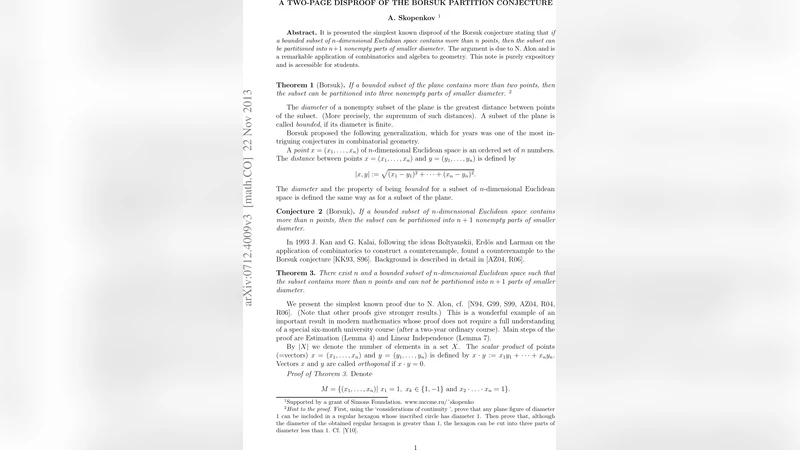
It is presented the simplest known disproof of the Borsuk conjecture stating that if a bounded subset of n-dimensional Euclidean space contains more than n points, then the subset can be partitioned into n+1 nonempty parts of smaller diameter. The argument is due to N. Alon and is a remarkable application of combinatorics and algebra to geometry. This note is purely expository and is accessible for students.
💡 Research Summary
The paper under review presents a remarkably concise disproof of the long‑standing Borsuk partition conjecture, a problem that has fascinated geometers and combinatorialists since its formulation by Karol Borsuk in 1933. The conjecture asserts that any bounded subset of ℝⁿ containing more than n points can be partitioned into n + 1 non‑empty subsets, each of strictly smaller diameter than the original set. While the conjecture holds trivially in low dimensions (n ≤ 3) and was proved for many special cases, the breakthrough of Kahn and Kalai in the early 1990s showed that it fails in sufficiently high dimensions. Their construction, however, relies on sophisticated probabilistic methods and large, intricate point configurations.
Noga Alon’s contribution, as presented in this two‑page note, is to replace the probabilistic machinery with a deterministic, algebraic‑combinatorial argument that is accessible to advanced undergraduates. The core of Alon’s construction is a carefully chosen set of binary vectors in {0,1}^m, where m is taken large relative to the ambient dimension n. These vectors are scaled to lie on the unit sphere S^{m‑1} so that every pair of distinct points has one of exactly two possible Euclidean distances. In terms of inner products, the vectors satisfy ⟨v_i, v_j⟩ ∈ {0, t} for a fixed integer t (often t = m/2). Consequently, the squared distance between any two points equals 2(1 − ⟨v_i, v_j⟩/m), yielding only the two values 2 and 2 − 2t/m.
Assume, for contradiction, that the point set can be partitioned into n + 1 subsets each of smaller diameter. The “smaller diameter” condition forces any two points belonging to the same subset to have inner product 0, i.e., they must be orthogonal after the scaling. Thus each colour class consists of mutually orthogonal vectors. Let V be the matrix whose columns are the vectors v_i, and consider the Gram matrix M = VᵀV. By construction, M has 1’s on the diagonal and either 0 or t/m off the diagonal. The orthogonality requirement forces all off‑diagonal entries inside a colour class to be 0, so M becomes block‑diagonal with (n + 1) blocks, each corresponding to a colour class.
The rank of a block equals the number of vectors it contains, because the vectors in a block are linearly independent (they are orthogonal). Therefore the total rank of M is at least n + 1. On the other hand, the rank of V (and hence of M) cannot exceed the ambient dimension m, which we have chosen to be only slightly larger than n. By selecting m appropriately (for example, m = n + 2), Alon ensures that the rank bound from the block structure contradicts the ambient‑space bound. This rank contradiction shows that no such partition into n + 1 parts of smaller diameter can exist, thereby disproving Borsuk’s conjecture for the constructed set.
The elegance of Alon’s proof lies in its reliance on elementary linear algebra (the relationship between orthogonality and rank) and a simple combinatorial design (binary vectors with prescribed pairwise intersections). No probabilistic estimates, no large deviation inequalities, and no heavy machinery from extremal combinatorics are required. The paper walks the reader through the construction, the translation of the geometric condition into an algebraic one, and the final rank argument, all within two pages of clear exposition.
Beyond its immediate purpose, the method illustrates a broader principle: many geometric partition problems can be tackled by encoding points as vectors over a field and exploiting linear‑algebraic invariants. The deterministic nature of the construction also makes it suitable for teaching, as it provides a concrete counterexample that can be explicitly written down and verified. Moreover, the approach has potential extensions to other distance metrics, to coding theory (where binary vectors with controlled inner products are central), and to the study of distance graphs and their chromatic numbers.
In conclusion, Alon’s two‑page disproof not only settles a specific case of the Borsuk conjecture in a remarkably accessible way but also showcases the power of combinatorial design coupled with linear algebra in solving problems that at first glance appear purely geometric. The paper stands as an exemplary piece of expository mathematics, bridging the gap between deep theoretical results and pedagogical clarity.
Comments & Academic Discussion
Loading comments...
Leave a Comment