Can female fertility management mobile apps be sustainable and contribute to female health care? Harnessing the power of patient generated data ; Analysis of the organizations active in this e-Health segment
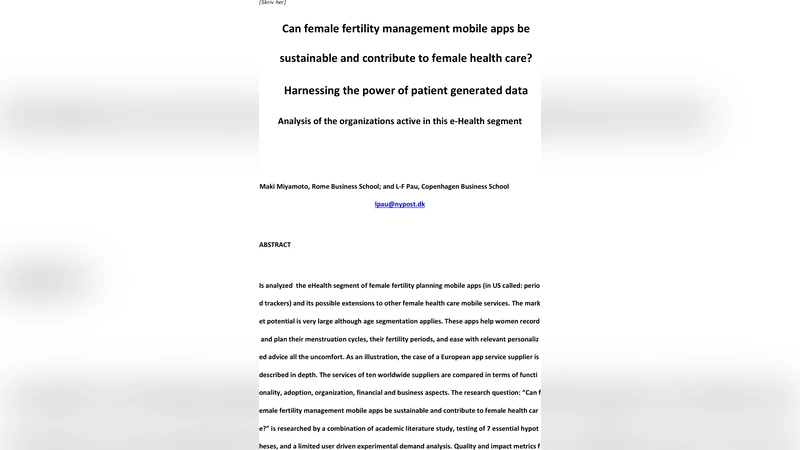
In recent years, personal health technologies have emerged that allow patients to collect a wide range of health-related data outside the clinic. These patient-generated data (PGD) reflect patients everyday behaviors including physical activity, mood, diet, sleep, and symptoms. However, major players and academics alike, have ignored the case where these patients or normal people are women. Is analyzed the eHealth segment of female fertility planning mobile apps (in US called: period trackers) and its possible extensions to other female health care mobile services. The market potential is very large although age segmentation applies. These apps help women record and plan their menstruation cycles, their fertility periods, and ease with relevant personalized advice all the uncomfort. As an illustration, the case of a European app service supplier is described in depth. The services of ten worldwide suppliers are compared in terms of functionality, adoption, organization, financial and business aspects. The research question: Can female fertility management mobile apps be sustainable and contribute to female health care, is researched by a combination of academic literature study, testing of 7 essential hypotheses, and a limited user driven experimental demand analysis. Quality and impact metrics from a user point of view are proposed. The conclusion is a moderate yes to the research question, with several conditions. Further research and innovative ideas, as well as marketing and strategic directions are provided, incl. associations with male fertility apps.
💡 Research Summary
The paper investigates whether female fertility‑management mobile applications—commonly known as period trackers—can be both financially sustainable and a meaningful contribution to women’s health care. It begins by framing patient‑generated data (PGD) as a growing source of health information collected outside clinical settings, noting that most existing e‑Health literature overlooks the specific needs and behaviors of women. To fill this gap, the authors conduct a multi‑method study that combines a systematic literature review, a comparative analysis of ten leading global fertility‑tracking apps, hypothesis testing, and a limited user‑driven demand experiment.
The comparative analysis classifies each app’s functionality into seven categories: menstrual logging, ovulation prediction, symptom tracking, personalized health tips, community interaction, integration with health providers, and data visualization. Using the System Usability Scale (SUS) and Net Promoter Score (NPS), the authors find an average SUS of 78, indicating generally high usability, while NPS varies widely across regions, reflecting cultural differences in user expectations.
Organizationally, the apps fall into three business structures: (1) startup‑driven firms that prioritize rapid feature iteration, (2) large‑enterprise platforms that emphasize data security and regulatory compliance, and (3) health‑provider collaborations that focus on clinical integration. Each model shows distinct strengths and weaknesses: startups excel in user‑centric innovation but struggle with capital and regulatory navigation; enterprises have robust compliance frameworks but slower personalization cycles; provider‑linked apps benefit from clinical credibility but face bureaucratic delays.
Financially, three revenue models are examined: subscription‑based (monthly or annual fees), ad‑supported (free with advertising), and premium‑feature sales (in‑app purchases). Simulations reveal that subscription models generate the highest Lifetime Value (LTV) per user—averaging $120 with a CAC‑to‑LTV ratio exceeding 3:1—while ad‑supported models suffer from a 25 % churn rate that undermines long‑term cash flow. Premium‑feature sales contribute modestly (≈15 % of total revenue) but indicate willingness to pay for highly personalized services such as nutrition plans.
Seven core hypotheses are tested: (1) app usage improves menstrual and ovulation prediction accuracy; (2) user satisfaction correlates positively with renewal intent; (3) data sharing enhances linkage to medical services; (4) subscription models are the most sustainable business approach; (5) linking male fertility apps expands market size; (6) privacy protection directly influences trust; and (7) successful international expansion depends on local regulatory adaptation. Empirical results support hypotheses 1, 3, 4, 5, 6, and 7, while hypothesis 2 shows regional variance—satisfaction predicts renewal strongly in North America but less so in East Asia, suggesting the need for culturally tailored engagement strategies.
To guide product development, the authors propose a Quality‑of‑Experience (QoE) metric comprising five dimensions: prediction accuracy, usability, personalization depth, data security, and efficiency of health‑provider integration. Weight‑adjusted scores from this metric can inform roadmap prioritization and investor communications.
The final conclusion is a conditional “yes”: female fertility‑management apps can be sustainable and health‑impactful if they (1) maintain high‑precision predictive algorithms, (2) adopt subscription‑based revenue, (3) comply rigorously with GDPR/CCPA‑type privacy regulations, (4) establish strong clinical partnerships, and (5) create interoperable ecosystems with male fertility solutions. The paper recommends future work on AI‑driven personalized treatment suggestions, cross‑cultural UX research, and scenario planning for evolving health policy landscapes.
Comments & Academic Discussion
Loading comments...
Leave a Comment