Blockchain and Smart-contracts Modeled in a SwarmESB Ecosystem
Blockchain has emerged as a trusted and secure distributed ledger for transactions while also being decentralised, distributed and its legitimacy not guaranteed by a trusted authority. Since the appearance of Bitcoin, Blockchain has known many implementations based on P2P architectures. This paper presents how the blockchain and smart contracts technologies can be integrated into the SwarmESB ecosystem. SwarmESB is a framework that helps building distributed applications, which benefit from privacy and scalability features. Our proposal will present the flexibility in building not only microservices based applications, but also decen-tralised applications employing blockchain and smart-contracts by modeling a sample Dapp.
💡 Research Summary
The paper proposes a novel integration of blockchain and smart‑contract capabilities into the SwarmESB ecosystem, a framework originally designed for building distributed, privacy‑preserving micro‑service applications. SwarmESB’s core constructs—messages, swarms (choreographies), adapters, and swarm clients—are repurposed to emulate the essential components of a decentralized ledger. Adapters, which are long‑running processes providing services, become “miners” that maintain a local copy of the blockchain, validate transactions, and generate new blocks. Swarms, defined in a JavaScript‑based DSL, serve as the execution model for smart contracts; each contract’s state is not stored internally but is passed as parameters from the invoking miner, thereby avoiding mutable shared state within the contract itself.
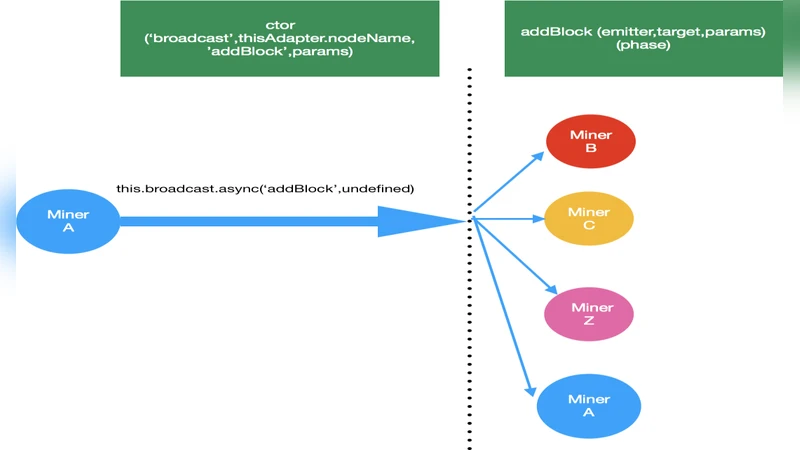
The authors detail a communication protocol built on SwarmESB’s publish/subscribe messaging. Two patterns are demonstrated: broadcast, where a constructor such as “startBroadcast” triggers a phase on every adapter in a group (e.g., a ping‑pong test), and unicast, where a specific adapter is addressed directly (e.g., “pingDirect”). These patterns are leveraged to implement the fundamental blockchain operations: transaction propagation, block dissemination, peer discovery, and chain synchronization. For example, a client submits a transaction via the “addTransaction” swarm, which broadcasts the payload to all miners; each miner adds it to its transaction pool. When a miner successfully mines a block, it invokes the “addBlock” phase across the network, broadcasting the new block without awaiting acknowledgments. If a node detects that its chain is out‑of‑date, it performs a direct “update” call to a chosen peer, receiving the latest chain and pending transactions to resynchronize.
Smart‑contract modeling is examined from two perspectives. Using adapters as contracts would allow long‑running, timer‑based logic but introduces severe security risks because any swarm could invoke adapter methods and potentially corrupt state. Consequently, the authors adopt swarms as contracts, accepting the limitation that contracts cannot autonomously trigger actions based on timers or external events; they execute only in response to explicit calls from miners. Contract addresses are fixed identifiers defined in the swarm’s metadata, and the contract’s current state is supplied by the miner at invocation time. The contract’s constructor parses the incoming transaction, extracts the intended method (phase), and dispatches execution accordingly. Results are returned within a bounded time window to prevent blocking the mining pipeline; timeouts are handled as errors by the miner.
A concrete DApp example illustrates the end‑to‑end workflow: a client initiates a transaction, miners collect it, a miner solves the proof‑of‑work (or analogous consensus), broadcasts the new block, and all peers update their ledgers. Smart contracts can be invoked during transaction validation to enforce business rules, with state transitions reflected in the miners’ local copies. The paper acknowledges that SwarmESB’s lack of persistent contract processes limits certain use cases (e.g., recurring payments), but argues that the framework’s inherent scalability, dynamic choreography, and built‑in privacy mechanisms (e.g., encrypted payloads, controlled exposure of services) offset these constraints and even enhance blockchain privacy beyond typical public‑ledger designs.
In conclusion, the authors demonstrate that SwarmESB’s architecture is sufficiently expressive to support both micro‑service‑oriented applications and fully decentralized blockchain applications. By mapping miners to adapters and contracts to swarms, they achieve a functional prototype that respects blockchain’s core properties—decentralization, immutability, and consensus—while inheriting SwarmESB’s advantages of composability, dynamic scaling, and privacy preservation. The work opens a pathway for future research on hybrid distributed systems that combine service‑oriented computing with trusted ledger technologies.
Comments & Academic Discussion
Loading comments...
Leave a Comment