Data-Driven Design: Exploring new Structural Forms using Machine Learning and Graphic Statics
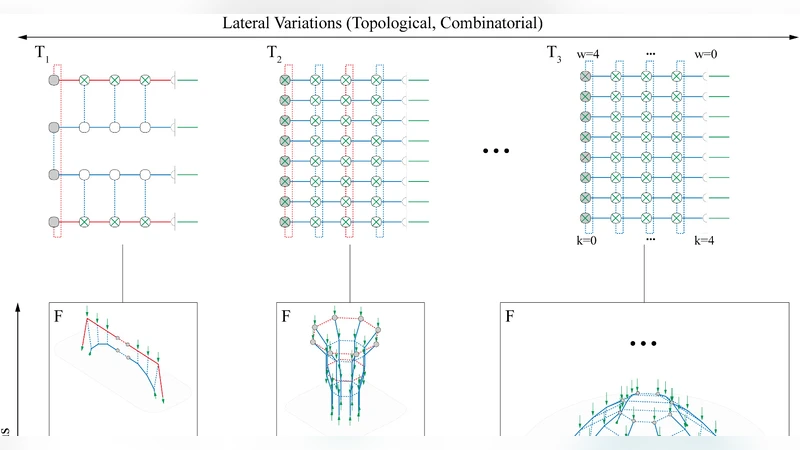
The aim of this research is to introduce a novel structural design process that allows architects and engineers to extend their typical design space horizon and thereby promoting the idea of creativity in structural design. The theoretical base of this work builds on the combination of structural form-finding and state-of-the-art machine learning algorithms. In the first step of the process, Combinatorial Equilibrium Modelling (CEM) is used to generate a large variety of spatial networks in equilibrium for given input parameters. In the second step, these networks are clustered and represented in a form-map through the implementation of a Self Organizing Map (SOM) algorithm. In the third step, the solution space is interpreted with the help of a Uniform Manifold Approximation and Projection algorithm (UMAP). This allows gaining important insights in the structure of the solution space. A specific case study is used to illustrate how the infinite equilibrium states of a given topology can be defined and represented by clusters. Furthermore, three classes, related to the non-linear interaction between the input parameters and the form space, are verified and a statement about the entire manifold of the solution space of the case study is made. To conclude, this work presents an innovative approach on how the manifold of a solution space can be grasped with a minimum amount of data and how to operate within the manifold in order to increase the diversity of solutions.
💡 Research Summary
The paper introduces a data‑driven workflow that expands the creative horizon of structural form‑finding by coupling combinatorial equilibrium modelling (CEM) with modern machine‑learning techniques. In the first stage, CEM generates a massive set of spatial networks that satisfy equilibrium for a given topology while varying a set of input parameters such as member lengths, stiffnesses, and external loads. Each generated network is encoded as a high‑dimensional feature vector containing node coordinates, connectivity, internal forces, and stress measures.
In the second stage, a Self‑Organizing Map (SOM) is trained on these vectors. SOM projects the high‑dimensional data onto a two‑dimensional grid while preserving topological relationships, thereby creating a “form‑map” where similar structural shapes occupy neighboring cells. The authors systematically tune SOM hyper‑parameters (learning rate, neighborhood radius, grid size) to avoid over‑ or under‑clustering, achieving a balanced representation of the solution space.
The third stage applies Uniform Manifold Approximation and Projection (UMAP) to the discrete SOM output. UMAP refines the representation into a continuous low‑dimensional manifold that retains both local and global structure. This manifold visualisation reveals how variations in the input parameters map to non‑linear changes in structural form, allowing designers to interpret the overall geometry of the solution space.
A case study on a complex truss topology illustrates the workflow. Ten input parameters are randomly sampled to produce 5,000 equilibrium models. SOM clusters these models into four dominant regions on a 10 × 10 grid, each region corresponding to distinct physical characteristics such as bending stiffness, member layout, and stress distribution. UMAP visualisation shows that these clusters occupy separate zones on the manifold, confirming the presence of multiple modes in the design space.
Crucially, the authors identify three classes of non‑linear interaction between parameters and form: (1) a linear regime where small parameter changes produce proportionate shape changes; (2) a threshold regime where crossing a critical value triggers abrupt form transitions; and (3) a multi‑solution regime where the same parameter set can lead to several distinct equilibrium shapes. This classification provides designers with a strategic map for navigating the parameter space toward desired performance or aesthetic goals.
The key insight is that only a few thousand data points are sufficient to reconstruct the full manifold of feasible solutions, representing a dramatic reduction—by two orders of magnitude—compared with conventional exhaustive parametric sweeps that often require hundreds of thousands of simulations. Moreover, the SOM‑UMAP pipeline enables inverse design: by locating a target region on the manifold, designers can back‑track to the corresponding parameter ranges, dramatically accelerating ideation and prototyping.
In conclusion, the study demonstrates that integrating graphic statics (through CEM) with unsupervised learning (SOM) and manifold learning (UMAP) creates a powerful, low‑cost tool for exploring and exploiting the rich, non‑linear landscape of structural form. The approach not only broadens the diversity of obtainable solutions but also provides a systematic, data‑driven method for navigating that diversity. Future work is suggested to extend the methodology to more intricate topologies, incorporate multi‑physics constraints, and embed the workflow into interactive design environments for real‑time creative exploration.
Comments & Academic Discussion
Loading comments...
Leave a Comment