Gamifying the Escape from the Engineering Method Prison - An Innovative Board Game to Teach the Essence Theory to Future Project Managers and Software Engineers
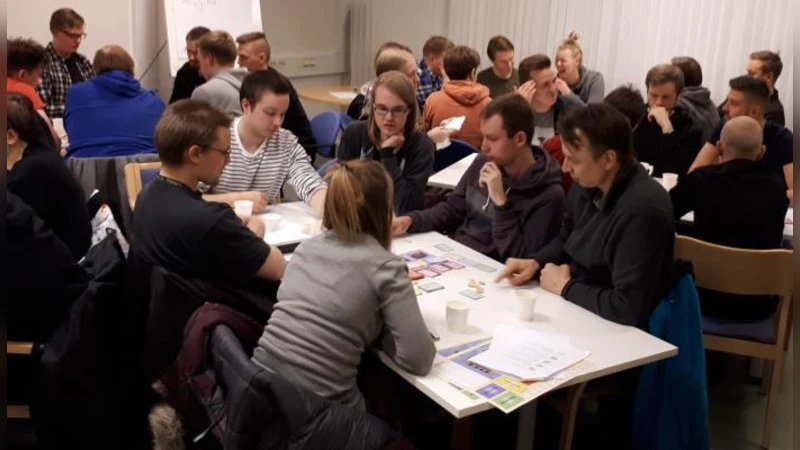
Software Engineering is an engineering discipline but lacks a solid theoretical foundation. One effort in remedying this situation has been the SEMAT Essence specification. Essence consists of a language for modeling Software Engineering (SE) practices and methods and a kernel containing what its authors describe as being elements that are present in every software development project. In practice, it is a method agnostic project management tool for SE Projects. Using the language of the specification, Essence can be used to model any software development method or practice. Thus, the specification can potentially be applied to any software development context, making it a powerful tool. However, due to the manual work and the learning process involved in modeling practices with Essence, its initial adoption can be tasking for development teams. Due to the importance of project management in SE projects, new project management tools such as Essence are valuable, and facilitating their adoption is consequently important. To tackle this issue in the case of Essence, we present a game-based approach to teaching the use Essence. In this paper, we gamify the learning process by means of an innovative board game. The game is empirically validated in a study involving students from the IT faculty of University of Jyv"askyl"a (n=61). Based on the results, we report the effectiveness of the game-based approach to teaching both Essence and SE project work.
💡 Research Summary
Software engineering, despite being an engineering discipline, suffers from a weak theoretical foundation. The SEMAT Essence specification attempts to address this gap by providing a meta‑model that consists of a “kernel” (the essential elements present in every software project) and a “language” (a notation for modeling practices and methods). In theory, Essence can be used to model any development method, making it method‑agnostic and potentially valuable for project management. However, the adoption barrier is high: practitioners must learn a new set of concepts and invest considerable manual effort to create and maintain Essence models.
The authors propose a game‑based learning solution to lower this barrier. They designed an innovative board game that maps the kernel’s alphas (e.g., Requirements, Architecture, Implementation, Test, Deployment), activities, capabilities, and states onto physical cards, a modular board, and event tokens. Players form a simulated project team, draw activity cards each turn, and decide how to advance or regress the alphas. Random “risk” cards introduce realistic complications such as schedule slips, resource shortages, or technical debt, forcing the team to negotiate, re‑allocate resources, and apply mitigation strategies. At the end of the game, each team’s score reflects the completeness of its alphas and the overall project health (budget, schedule, quality), directly linking gameplay outcomes to Essence’s state model.
To evaluate effectiveness, the study involved 61 undergraduate IT students at the University of Jyväskylä. Participants were split into a control group that received traditional lectures and workshops on Essence, and an experimental group that learned through the board game. Pre‑ and post‑test questionnaires measured (1) conceptual understanding of Essence terminology, (2) grasp of relationships among alphas, (3) project‑management knowledge, and (4) learning satisfaction and engagement. Statistical analysis showed that the game group improved significantly more than the control group: average test scores rose by roughly 18 %, with the most pronounced gains in recognizing alpha dependencies and state transitions. Moreover, the game group reported higher satisfaction, greater immersion, and a perception that “learning by playing a realistic project scenario helped me understand the theory.”
The paper’s contribution is twofold. First, it demonstrates that a tangible, collaborative board game can effectively convey a complex, abstract meta‑model such as Essence, reducing cognitive load and fostering experiential learning. Second, it provides empirical evidence that this approach not only boosts theoretical comprehension but also enhances practical project‑management skills, as participants practiced risk handling, resource planning, and team coordination within the game’s constraints.
Limitations include the exclusive use of university students (which may limit generalizability to industry professionals), the short‑term nature of the assessment (no longitudinal data on retention), and the reliance on a physical board game that may be less suitable for remote or distributed learning contexts. The authors suggest future work in three areas: (1) pilot studies with professional software engineers to test industrial relevance, (2) development of a digital version of the game to support online collaboration and scalability, and (3) longitudinal studies to examine the durability of learning gains. They also propose extending the game‑based methodology to other software‑engineering frameworks and methods, potentially reshaping the broader curriculum of software engineering education.
In summary, the study validates that gamifying the introduction of SEMAT Essence through an innovative board game is an effective pedagogical strategy. It lowers entry barriers, improves conceptual mastery, and simultaneously cultivates essential project‑management competencies, offering a promising avenue for both academic instruction and industry training.
Comments & Academic Discussion
Loading comments...
Leave a Comment