Multiuser One-Bit Massive MIMO Precoding Under MPSK Signaling
Most recently, there has been a flurry of research activities on studying how massive MIMO precoding should be designed when the digital-to-analog conversion at the transmitter side is operated by cheap one-bit digital-to-analog converters (DACs). Su…
Authors: Mingjie Shao, Qiang Li, Yatao Liu
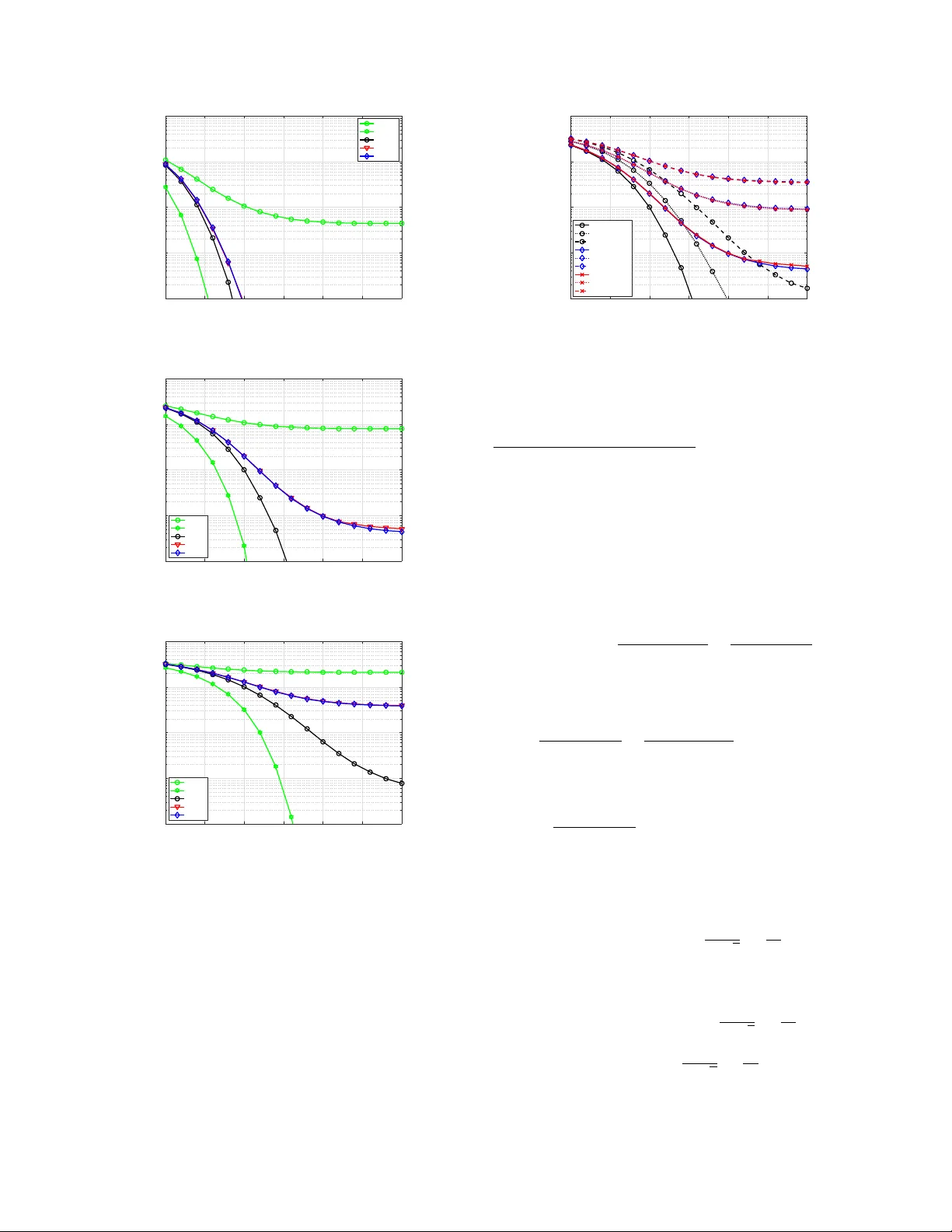
MUL TIUSER ONE-BIT MASSIVE MIMO PRECODING UNDER MPSK SIGNALING Mingjie Shao † , Qiang Li ? , Y atao Liu † and W ing-Kin Ma † † Department of Elec. Eng., The Chinese Uni versity of Hong Kong, Hong K ong SAR, China ? School of Info. & Comm. Eng., Univ ersity of Electronic Science and T echnology of China, China E-mail: † { mjshao, ytliu, wkma } @ee.cuhk.edu.hk, ? lq@uestc.edu.cn ABSTRA CT Most recently , there has been a flurry of research acti vities on study- ing how massi ve MIMO precoding should be designed when the digital-to-analog con version at the transmitter side is operated by cheap one-bit digital-to-analog con verters (D ACs). Such research is motiv ated by the desire to substantially cut down the hardware cost and power consumption of the radio-frequency chain, which is un- affordable in massiv e MIMO if high-resolution DA Cs are still used. One-bit MIMO precoding design problems are much harder to solv e than their high-resolution D A C counterparts. In our previous work, we de veloped a minimum symbol-error probability (SEP) design for one-bit precoding under the multiuser MISO downlink scenario and under quadrature amplitude modulation signaling. Lev eraging on the previous work, this work shows how the minimum SEP design is applied to M -ary phase shift ke ying (MPSK) signaling. Simula- tion results show that our minimum SEP design deliv ers significantly better bit-error rate (BER) performance than the other designs for higher-order PSK such as 8 -PSK and 16 -PSK. As a minor , but use- ful, side contrib ution, we also tackle an MPSK SEP characterization problem which was only intuiti vely treated in the prior arts. Index T erms — Massive MIMO, one-bit precoding, symbol er- ror probability , MPSK signaling 1. INTR ODUCTION Massiv e MIMO is a promising physical-layer technique for future wireless communication systems. It promises high spectral effi- ciency , robustness against channel fading, and many other good properties [1, 2]. Howev er , the benefits of massiv e MIMO come at a price of scaling up the radio-frequency (RF) chains, which have non- negligible hardware costs and are power hungry if high-resolution digital-to-analog conv erters (D A Cs)/analog-to-digital conv erters (ADCs) are employed and good linear dynamic ranges are desired. As such, there has been growing interest in implementing massive MIMO by low-cost and power -ef ficient hardwares, and the use of one-bit ADCs and D A Cs—which can be cheaply implemented and do not require the RF chains to ha ve high linear dynamic ranges—is seen as a promising solution [3, 4]. The use of one-bit ADCs in massi ve MIMO was first considered in uplink problems such as symbol detection and channel estimation from one-bit quantized measurements [5–7]. Recently , the research focus mov es from one-bit ADC uplink to one-bit D A C do wnlink. Mingjie Shao’ s work was supported by Hong Kong PhD Fellowship. Qiang Li’ s work was supported in part by the National Natural Science Foun- dation of China under Grant 61531009, and in part by the Fundamental Re- search Funds for the Central Univ ersities under Grant ZYGX2016J011. The work [8] analyzed the performance of one-bit quantized zero- forcing (ZF) precoding when the ratio of the number of transmit an- tennas to the number of users is high. Later , in [9], it was sho wn that adding random perturbations on the symbols is effecti ve in mitigat- ing the quantization errors. Departing from the notion of designing a linear precoder and then quantizing it, some works proceed with a direct one-bit precoder design approach. In [10] and [11], mini- mum mean square error (MMSE)-based one-bit precoding schemes were proposed to minimize the distance between the desired sym- bols and the transmit symbols for single-carrier and OFDM systems, respectiv ely . Some other designs exploit the underlying symbol con- stellation structures for enhancing the symbol-error probability per- formance. The work [12] dealt with the M -ary phase shift ke ying (MPSK) case, and dev eloped a precoding solution based on linear program (LP) relaxation; see also [13] and [14] which described similar ideas in the contexts of constructive interference and con- stant en velope precoding, respectiv ely . In our recent work [15], we considered a minimum symbol-error probability (SEP) design for the quadratic amplitude modulation (QAM) case. There, we developed a non-con vex optimization approach to handle the very difficult na- ture of the one-bit precoding problem, namely , the binary constraint arising from the restriction of one-bit signal transmission. Numerical results showed promising performance with our design. The goal of this paper is to apply our non-conv ex optimization approach to the MPSK case. The details with the approach we take on will become clear later as we proceed to the main development. As will be shown numerically , the application of our approach to the MPSK case sho ws superior bit-error rate (BER) performance com- pared to the existing (and very recently developed) one-bit precoder designs for MPSK. Also, as a minor , but useful, side contribution, we address an MPSK SEP characterization problem which w as intu- tiv ely treated in the previous studies. Again, this will become clear as we describe the problem in the next section. 2. PR OBLEM FORMULA TION Our one-bit massive MIMO precoding problem is described as fol- lows. Our scenario of interest is that of a multiuser downlink, where a base station (BS), equipped with N transmit antennas, transmits information signals to K single-antenna users in a simultaneous and unicast fashion. W e follo w the widely-used system model in this context, where the relationship of the transmitted and received sig- nals is modeled as y i,t = h T i x t + η i,t , i = 1 , . . . , K, t = 1 , . . . , T . (1) Here, x t ∈ C N is the multi-antenna signal transmitted by the BS at symbol time t ; y i,t is the signal recei ved by user i at symbol time t ; h i ∈ C N is the channel associated with user i ; η i,t is noise and is assumed to be circular complex Gaussian with mean zero and vari- ance σ 2 ; T is the length of the transmission block. The BS employs a massi ve antenna array , implemented by one-bit D A Cs. This leads to the restriction x t ∈ X , ± q P 2 N ± q P 2 N j N , where P is the total transmit power . Our precoding problem is to design { x t } t such that every user will receive its own symbol stream, with the symbol-error probabil- ity being as small as possible. T o put into context, let { s i,t } t be the symbol stream for user i . In this work, we assume the MPSK constellation where s i,t ∈ S , { s | s = e j n 2 π M , n = 0 , . . . , M − 1 } . (2) Also, let dec : C → S be the MPSK decision function, i.e., dec( y ) = e j ˆ n 2 π M where ˆ n ∈ { 0 , . . . , M − 1 } is such that the phase angle of y lies in [ 2 π ˆ n M − π M , 2 π ˆ n M + π M ] . At the users’ side, each user detects their symbol stream by ˆ s i,t = dec( y i,t ) . Let SEP i,t = Pr( ˆ s i,t 6 = s i,t | s i,t ) (3) denote the symbol error probability (SEP) of detecting s i,t condi- tioned on s i,t . The problem is to find an appropriate x t such that all SEP i,t ’ s will be as small as possible. Specifically , we consider a precoding design problem min x t max i =1 ,...,K SEP i,t s . t . x t ∈ X , (4) where we seek to minimize the worst user’ s SEP under the one-bit constraint. W e will focus on how problem (4) is tackled. But before we proceed to our main dev elopment, we should shed some light on the intuitiv e side of the problem. The SEP for MPSK symbols, in its exact form, does not admit a simple expression in general. But suppose that we impose a restriction on x t , namely , h T i x t = α i,t s i,t , for all i, (5) for some α i,t > 0 . Then, it is well-known in the classical digital communication literature that the SEP admits a simple upper-bound approximation SEP i,t ≤ 2 Q α i,t σ / √ 2 sin π M , (6) where Q ( x ) = R ∞ x 1 √ 2 π e − z 2 / 2 dz ; see [16, Eqn. (8.26)]. By ap- plying the abov e approximation to problem (4), one can readily see that the corresponding objective function can be reduced to max i =1 ,...,K − α i,t —which is easy to handle. Unfortunately , while the restriction (5) can be easily satisfied by applying ZF when we do not ha ve the one-bit constraint, it is not clear whether and ho w (5) may be enforced in the presence of the one-bit constraint. This will lead us to study an SEP approximation that does not require (5). W e should also take this opportunity to mention related works. It is belie ved in [12, 13, 17] that the SEP can be reduced by increasing the so-called safety margin, which is gi ven by α i,t = R { h T i x s ∗ i,t } − | I { h T i x s ∗ i,t }| cot π M . (7) Readers are referred to the aforementioned references for the intu- itions that led to the safety margin. Note that (7) does not require (5). The approximation (7) is simple and greatly simplifies the sub- sequent MIMO precoding design, as shown in the aforementioned references. Howe ver , up to this point, there has not been a study that mathematically underlies how sound the approximation (7) is. 3. THE PR OPOSED MINIMUM SEP DESIGN 3.1. SEP Analysis W e first address the SEP characterization problem described in the last section. The problem boils down to a basic probability problem as follows: W e ha ve an observ ation w = z + η , (8) where z ∈ C can take any value and does not necessarily lie in the symbol constellation S in (2); η is circular complex Gaussian with mean zero and variance σ 2 . The problem is to find, through analyses, a tractable approximation of the probability Pr(dec( w ) 6 = 1) . W e start our analysis with considering a perturbed version of (8) ˆ w = ˆ z + η , ˆ z = z + ∆ z , (9) where ∆ z = −| I { z }| cot( π/ M ) − j I { z } . One can verify that ˆ z = α, where α = R { z } − | I { z }| cot π M . W e should point out that the above α takes the same form as the safe margin in (7). Fig. 1 illustrates how z and ˆ z are related on the Cartesian plane. W e have the follo wing result. Proposition 1 It holds that Pr(dec( w ) 6 = 1) ≤ Pr(dec( ˆ w ) 6 = 1) (10) Also, we have Pr(dec( ˆ w ) 6 = 1) ≤ 2 Q α σ / √ 2 sin π M (11) The proof of Proposition 1 is shown in the Appendix. Fig. 1 : Illustration of ˆ z . As the direct consequence of applying Proposition 1 to our MIMO precoding problem, we hav e the following result. Corollary 1 The SEP (3) of the one-bit precoding pr oblem in the last section admits an upper-bound appr oximation SEP i,t ≤ 2 Q α i,t σ / √ 2 sin π M wher e α i,t is defined as the safety mar gin in (7) . Corollary 1 shows an interesting revelation: the safety margin used in prior work is sound in that it leads to an upper-bound approxima- tion of the SEP . 3.2. Reformulation, and the Algorithm W e are now ready to attack the one-bit precoding design problem in (4). By applying Corollary 1 to problem (4), and using the mono- tonicity of Q , we obtain an approximation of problem (4) as follows max x t min i =1 ,...,K α i,t s.t. x t ∈ X , (12) where α i,t is given in (7). For the sak e of notational bre vity , let us re- mov e the subscript “ t ” in our subsequent expressions. By complex- to-real con version, we reformulate problem (12) as min ¯ x max i =1 ,...,K max { u T i ¯ x , w T i ¯ x } s.t. ¯ x ∈ X < , (13) where X < , n x ∈ R 2 N | x i = ± p P / 2 N , i = 1 , . . . , 2 N o , ¯ x = [ <{ x } T , ={ x } T ] T , b i = [ <{ s ∗ i h T i } , − ={ s ∗ i h T i } ] T , r i = cot π M [ ={ s ∗ i h T i } , <{ s ∗ i h T i } ] T , u i = − b i + r i , w i = − b i − r i . Problem (13) is a non-conv ex non-smooth optimization prob- lem. W e tackle it by applying a most recently proposed technique by us [15]. The technique has three steps. Step 1: Smoothing the objective function W e apply smooth approximation to the objecti ve function of problem (13), thereby circumventing non-smoothness of the prob- lem. Specifically , we replace the (non-smooth) point-wise maximum function by a (smooth) log-sum-exponential function. The resulting approximate problem of problem (13) is giv en by min ¯ x ∈X < f ( ¯ x ) , µ log K X i =1 e u T i ¯ x µ + e w T i ¯ x µ (14) where µ > 0 is a pre-specified constant that controls the smoothing accuracy . In particular, the approximation is tight as µ → 0 . Step 2: Binary constraint r eformulation W e apply a reformulation that will turn the original problem, which is discrete, to a continuous problem. It can be shown that the following equi valence holds: x ∈ {− 1 , +1 } n ⇐ ⇒ ∃ v : − 1 ≤ x ≤ 1 , k v k 2 2 ≤ n, x T v = n. Lev eraging the above equiv alence, we consider the following refor- mulation of problem (14) min ¯ x , v F λ ( ¯ x , v ) , f ( ¯ x ) + λ ( P − ¯ x T v ) s.t. − r P 2 N 1 ≤ ¯ x ≤ r P 2 N 1 , || v || 2 2 ≤ P, (15) where λ > 0 is a penalty parameter for enforcing ¯ x T v = P . It can be shown that for a sufficiently large λ , problem (15) is equiv alent to problem (14); see [15, Lemma 1]. Step 3: Alternating minimization W e apply alternating minimization to problem (15). Fixing ¯ x , the minimization with respect to (w .r .t.) v has a closed form v = ( √ P ¯ x / k ¯ x k 2 , for ¯ x 6 = 0 , any feasible v , otherwise . (16) Fixing v , the minimization w .r .t. ¯ x is a smooth con vex optimiza- tion problem with (simple) box constraints. W e apply an acceler- ated projected gradient (APG) algorithm [18, 19] to solve the prob- lem. Readers are referred to [15] for the detailed implementations of APG. Algorithm 1 summarizes the ov erall procedure of handling problem (13). Algorithm 1 Fast ALternating Minimization (F ALM) for (13) 1: Initialize λ , δ > 1 , µ , ¯ x 0 = v 0 = 0 and iteration index k = 0 2: repeat 3: Fix v = v k in (15) and update ¯ x k +1 by the APG algorithm; 4: Update v k +1 according to (16) with ¯ x = ¯ x k +1 ; 5: Update λ = λ × δ every M iterations; 6: k = k + 1 ; 7: until λ is greater than some threshold λ > λ 0 . 4. SIMULA TION RESUL TS AND CONCLUSION W e evaluate the performance of our algorithm using Monte-Carlo simulations. For con venience, we will name our algorithm (Algo- rithm 1) “F ALM”. W e benchmark it with the following algorithms: zero-forcing (ZF) with infinite-resolution DA Cs, which will be named “ZF”; ZF followed by one-bit quantization, which will be named “ZF-OB”; the SQUID algorithm which is based on the MMSE design [10]; and the LP relaxation algorithm for maximum safety margin (MSM) design [12], which will be named “MSM. ” A number of 1 , 000 channel realizations were used to test F ALM and the benchmarked algorithms. Each channel realization was ran- domly generated, following the standard i.i.d. circular complex Gaussian distrib ution. The transmission block length is T = 100 . The total transmit power is P = 1 . The number of transmit antennas is N = 128 , and the number of users is K = 24 . W e should also mention the parameter settings of F ALM. The smoothing parameter is µ = 0 . 01 . The penalty parameter λ is ini- tialized as 0 . 01 , and δ is set as δ = 10 . Algorithm 1 stops when λ > 100 , i.e. we update λ for 5 times. Figs. 2–4 show the BER plots of the various algorithms under QPSK, 8 -PSK and 16 -PSK, respecti vely . W e can see that F ALM outperforms the other one-bit precoding algorithms, and the perfor- mance gaps are significant for 8 -PSK and 16 -PSK. In fact, for 8 -PSK and 16 -PSK, SQUID and MSM are seen to suffer from error floor ef- fects. In comparison, F ALM does not have the same problem. Fig. 5 evaluates how the BER performance of F ALM, SQUID and MSM scales with the number of users. The number of transmit antennas is again N = 128 ; the MPSK constellation size is fixed at 8 ; the number of users is varied from K = 24 to K = 40 . W e once again see that F ALM outperforms SQUID and MSM. T o conclude, we ha ve dev eloped a one-bit precoding algorithm for multiuser MISO downlink and under MPSK symbol constella- tions. The algorithm is based on a minimum symbol-error probabil- ity formulation, and it applies a continuous non-con vex optimization 0 5 10 15 20 25 30 (P/ σ n 2 ) / (dB) 10 -4 10 -3 10 -2 10 -1 10 0 Bit Error Rate (BER) ZF - OB ZF FALM MSM SQUID Fig. 2 : A verage BER performance v ersus P /σ 2 n ; QPSK. 0 5 10 15 20 25 30 (P/ σ n 2 ) / (dB) 10 -4 10 -3 10 -2 10 -1 10 0 Bit Error Rate (BER) OB ZF ZF FALM MSM SQUID Fig. 3 : A verage BER performance v ersus P /σ 2 n ; 8 -PSK. 0 5 10 15 20 25 30 (P/ σ n 2 ) / (dB) 10 -4 10 -3 10 -2 10 -1 10 0 Bit Error Rate (BER) OB ZF ZF FALM MSM SQUID Fig. 4 : A verage BER performance v ersus P /σ 2 n ; 16 -PSK. methodology to tackle the very difficult binary constraint in one- bit precoding. Numerical results show that the proposed algorithm yields superior BER performance. 5. APPENDIX Let us first prove the inequality (10). It suffices to show that for any giv en noise realization η , the follo wing implication holds true: dec ( ˆ w ) = 1 = ⇒ dec ( w ) = 1 . (17) In words, if the noisy reception ˆ w can be correctly decoded as 1 , then so does w . T o this end, we notice that the left-hand side of (17) 0 5 10 15 20 25 30 (P/ σ n 2 ) / (dB) 10 -4 10 -3 10 -2 10 -1 10 0 Bit Error Rate (BER) FALM (K=24) FALM (K=32) FALM (K=40) SQUID (K=24) SQUID (K=32) SQUID (K=40) MSM(K=24) MSM (K=32) MSM (K=40) Fig. 5 : A verage BER performance for different No. of users; 8 -PSK. is equiv alent to <{ z } − |={ z }| cot( π/ M ) + <{ η } ≥ 0 , (18a) ={ η } <{ z } − |={ z }| cot( π/ M ) + <{ η } ∈ [ − tan( π/ M ) , tan( π / M )] . (18b) From (18a), we hav e <{ z } + <{ η } ≥ |={ z }| cot( π / M ) ≥ 0 , (19) and from (18b), we hav e ={ η } ≥ − ( <{ z } + <{ η } ) tan( π / M ) + |={ z }| , ={ η } ≤ ( <{ z } + <{ η } ) tan( π / M ) − |={ z }| . (20) The first inequality in (20) implies − tan( π / M ) ≤ ={ η } − |={ z }| <{ z } + <{ η } ≤ ={ η } + ={ z } <{ z } + <{ η } , (21) where the second inequality in (21) is due to ={ η } − |={ z }| ≤ ={ η } + ={ z } and (19). Similarly , from the second inequality in (20), we hav e ={ η } + ={ z } <{ z } + <{ η } ≤ ={ η } + |={ z }| <{ z } + <{ η } ≤ tan( π / M ) . (22) Combining (19), (21) and (22), we get <{ z } + <{ η } ≥ 0 , (23) ={ z } + ={ η } <{ z } + <{ η } ∈ [ − tan( π/ M ) , tan( π / M )] , (24) which means that w = z + η lies in the correct decision region of symbol 1 , i.e, dec ( w ) = 1 . Next, we prove the inequality (11). If α ≥ 0 , the upper bound (6) directly holds from the well-known union bound for MPSK [16]: Pr( dec ( ˆ w ) 6 = 1) ≤ 2 Q α σ / √ 2 sin π M . If α < 0 , we can apply the similar techniques as in the deriv ation of upper bound [16] to obtain Pr( dec ( ˆ w ) 6 = 1) ≤ 2 1 − Q − α σ / √ 2 sin π M =2 Q α σ / √ 2 sin π M , where the equality is due to the fact Q ( x ) = 1 − Q ( − x ) . This completes the proof. 6. REFERENCES [1] F . Rusek, D. Persson, B. K. Lau, E. G. Larsson, T . L. Marzetta, O. Edfors, and F . T ufvesson, “Scaling up MIMO: Opportuni- ties and challenges with very large arrays, ” IEEE Signal Pro- cess. Mag. , v ol. 30, no. 1, pp. 40–60, Jan. 2013. [2] L. Lu, G. Y . Li, A. L. Swindlehurst, A. Ashikhmin, and R. Zhang, “ An overvie w of massiv e MIMO: Benefits and chal- lenges, ” IEEE J. Sel. T opics Signal Process. , vol. 8, no. 5, pp. 742–758, Oct. 2014. [3] C. Risi, D. Persson, and E. G. Larsson, “Massive MIMO with 1-bit ADC, ” arXiv pr eprint:1404.7736 , 2014. [4] J. Guerreiro, R. Dinis, and P . Montezuma, “Use of 1-bit digital- to-analogue conv erters in massi ve MIMO systems, ” Electr on- ics Letters , v ol. 52, no. 9, pp. 778–779, 2016. [5] J. Choi, D. J. Lov e, D. R. Bro wn III, and M. Boutin, “Quan- tized distributed reception for MIMO wireless systems using spatial multiplexing. ” IEEE T rans. Signal Pr ocess. , vol. 63, no. 13, pp. 3537–3548, 2015. [6] J. Choi, J. Mo, and R. W . Heath, “Near maximum-likelihood detector and channel estimator for uplink multiuser massive MIMO systems with one-bit ADCs, ” IEEE T rans. Commun. , vol. 64, no. 5, pp. 2005–2018, 2016. [7] C. Studer and G. Durisi, “Quantized massiv e MU-MIMO- OFDM uplink, ” IEEE T rans. Commun. , vol. 64, no. 6, pp. 2387–2399, 2016. [8] A. K. Saxena, I. Fijalko w , A. Mezghani, and A. L. Swindle- hurst, “ Analysis of one-bit quantized ZF precoding for the mul- tiuser massive mimo downlink, ” in Conf. Record 50th Asilomar Conf. Signals, Systems, Computer s . IEEE, 2016, pp. 758–762. [9] A. Swindlehurst, A. Saxena, A. Mezghani, and I. Fijalko w , “Minimum probability-of-error perturbation precoding for the one-bit massiv e MIMO downlink, ” in Pr oc. IEEE Int. Conf. Acous., Speech, Signal Pr ocess. (ICASSP) , Mar . 2017, pp. 6483–6487. [10] S. Jacobsson, G. Durisi, M. Coldrey , T . Goldstein, and C. Studer, “Quantized precoding for massiv e MU-MIMO, ” IEEE T rans. Commun. , v ol. 65, no. 11, pp. 4670–4684, Nov 2017. [11] S. Jacobsson, O. Castaeda, C. Jeon, G. Durisi, and C. Studer , “Nonlinear precoding for phase-quantized constant-env elope massiv e MU-MIMO-OFDM, ” in 25th Int. Conf. T elecommun. (ICT) , June 2018, pp. 367–372. [12] H. Jedda, A. Mezghani, J. A. Nossek, and A. L. Swindlehurst, “Massiv e MIMO downlink 1-bit precoding with linear pro- gramming for PSK signaling, ” in 2017 IEEE 18th Int. W ork- shop Signal Pr ocess. Advances W ir eless Commun. (SP A WC) , July 2017, pp. 1–5. [13] C. Masouros and G. Zheng, “Exploiting kno wn interference as green signal power for downlink beamforming optimization, ” IEEE T rans. Signal Pr ocess. , vol. 63, no. 14, pp. 3628–3640, 2015. [14] P . V . Amadori and C. Masouros, “Constant en velope pre- coding by interference exploitation in phase shift keying- modulated multiuser transmission, ” IEEE T rans. W ir eless Commun. , vol. 16, no. 1, pp. 538–550, 2017. [15] M. Shao, Q. Li, and W .-K. Ma, “One-bit massiv e MIMO precoding via a minimum symbol-error probability design, ” in Pr oc. IEEE Int. Conf. Acous., Speech, Signal Process. (ICASSP) , 2018. [16] M. K. Simon and M.-S. Alouini, Digital communication over fading channels . John W iley & Sons, 2005, v ol. 95. [17] A. Swindlehurst, H. Jedda, and I. Fijalko w , “Reduced dimen- sion minimum BER PSK precoding for constrained transmit signals in massiv e MIMO, ” in Pr oc. IEEE Int. Conf. Acous., Speech, Signal Pr ocess. (ICASSP) , 2018. [18] Y . Nesterov , Introductory Lectures on Conve x Optimization . Springer Science & Business Media, 2004, vol. 87. [19] A. Beck and M. T eboulle, “ A f ast iterative shrinkage- thresholding algorithm for linear in verse problems, ” SIAM J. Imag. Sci. , v ol. 2, no. 1, pp. 183–202, 2009. [20] M. Grant and S. Boyd, “CVX: Matlab software for disciplined con ve x programming, version 2.1, ” http://cvxr .com/cvx, Mar . 2014. [21] G. Y uan and B. Ghanem, “Binary optimization via math- ematical programming with equilibrium constraints, ” arXiv pr eprint:1608.04425 , Sep. 2016.
Original Paper
Loading high-quality paper...
Comments & Academic Discussion
Loading comments...
Leave a Comment