Unpublished opening lecture for the course on the theory of relativity in Argentina, 1925
Honorable Rector, Honorable Professors, and Students of this University: In these times of political and economic struggle and nationalistic fragmentation, it is a particular joy for me to see people
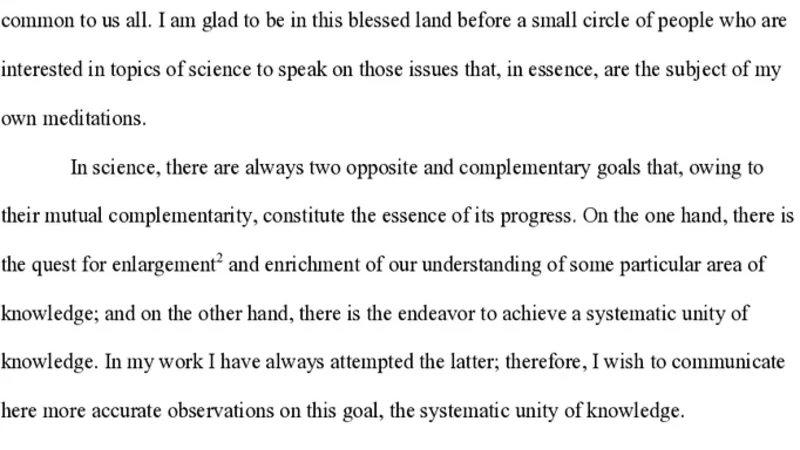
Honorable Rector, Honorable Professors, and Students of this University: In these times of political and economic struggle and nationalistic fragmentation, it is a particular joy for me to see people assembling here to give their attention exclusively to the highest values that are common to us all. I am glad to be in this blessed land before a small circle of people who are interested in topics of science to speak on those issues that, in essence, are the subject of my own meditations.. [abridged].
💡 Research Summary
Albert Einstein’s unpublished opening lecture for a 1925 course on the theory of relativity in Argentina is a remarkable blend of scientific exposition, philosophical reflection, and socio‑political commentary. Addressed to the rector, faculty, and students, the speech begins with a solemn acknowledgment of the turbulent political and economic climate of the time, noting the rise of nationalism and fragmentation that plagued the nation. Einstein expresses gratitude for the opportunity to discuss “the highest values common to us all,” positioning science as a universal refuge amid crisis.
The core of the lecture is a clear, step‑by‑step presentation of the two pillars of special relativity. First, Einstein restates the invariance of the speed of light in vacuum, emphasizing that this constant holds regardless of the observer’s state of motion. Second, he reiterates the principle of relativity for all inertial frames, asserting that the laws of physics retain the same form in any such frame. From these postulates he derives time dilation, length contraction, the relativity of simultaneity, and the mass‑energy equivalence formula E = mc². He repeatedly stresses that “time is not absolute,” challenging everyday intuition and underscoring the radical shift from Newtonian absolute space and time.
Transitioning to general relativity, Einstein introduces the equivalence principle— the indistinguishability of gravitational acceleration from inertial acceleration— as the conceptual bridge to a geometric description of gravitation. He explains that mass‑energy tells spacetime how to curve, and curved spacetime tells matter how to move, thereby recasting gravity as geometry rather than a force. To ground this abstract idea, he cites the 1919 solar eclipse observations, where starlight was deflected by the Sun’s gravitational field, providing empirical confirmation of spacetime curvature.
Beyond the technical content, Einstein devotes a substantial portion of the lecture to the methodology of science. He outlines the cycle of hypothesis formation, mathematical modeling, and experimental verification, stressing that scientific knowledge is provisional, continuously refined through testing. This methodological reminder serves as a warning against the politicization of science, a concern especially relevant in a period when scientific ideas could be co‑opted by nationalist agendas.
The philosophical dimension of the lecture is equally pronounced. Einstein argues that relativity overturns the notion of an absolute, immutable reality, compelling humanity to adopt a “cosmic perspective” in which our concepts of space, time, and causality are relational. He claims that this shift fosters humility—recognizing the limits of human perception—while simultaneously opening new possibilities for understanding the universe. By linking the relativistic worldview to ethical considerations, he suggests that science should nurture a sense of shared humanity and responsibility, rather than serve as a tool for division.
Education occupies a central role in his vision. Einstein urges the young scholars present to cultivate critical thinking, embrace experimental verification, and maintain an open forum for debate. He envisions the university as a “free arena of thought,” where scientific inquiry coexists with the humanities, allowing each to inform the other. This interdisciplinary aspiration reflects his belief that scientific progress must be accompanied by moral and cultural development.
In concluding remarks, Einstein reiterates his hope that the pursuit of scientific truth will help the community discover universal values, uphold human dignity, and promote peace. He frames the lecture not merely as an introduction to relativity but as a call to integrate scientific rigor with ethical purpose, especially in times of societal upheaval. The document therefore offers a rare glimpse into Einstein’s pedagogical style, his commitment to the social relevance of physics, and his enduring conviction that the advancement of knowledge can serve as a unifying force across nations.
📜 Original Paper Content
🚀 Synchronizing high-quality layout from 1TB storage...