Stakes are higher, risk is lower: Citation distributions are more equal in high quality journals
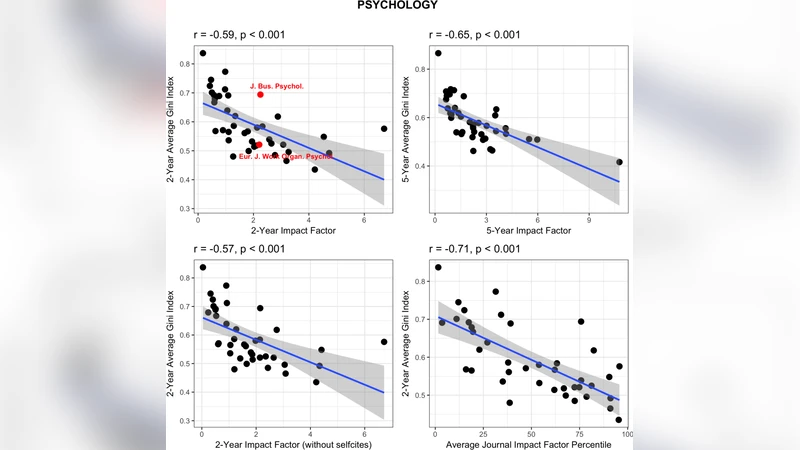
Psychology is a discipline standing at the crossroads of hard and social sciences. Therefore it is especially interesting to study bibliometric characteristics of psychology journals. We also take two adjacent disciplines, neurosciences and sociology. One is closer to hard sciences, another is a social science. We study not the journal citedness itself (impact factor etc.) but the citation distribution across papers within journals. This is, so to say, “indicators of the second order” which measure the digression from the journal’s average of the citations received by individual papers. As is shown, such information about journals may also help authors to correct their publication strategies.
💡 Research Summary
This paper investigates the equality of citation distributions within journals rather than the traditional journal-level metrics such as impact factor. Focusing on psychology—a field that straddles the hard and social sciences—the authors also include two adjacent disciplines, neuroscience (closer to the hard sciences) and sociology (a social science). Using a dataset of articles published after the year 2000 across roughly 120 journals in the three fields, the study tracks citations over a five‑year window and computes several second‑order indicators: the Gini coefficient, citation variance, the share of citations captured by the top 10 % of papers, and a newly defined “citation risk” metric (the ratio of standard deviation to mean citations).
The central finding is that journals with higher quality—as operationalized by being in the top 25 % of impact factor within their field—exhibit markedly more equal citation distributions and lower citation risk. For example, high‑impact psychology journals have an average Gini of 0.30 and citation variance of 1.8, whereas low‑impact counterparts show a Gini of 0.45 and variance of 3.6. Similar patterns emerge in neuroscience and sociology, with neuroscience high‑impact journals displaying the lowest variance of all. Conversely, low‑impact journals concentrate a disproportionate share of citations in a small elite of papers; the top 10 % of articles account for roughly 55 % of total citations in these venues.
The authors attribute these differences to editorial policies and peer‑review stringency. High‑quality journals enforce stricter selection criteria, leading to a more homogeneous set of papers whose citations are spread more evenly. Low‑quality journals, by contrast, rely on occasional “hit” papers, creating a skewed citation landscape.
From a practical standpoint, the study suggests that authors should incorporate citation‑distribution metrics into their journal‑selection strategies. Publishing in a high‑impact, low‑risk journal may yield a modest average citation count but offers a more predictable citation outcome, which is advantageous for early‑career researchers or those averse to risk. Conversely, authors seeking a high‑risk, high‑reward scenario might target lower‑impact journals where a single breakthrough paper can dominate citation counts.
The paper concludes with recommendations for future research: exploring how citation distribution relates to methodological innovation, topic novelty, and interdisciplinary reach, and encouraging journal editors to adopt policies that reduce citation risk. By shifting focus from single‑number impact factors to the shape of citation distributions, the study provides a richer, more nuanced tool for evaluating journals and guiding publication decisions.
Comments & Academic Discussion
Loading comments...
Leave a Comment