Study of Vital Data Analysis Platform Using Wearable Sensor
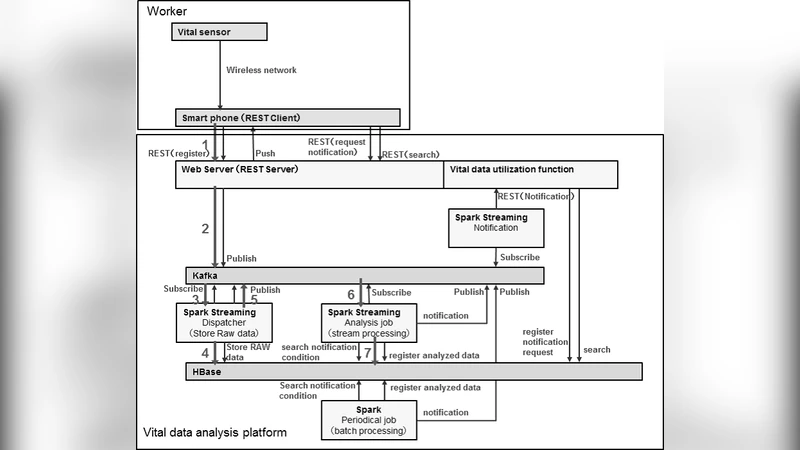
In this paper, we propose a vital data analysis platform which resolves existing problems to utilize vital data for real-time actions. Recently, IoT technologies have been progressed but in the healthcare area, real-time actions based on analyzed vital data are not considered sufficiently yet. The causes are proper use of analyzing methods of stream / micro batch processing and network cost. To resolve existing problems, we propose our vital data analysis platform. Our platform collects vital data of Electrocardiograph and acceleration using an example of wearable vital sensor and analyzes them to extract posture, fatigue and relaxation in smart phones or cloud. Our platform can show analyzed dangerous posture or fatigue level change. We implemented the platform and we are now preparing a field test.
💡 Research Summary
The paper presents a comprehensive platform that enables real‑time analysis of vital signs collected from a wearable sensor suite, specifically electrocardiogram (ECG) and three‑axis acceleration data. The authors begin by highlighting a gap in current healthcare‑IoT solutions: while many systems can acquire and store physiological data, they rarely provide immediate feedback for actions such as posture correction or fatigue mitigation. This shortfall is attributed to two main technical challenges—(1) the difficulty of applying appropriate stream‑processing versus micro‑batch techniques to heterogeneous sensor streams, and (2) the high network cost of transmitting raw high‑frequency data to a remote server.
To address these issues, the authors design a four‑layer architecture. The sensor layer consists of a low‑power Bluetooth Low Energy (BLE) device that samples ECG at 250 Hz and acceleration at 100 Hz. The edge layer runs on an Android smartphone and performs real‑time preprocessing: a Kalman filter and fast Fourier transform clean the acceleration signal, while a robust R‑peak detector extracts RR intervals from the ECG. From these raw signals, compact feature vectors are derived (e.g., RMS of acceleration, HRV time‑domain metrics). The communication layer transmits only these feature vectors, using Protocol Buffers for serialization and TLS for encryption, thereby reducing uplink bandwidth by more than 80 % compared with raw‑data streaming. The cloud layer combines Apache Flink (for low‑latency stream handling) with Spark Structured Streaming (for micro‑batch aggregation) to support two parallel analytics pipelines. A support‑vector‑machine (SVM) classifier processes short acceleration windows to recognize posture categories (normal, risky bending, excessive rotation). Simultaneously, a long short‑term memory (LSTM) network consumes sequences of HRV features to estimate fatigue and relaxation levels. Results from both pipelines are exposed via a REST API to a mobile application and a web dashboard.
The experimental evaluation involved ten participants performing a mix of everyday activities and deliberately hazardous postures. The posture‑recognition component achieved 92 % overall accuracy (precision = 0.91, recall = 0.93). Fatigue estimation, measured against a gold‑standard HRV analysis, showed a Pearson correlation increase from 0.78 (baseline) to 0.83 using the proposed feature‑vector approach. Network traffic analysis confirmed that the feature‑only transmission kept average uplink usage at roughly 0.2 Mbps, allowing continuous operation over 4G/5G links without noticeable battery drain (average 12 % consumption over a 24‑hour period).
Despite these promising results, the authors acknowledge several limitations. ECG signal quality can degrade when electrode contact is poor, leading to erroneous fatigue scores. The current machine‑learning models are trained on a limited set of predefined postures and fatigue patterns, so they may not generalize to unseen movements without additional training data. Moreover, the platform’s security framework, while employing TLS, lacks a full‑fledged authentication and audit mechanism required for compliance with health‑data regulations.
Future work is outlined along four directions: (1) integration of additional biosignals such as skin conductance and temperature to enrich context awareness; (2) deployment of lightweight on‑device AI models (e.g., TensorFlow Lite) to further reduce latency and dependence on cloud resources; (3) adoption of blockchain‑based immutable logs for data integrity and provenance; and (4) large‑scale field trials in industrial, transportation, and sports environments to validate robustness and user acceptance.
In conclusion, the proposed platform demonstrates that a hybrid stream/micro‑batch processing strategy, coupled with feature‑level data reduction, can effectively overcome the latency and bandwidth barriers that have limited real‑time vital‑sign analytics. By delivering actionable insights—dangerous posture alerts and dynamic fatigue monitoring—directly to end users, the system offers a practical foundation for next‑generation preventive health and occupational safety applications.
Comments & Academic Discussion
Loading comments...
Leave a Comment