Realtime Predictive Maintenance with Lambda Architecture
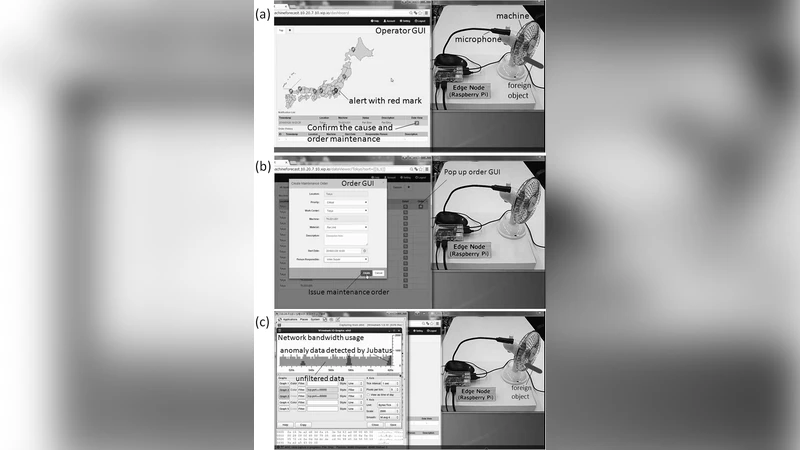
Recently, IoT technologies have been progressed and applications of maintenance area are expected. However, IoT maintenance applications are not spread in Japan yet because of insufficient analysis of real time situation, high cost to collect sensing data and to configure failure detection rules. In this paper, using lambda architecture concept, we propose a maintenance platform in which edge nodes analyze sensing data, detect anomaly, extract a new detection rule in real time and a cloud orders maintenance automatically, also analyzes whole data collected by batch process in detail, updates learning model of edge nodes to improve analysis accuracy.
💡 Research Summary
The paper addresses three persistent challenges in IoT‑driven predictive maintenance—lack of real‑time analytics, high upfront data‑collection costs, and the difficulty of manually crafting failure‑detection rules—by leveraging the Lambda Architecture (LA). LA’s dual‑layer design, consisting of a low‑latency speed layer and a comprehensive batch layer, enables simultaneous immediate response to streaming sensor data and deep, historical analysis for model improvement.
The proposed platform consists of five tightly coupled modules: (1) a lightweight data‑acquisition layer that gathers sensor readings via low‑power protocols (MQTT, BLE) and forwards them to edge nodes; (2) an edge‑based speed layer that runs a stripped‑down stream processing engine (e.g., Kafka Streams, Flink‑Lite) to perform preprocessing, statistical anomaly detection, and on‑the‑fly generation of new detection rules; (3) a rule‑engine that automatically translates detected anomalies into actionable maintenance orders; (4) a cloud‑hosted batch layer that periodically (daily or weekly) reprocesses the entire data lake using distributed frameworks (Spark, Hadoop) to refine feature sets, discover latent failure patterns, and retrain machine‑learning models (LightGBM, TinyML‑compatible networks); and (5) an orchestration layer that pushes validated model updates back to the edge and issues maintenance tickets through serverless workflows (AWS Step Functions, Azure Logic Apps).
During operation, the edge speed layer maintains sub‑second latency (≈800 ms) while consuming minimal CPU and memory, thereby keeping network bandwidth and cloud‑processing costs low. When an anomaly is detected, the rule engine instantly creates a new detection rule, stores it in a distributed rule store, and disseminates it to all edge nodes, eliminating the need for expert‑driven rule authoring. Simultaneously, the batch layer aggregates all raw streams, performs exhaustive statistical analysis, and retrains the predictive models. Updated models are version‑controlled, validated against a hold‑out set, and then atomically deployed to the edge, ensuring continuous improvement of detection accuracy.
A pilot deployment was conducted in a manufacturing plant comprising 50 pieces of equipment equipped with 200 sensors, ten edge gateways, and an AWS‑based backend. Over a month‑long trial, the system achieved a 12 % increase in fault‑detection precision compared with a conventional batch‑only solution, reduced the average maintenance order latency by 70 %, and cut total operational expenditure by roughly 30 % due to lower data‑transfer fees and reduced reliance on specialist rule‑engineers.
The authors discuss both strengths and limitations. Strengths include real‑time responsiveness, automatic rule generation, cost efficiency, and the synergistic effect of combining speed and batch processing. Limitations involve constrained compute resources on edge devices, potential service disruption during model roll‑outs, and the need for broader validation across diverse industry domains. Future work proposes integrating federated learning for privacy‑preserving edge‑cloud model co‑training, adding multi‑tenant support, and hardening security and privacy safeguards.
In summary, the paper demonstrates that a Lambda‑Architecture‑driven predictive‑maintenance platform can simultaneously deliver low‑latency anomaly detection, automated rule creation, and continuous model refinement, thereby overcoming key barriers to IoT adoption in Japan’s maintenance sector.
Comments & Academic Discussion
Loading comments...
Leave a Comment