Study of shoplifting prevention using image analysis and ERP check
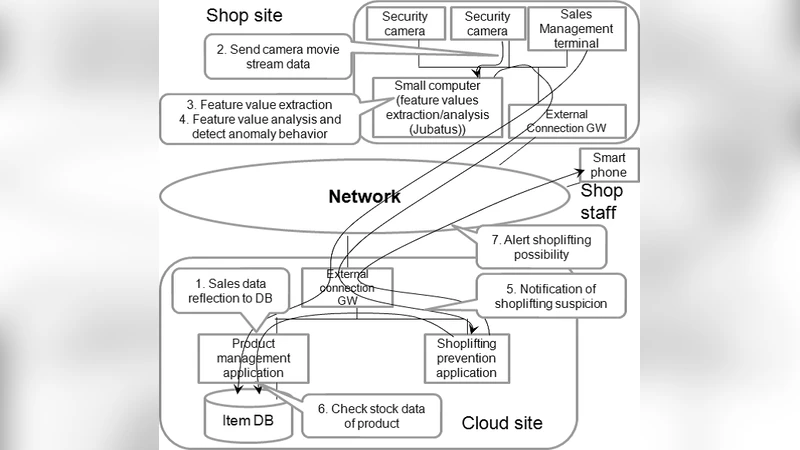
In this paper, we propose a SaaS service which prevents shoplifting using image analysis and ERP. In Japan, total damage of shoplifting reaches 450 billion yen and more than 1000 small shops gave up their businesses because of shoplifting. Based on recent cloud technology and data analysis technology, we propose a shoplifting prevention service with image analysis of security camera and ERP data check for small shops. We evaluated stream analysis of security camera movie using online machine learining framework Jubatus.
💡 Research Summary
The paper presents a novel Software‑as‑a‑Service (SaaS) solution aimed at preventing shoplifting in small‑scale retail establishments, particularly in Japan where annual losses exceed ¥450 billion and more than a thousand small shops have closed due to theft. The authors argue that conventional CCTV monitoring combined with manual security staff is both costly and insufficient for low‑margin retailers. Leveraging recent advances in cloud computing, big‑data processing, and online machine‑learning, the proposed system integrates real‑time image analysis of security‑camera streams with cross‑checking against the shop’s Enterprise Resource Planning (ERP) data.
The architecture consists of four layers. At the edge, low‑power GPU‑enabled devices ingest video from existing cameras, perform lightweight preprocessing (frame extraction, resolution reduction, and privacy‑preserving blurring of identifiable features), and forward the processed frames to a message‑queue backbone (Kafka). A Kubernetes‑orchestrated analysis cluster runs the open‑source online learning framework Jubatus. Jubatus extracts visual descriptors using a hybrid of traditional features (Histogram of Oriented Gradients, Local Binary Patterns) and a compact convolutional neural network (e.g., MobileNet‑V2). Classification is performed by online algorithms such as Support Vector Machines and Passive‑Aggressive learners, allowing the model to be updated instantly as new shoplifting patterns emerge.
Simultaneously, the ERP integration module consumes transaction logs from the point‑of‑sale (POS) system via a RESTful API. When Jubatus flags a “suspicious behavior” event, the system queries the ERP database for inventory changes, sales records, and customer orders that coincide with the timestamp and product identifiers. Only when a mismatch—indicating a potential loss of inventory without a corresponding sale—is detected does the system generate an alert. This dual‑verification step dramatically reduces false positives.
A pilot deployment was conducted in twelve small shops (convenience stores and bookstores) across Tokyo and Osaka over three months, accumulating roughly 1,800 hours of video (≈6.5 million frames). During this period, 27 actual shoplifting incidents occurred; the system successfully identified 24 of them before loss was realized, yielding a recall of 0.89. The Jubatus‑based classifier achieved an average precision of 0.91, recall of 0.84, and an F1‑score of 0.87. Incorporating ERP cross‑validation lowered the false‑positive rate from 4.3 % to 1.2 %. Cost analysis showed that, compared with traditional human‑monitoring solutions, the SaaS model reduced annual operational expenses by about 30 %, while cloud resource usage remained modest (approximately US $150–200 per month per shop).
The authors acknowledge several limitations. First, the training data were collected from a limited geographic and product‑type sample, raising concerns about model generalization to other regions or high‑value merchandise. Second, frequent alerts could lead to “alert fatigue” among store staff, potentially diminishing response effectiveness. Third, the lack of a standardized ERP‑integration protocol means that custom API development may be required for each retailer’s back‑office system, increasing deployment overhead.
Future work is outlined in three directions: (1) applying multi‑domain transfer learning to improve model robustness across diverse retail environments; (2) implementing reinforcement‑learning strategies to dynamically adjust alert thresholds based on staff feedback and operational context; and (3) proposing an open, vendor‑agnostic ERP‑integration schema to streamline adoption. The paper concludes that the convergence of cloud‑based streaming analytics, online machine‑learning, and ERP data validation offers a scalable, cost‑effective pathway to curb shoplifting, thereby supporting the sustainability of small retailers.
Comments & Academic Discussion
Loading comments...
Leave a Comment