LMPIT-inspired Tests for Detecting a Cyclostationary Signal in Noise with Spatio-Temporal Structure
In spectrum sensing for cognitive radio, the presence of a primary user can be detected by making use of the cyclostationarity property of digital communication signals. For the general scenario of a cyclostationary signal in temporally colored and s…
Authors: Aaron Pries, David Ramirez, Peter J. Schreier
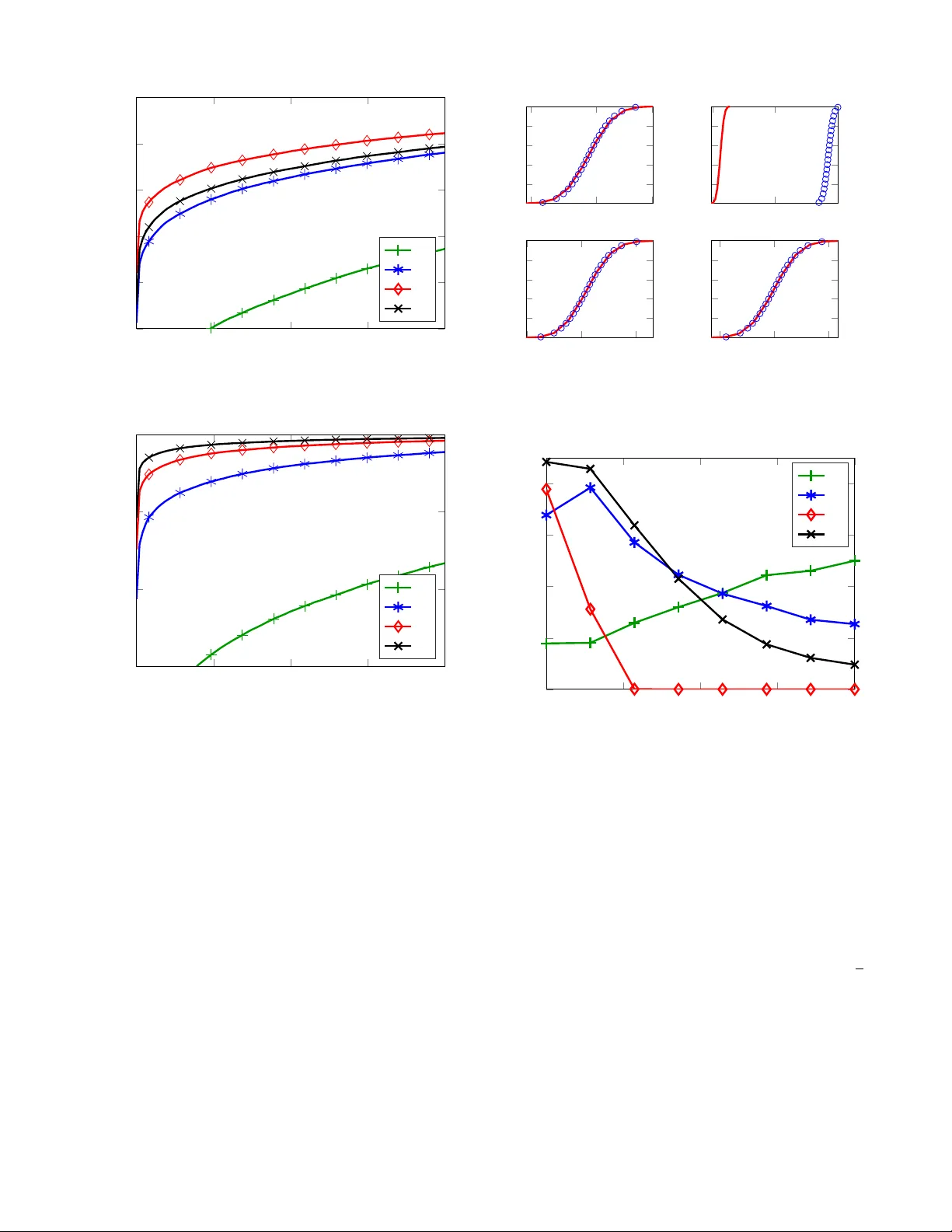
1 LMPIT -inspired T ests for Detecting a Cyclostationary Signal in Noise with Spatio-T emporal Structure Aaron Pries, Student Member , IEEE, David Ramírez, Senior Member , IEEE, and Peter J. Schreier , Senior Member , IEEE Abstract —In spectrum sensing for cogniti ve radio, the presence of a primary user can be detected by making use of the cyclo- stationarity property of digital communication signals. For the general scenario of a cyclostationary signal in temporally colored and spatially correlated noise, it has pr eviously been shown that an asymptotic generalized likelihood ratio test (GLR T) and locally most powerful inv ariant test (LMPIT) exist. In this paper , we derive detectors for the presence of a cyclostationary signal in various scenarios with structur ed noise. In particular , we consider noise that is temporally white and/or spatially uncorrelated. Detectors that make use of this additional information about the noise process hav e enhanced performance. W e hav e previously derived GLRTs for these specific scenarios; here, we examine the existence of LMPITs. W e show that these exist only for detecting the presence of a cyclostationary signal in spatially uncorrelated noise. For white noise, an LMPIT does not exist. Instead, we propose tests that approximate the LMPIT , and they are shown to perform well in simulations. Finally , if the noise structure is not known in advance, we also present hypothesis tests using our framework. Index T erms —Cyclostationarity , detection, generalized likeli- hood ratio test (GLR T), interweav e cognitive radio, locally most powerful in variant test (LMPIT), spectrum sensing I . I N T R OD U C T I O N D ETECTION of cyclostationarity has recei ved rene wed attention in recent years. A particularly interesting ap- plication is interweave cogniti ve radio [1]. This technology contributes to a more efficient use of the electromagnetic spectrum by sensing wireless channels, such that unlicensed secondary users can opportunistically access radio resources. The signal transmitted by the primary user is unknown to the secondary user , b ut ne vertheless the detection has to perform reliably ev en for low SNR. For the detection of a primary user in noise, there exist many models and corresponding tests (e.g. [2]–[8]). Existing This research was supported by the German Research Foundation (DFG) under grant SCHR 1384/6-1. The work of D. Ramírez has been partly supported by Ministerio de Economía of Spain under projects: O TOSIS (TEC2013-41718-R) and the COMONSENS Network (TEC2015-69648- REDC), by the Ministerio de Economía of Spain jointly with the European Commission (ERDF) under projects AD VENTURE (TEC2015-69868-C2-1- R) and CAIMAN (TEC2017-86921-C2-2-R), by the Comunidad de Madrid under project CASI-CAM-CM (S2013/ICE-2845), and by the German Re- search Foundation (DFG) under project RA 2662/2-1. A. Pries and P . J. Schreier are with the Signal & System Theory Group, Paderborn Univ ersity , Paderborn, Germany (e-mail: aaron.pries@sst.upb.de; peter .schreier@sst.upb .de). D. Ramírez is with the Signal Processing Group, Univ ersidad Carlos III de Madrid, Leganés, Spain, and the Gregorio Marañón Health Research Institute, Madrid, Spain (e-mail: david.ramirez@uc3m.es). detectors include energy detectors (e.g. [2], [3], [7], [8]), eigen value detectors (e.g. [5], [7]), correlation-based detectors (e.g. [2], [4], [7], [8]) and others. Some detectors are based on the generalized likelihood ratio test (GLR T), and man y assume white noise. Which detector is applicable for a partic- ular scenario depends on the information av ailable about the primary-user signal. A more general scenario was considered in [9], where the noise is allowed to be spatially uncorrelated and temporally colored. These papers, howe ver , do not exploit the prior information that the signal of interest is a digital communication signal, which is cyclostationary (e.g. [10]), while the noise is wide-sense stationary (WSS). This enables us to build better detectors by detecting this cyclostationarity feature. If it cannot be found, we conclude that only noise is present. For an introduction to cyclostationarity in general, and its detection in particular , the reader is referred to the papers [1], [11]–[14]. Early detectors for cyclostationarity were dev eloped in [12], [15]–[17], and since cogniti ve radio has become a popular idea, more detectors hav e been proposed, e.g. [18]–[20]. Recent publications have also proposed detectors for particular classes of primary-user signals, for example BPSK [21], OFDM [22], and GFDM [23]. Our goal in this paper is to dev elop detectors of cyclostationarity for arbitrary modulation schemes. A problem related to the detection of signals is the identification of the modulation scheme, where it also is pos- sible to utilize the cyclostationarity feature of communications signals [24]–[27]. The classical detector for the presence of cyclostationarity is given in [16] and similar detectors for observations from multiple antennas are proposed in [18], [19]. These detectors test whether cycles are present in the autocorrelation function for a specified set of lags. The tests from [12], [17], [20], [28] use the fact that spectral components of a cyclostationary process are correlated for some lags/frequencies. The choice of these lags is commonly optimized in advance, but this may not be possible in a cognitive radio framework, where we do not hav e prior information about the signal of the primary user . A different family of detectors, where only the cycle period needs to be known, was deriv ed in [29], [30]. These detectors can inherently deal with observations from multiple antennas, but they are based on the assumption of having av ailable independent complex normally-distrib uted observations. This assumption may sound restrictive at first, but it enables the use of powerful statistical methods. While normality is necessary c 2018 IEEE. Personal use is permitted, but republication/redistribution requires IEEE permission. See http://www .ieee.org/publications_standards/publications/rights/index.html for more information. 2 to deriv e the detectors, the cov ariance matrices need not be known. In practice, independently distributed observations can be approximately obtained by chopping one long observation into multiple short observ ations. The detectors in [29] and [30] are an asymptotic GLR T and an asymptotic locally most powerful inv ariant test (LMPIT) for a low-SNR scenario. Interestingly , both tests are different functions of the same coherence matrix. Further, both proposed detectors outperform classical detectors ev en when applied to the detection of communication signals, which are not Gaussian. While these detectors assume arbitrarily colored and spa- tially correlated noise under the null hypothesis, the noise might have further structure in the context of cognitive radio. In a properly calibrated system, noise is temporally white and spatially uncorrelated, which is commonly assumed. Y et calibration may also fail in either one of these domains, leading to noise that is only temporally white or spatially uncorrelated. In this paper , we treat all possible cases, i.e., temporally white and/or spatially uncorrelated noise. These scenarios were already considered in [31], which deriv ed GLR Ts for each of them. It turns out that the GLR Ts are again a function of a coherence matrix, b ut the coherence matrix is defined dif ferently from [30] in order to account for the additional structure of the noise. Other tests for the detection of a cyclostationary process in white noise were developed by [32], [33]. For the case of white noise, the proposed GLR T of [31] results in a substantially improved performance compared to either the GLR Ts in [30] or the general-noise detectors in [18], [20]. Our paper in vestigates the existence of (locally) optimal tests for the same assumptions about the noise as in [31], i.e. for temporally white and/or spatially uncorrelated noise. A. Contrib utions The main contrib utions of this paper can be summarized as follows: 1) W e propose detectors for an arbitrary cyclostationary signal with known cycle period in noise that is tempo- rally white and/or spatially uncorrelated. By incorporat- ing the additional information about the noise into our model, we are able to derive detectors with improv ed performance. Our detectors do not require kno wledge of the signal parameters. 2) W e in vestigate whether locally (i.e. low-SNR) optimal tests, that is, LMPITs, exist for these scenarios. For temporally colored but spatially uncorrelated noise the LMPIT exists, and we derive its closed-form expression. For temporally white noise, such a test does not exist as it depends on unknown quantities. Instead we propose LMPIT -inspired tests. For all tests we deriv e an approxi- mate distrib ution under the nu l l hypothesis, which allows us to choose the thresholds of the tests. 3) W e giv e an interpretation of our LMPIT -inspired tests in terms of the cyclic spectrum. W e show that our detectors use the cyclic coherence function, generalized to multiple antennas/time series, and show ho w they utilize different cyclic frequencies. 4) W e validate our detectors in simulations using different setups for the signal and noise. W e show that the LMPIT for spatially uncorrelated noise outperforms both the GLR T and the LMPIT for correlated noise. For tem- porally white noise, we demonstrate that our proposed tests also outperform other state-of-the-art detectors. Furthermore we ev aluate the computational complexity of our detectors. B. Outline Our program for this paper is the following: In Section II, we formulate the problem and an asymptotic approximation thereof. Then we deri ve the structure of the hypothesis test for the v arious noise assumptions. W e revie w the GLR Ts for these problems in Section III. In Section IV, we analyze the existence of LMPITs for the dif ferent scenarios. Based on these results, we propose LMPIT -inspired detectors for the case of temporally white noise (Section V). All proposed tests are e valuated and compared to state-of-the-art detectors by numerical simulations in Section VI. W e deri ve the compu- tational complexity of our detectors in Section VII. Finally , in Section VIII, we propose tests to determine the spatial and temporal structure of the noise, which can be used to select the appropriate test for cyclostationarity . I I . P R O B LE M F O R M U L A T I O N W e consider the detection of a discrete-time cyclostationary signal with kno wn cycle period P ∈ N \ { 1 } in the pres- ence of noise with spatio-temporal structure. 1 Denoting the observations from L time series by the v ector x [ n ] ∈ C L , cyclostationarity means that the autocorrelation function is periodic in the global time variable n : E x [ n ] x H [ n − k ] : = M [ n, k ] = M [ n + P , k ] . (1) W e stack N P consecutive samples of x [ n ] into the vector y = x T [0] , . . . , x T [ N P − 1] T . (2) Based on y , the goal is to decide whether or not the observed process is cyclostationary . W e assume that x [ n ] , and thus y , is a proper complex Gaussian random variable with zero mean. The cov ariance matrix R = E yy H of y depends on the autocorrelation sequence M [ n, k ] : R = M [0 , 0] . . . M [0 , − N P + 1] . . . . . . . . . M [ N P − 1 , N P − 1] . . . M [ N P − 1 , 0] . (3) Any additional information about M [ n, k ] will result in a particular structure of the cov ariance matrix R . Regarding the observation x [ n ] , we hav e two scenarios: Either a signal is present and then x [ n ] is cyclostationary , or 1 If the cycle period is not known in advance, it can be estimated, for example with the estimators in [16], [34]. Making our detectors robust against cycle-period mismatch is beyond the scope of this paper but it could possibly be achiev ed following along the lines of [35]. Other existing robust solutions can be found in [36]–[38]. 3 only noise is observed and then x [ n ] is WSS. This is described by the hypotheses H 1 : x [ n ] is cyclostationary , H 0 : x [ n ] is WSS, and additionally temporally white and/or spatially uncorrelated. (4) “Spatial” correlation has to be interpreted as the correlation between the different time series in the vector x [ n ] . Because of the Gaussian assumption, we use the following equiv alent formulation of (4) in terms of the cov ariance matrix of y : H 1 : y ∼ C N ( 0 , R 1 ) H 0 : y ∼ C N ( 0 , R 0 ) , (5) where C N denotes the proper complex Gaussian distribution. Thus the hypotheses only differ in the cov ariance matrix, and we are therefore interested in the structure of R 1 and R 0 . T o determine this structure, we define the autocorrelation functions of x [ n ] for the respectiv e hypotheses as M 1 [ n, k ] : = E H 1 x [ n ] x H [ n − k ] (6a) M 0 [ k ] : = E H 0 x [ n ] x H [ n − k ] . (6b) Under H 1 , the cyclostationarity of the signal means that M 1 [ n, k ] is periodic in n : M 1 [ n, k ] = M 1 [ n + P , k ] , (7) where P is the cycle period. This periodicity causes the cov ariance matrix R 1 to be block-T oeplitz with block-size LP [30], [39]. Under the null hypothesis, the considered spatio-temporal information about the noise process results in distinct prop- erties of M 0 [ k ] : In the case of spatially uncorrelated noise, M 0 [ k ] is diagonal for all k . White noise results in an M 0 [ k ] that is zero except for the lag k = 0 . If the noise is temporally white and spatially uncorrelated, we further know that M 0 [0] is diagonal. In terms of the cov ariance matrix R 0 , all considered scenarios of the noise result in a block- T oeplitz R 0 , with block-size L [31]: In the case of spatially uncorrelated noise, all L × L blocks will be diagonal . For temporally white noise, the matrix R 0 becomes bloc k-diagonal and the combination of white and uncorrelated noise will cause the whole matrix to be diagonal . W e could now test between the two hypotheses based on the structure of the covariance matrix, if the correlation functions (6), or equiv alently , R 1 and R 0 , were completely known. Howe ver , since we do not have any kno wledge about them (besides the structure), this is a composite hypothesis test. Common approaches for this type of test are the GLR T , the uniformly most powerful in v ariant test (UMPIT), or the LMPIT . For the particular case of the GLR T , this poses a problem because closed-form maximum likelihood (ML) esti- mates of block-T oeplitz matrices do not exist [40]. Therefore, we follo w the approach from [30], where we approximate the block-T oeplitz matrices R 0 and R 1 as block-circulant matrices, denoted by Q 0 and Q 1 . This means that Q 0 and Q 1 can be block-diagonalized by DFT matrices, and thus be estimated in closed form. For this, the vector y is transformed into the frequency domain using z = ( L N P ,N ⊗ I L ) ( F N P ⊗ I L ) H y , (8) where L N P ,N is the commutation matrix, defined such that v ec ( A ) = L N P ,N v ec A T for a P × N matrix A [41]. Further , F N P is the N P -dimensional DFT -matrix, and ⊗ denotes the Kronecker product. The linear transformation (8) then block-diagonalizes Q 0 and Q 1 , and we can express the hypotheses as H 1 : z ∼ C N ( 0 , S 1 ) H 0 : z ∼ C N ( 0 , S 0 ) . (9) The transformation (8) is designed such that the covariance matrix of z becomes asymptotically (for N → ∞ ) block- diagonal under both hypotheses. The cov ariance matrix S 1 has diagonal blocks of size LP × LP , and S 0 is block-diagonal with blocks of size L × L [30]. As before, we obtain further structure under H 0 depending on the assumption about the noise: For the case of spatially uncorrelated and temporally colored noise, the whole matrix S 0 becomes diagonal (case I). For white and spatially correlated noise (case II), the diagonal blocks are identical and thus S 0 can be factorized as I N P ⊗ ˜ S 0 , where the matrix ˜ S 0 is unknown. In the case of temporally white and spatially uncorrelated noise, these blocks are also diagonal (case III) [31]. The structure of the cov ariance matrix S 0 for all considered cases is illustrated in Figure 1. A. Comparison with related pr oblems For temporally colored but spatially uncorrelated noise, the hypotheses in (9) dif fer only in the block-size of the cov ariance matrices. An LMPIT for hypotheses with such a structure was already deri ved in [30], so the results can be immediately applied to this problem. More details will be presented in Section IV -A. For the case of temporally white noise, the covariance matrix is block-diagonal under H 1 and H 0 , and the block-sizes are LP and L , respectively . Under H 0 , ho wev er , the blocks are identical. Apart from this structure, the only additional information we have is that all blocks are positive definite. In a related paper for the detection of cyclostationarity in WSS noise [30], the structure is very similar , but under H 0 , the blocks are not identical. At the same time, the structure of the white-noise scenario is related to another problem, where the cov ariance matrix is positiv e definite under H 1 and block-diagonal with the same positi ve definite blocks under H 0 . This scenario w as considered in [42], and the present problem is a generalization thereof. For the special case of N = 1 , the two problems are identical. Ho wev er, for N > 1 this problem is much more difficult and, as we will show , the LMPIT does not exist. I I I . G L RT S F O R S T RU C T U R E D N O I S E In this section, we re view the GLR Ts for detecting a cyclo- stationary signal in WSS noise with further spatio-temporal structure. W e originally deriv ed these in [31], and here we 4 S 1 S 0 (case I) S 0 (case II) S 0 (case III) Fig. 1. Structure of the cov ariance matrices, with L = 3 , P = 2 , and N = 3 . Case I is temporally colored and spatially uncorrelated noise, case II is white and correlated noise, and case III is white and uncorrelated noise. T ABLE I E S TI M A T E O F S 0 F O R DI FF E R EN T N O I S E A S S U MP T I O NS noise structure ˆ S 0 colored & correlated diag L ( ˆ S ) colored & uncorrelated (case I) diag ( ˆ S ) white & correlated (case II) I N P ⊗ 1 N P N P − 1 P k =0 ˆ S ( k,k ) white & uncorrelated (case III) I N P ⊗ 1 N P N P − 1 P k =0 diag ( ˆ S ( k,k ) ) also present a way to set the threshold of the tests to achiev e a particular probability of false alarm. T o apply the GLR T to observed data, we assume to have M ≥ LP independent and identically distributed (i.i.d.) realizations z i of the vector z . In practice, often there is only one observation av ailable. In such a case, we would split the whole observation (assumed to be of length M N P ) into M signals of length N P . Formally , this violates the assumption of independence, b ut as we will show in later simulations, this does not affect the performance much. Splitting the whole observ ation into segments can be interpreted in light of Bartlett’ s method of estimating the (cyclic) po wer spectral density [43], [44]. It sacrifices resolution in the frequency domain in order to decrease the v ariance of the estimators. The ratio between M and N thus controls the tradeof f between these two effects. For the generalized likelihood ratio, which is defined as L G = max S 0 p ( z 1 , . . . , z M ; S 0 ) max S 1 p ( z 1 , . . . , z M ; S 1 ) , (10) we need the ML estimates of the unknown cov ariance matri- ces. They depend on the sample covariance matrix ˆ S = 1 M M − 1 X i =0 z i z H i . (11) The ML-estimate of S 1 is [30] ˆ S 1 = diag LP ( ˆ S ) , (12) where the diag B ( · ) operator returns the diagonal blocks of size B and sets the off-diagonal blocks to zero. For the case T ABLE II D E GR E E S O F F RE E D O M O F T H E χ 2 - D IS T R I BU T I ON . noise structure degrees of freedom colored & correlated L 2 N P ( P − 1) colored & uncorrelated (case I) LN P ( LP − 1) white & correlated (case II) L 2 ( N P 2 − 1) white & uncorrelated (case III) L ( LN P 2 − 1) of B = 1 , we will use diag ( · ) . Under H 0 , the likelihood function can be written as π − LM N P N P − 1 Y k =0 det S ( k,k ) 0 − M × exp ( − M tr N P − 1 X k =0 S ( k,k ) 0 − 1 ˆ S ( k,k ) !) (13) for all cases, where ( · ) ( k,k ) denotes the ( k , k ) th L × L block of a matrix. For matrix blocks and elements, we use indexing starting from zero. Depending on the structure of the noise, the blocks S ( k,k ) 0 hav e further structure, as outlined in Section II. This leads to the ML estimates of S 0 as deri ved in [31] and listed in T able I. The case of temporally colored and spatially correlated noise was cov ered in [30] and is listed for the sake of completeness. W ith these estimates plugged into (10), the GLR Ts for the different scenarios can all be expressed as L G ∝ det( ˆ C ) H 0 ≷ H 1 η , (14) with the sample coherence matrix ˆ C = ˆ S − 1 / 2 0 ˆ S 1 ˆ S − 1 / 2 0 . (15) For the interpretation of the blocks of ˆ C in terms of the cyclic po wer spectral density (PSD), see the remarks in [30, Section VI]. The threshold η can be obtained for a given false alarm rate using Wil ks’ theorem [30], [45]: According to W ilks, − 2 M log det( ˆ C ) is asymptotically χ 2 -distributed under the null hypothesis, with degrees of freedom depending on the number of parameters to be estimated under the two hypotheses. For the cases considered in this paper , the degrees of freedom are listed in T able II. 5 I V . L M P I T S F O R S T RU C T U R E D N O I S E As in [30], [42], we use W ijsman’ s theorem [46] to find an expression for the LMPIT . With this theorem, it is possible to express the likelihood ratio of the maximal in v ariant statistic without the distribution of the likelihood of the maximal in variant. If the resulting expression only depends on known quantities or observations, we obtain a UMPIT [47]. If this is not the case, we can seek approximations in order to find an LMPIT , which is only locally optimal. Such an LMPIT for the case of a multiv ariate cyclostationary process in WSS noise with arbitrary spatio-temporal correlations was deriv ed in [30]. In the following subsections, we discuss the case where more specific information about the noise is av ailable. A. LMPIT for T emporally Colored and Spatially Uncorr elated Noise In the case of temporally colored and spatially uncorrelated noise, we test between two block-diagonal covariance matrices that differ only in their block-size. In [30], the LMPIT was deriv ed for two arbitrary block sizes and here it is applied to our problem. Hence the statistic of the LMPIT is L u = diag ( ˆ S ) − 1 / 2 ˆ S 1 diag ( ˆ S ) − 1 / 2 2 F , (16) where k·k F denotes the Frobenius norm of a matrix. The LMPIT is obtained by comparing L u with a threshold η u : L u H 1 ≷ H 0 η u . (17) As for the tests in [30], M ( L u − LN P ) is approximately χ 2 - distributed under the null hypothesis, with the same degrees of freedom as the GLR T in T able II, i.e. LN P ( LP − 1) . B. LMPIT for T emporally White and Spatially Corr elated Noise If the noise is assumed to be temporally white and spatially correlated, the cov ariance matrix under the null hypothesis is block-diagonal with identical blocks of size L . As before, the structure of the cov ariance matrix under the alternati ve hypothesis is block-diagonal with block-size LP . T o find an optimal in variant test for this scenario using W ijsman’ s theorem [46], we first need to identify the problem in variances as a group. For the structure of the cov ariance matrix under the hypotheses as listed in Section II, the group G is G = { z → g ( z ) : g ( z ) = ( P ⊗ Q ⊗ G ) z } , (18) where P is an N × N permutation matrix, Q is a P × P unitary matrix, and G is an L × L nonsingular matrix. T o keep the notation concise, we define ˜ G = P ⊗ Q ⊗ G , and the sets of permutation, unitary , and nonsingular matrices are denoted by P , Q , and G , respectiv ely . A transformation from this group lea ves the structure of the hypotheses unchanged and can be interpreted as follows: Since the cov ariance matrix is block-diagonal with unknown LP × LP blocks under both hypotheses (see Section II and Figure 1), the blocks on the diagonal can be permuted arbitrarily without changing the block-diagonal structure. This is captured by the matrix P and represents a frequency reordering. T o see the effect of ( Q ⊗ G ) , we ha ve to look at the structure of the diagonal LP × LP blocks of S under the two hypotheses, i.e. either S 0 or S 1 . If we denote their j th block by S j , then the group action transforms this block to ( Q ⊗ G ) S j Q H ⊗ G H . (19) Under H 1 , S j is an unknown and unstructured matrix, and this is not affected by the group action. Under H 0 , the block S j is itself a block-diagonal matrix, with identical blocks on the diagonal, i.e. it can be written as I P ⊗ A . Then, according to (19), the transformed block becomes I P ⊗ GA G H , which is still block-diagonal with identical blocks (transformed by G ) on the diagonal. Applying W ijsman’ s theorem, we obtain (20) on the top of the next page for the ratio of the distributions of the maximal in variant statistic. This expression is now simplified and similar to the GLR T in (14), Equation (20) can be written as a function of the sample coherence matrix ˆ C : Lemma 1. The ratio of the distributions of the maximal in variant statistic (20) can be written as L ∝ X P Z Q Z G β ( G ) e − α d G d Q , (21) with α defined as α = M tr W ˆ C , (22) which is a function of the observations and the matrices forming the gr oup G as follows: ˆ C = ˆ S − 1 / 2 0 ˆ S 1 ˆ S − 1 / 2 0 , (23) ˆ S 0 = I N P ⊗ 1 N P N − 1 X j =0 P − 1 X k =0 ˆ S ( k,k ) j , (24) W = ˜ G H ( ˜ S 1 − I ) ˜ G , (25) ˜ S 1 = ( I N P ⊗ ¯ S − 1 / 2 1 ) S − 1 1 ( I N P ⊗ ¯ S − 1 / 2 1 ) , (26) ¯ S 1 = 1 N P N − 1 X j =0 P − 1 X k =0 S ( k,k ) 1 ,j , (27) β ( G ) = | det G | 2 M N P exp n − M N P tr GG H o . (28) Pr oof. Please refer to Appendix A. Since the expression in (21) depends on the unknown parameters in ˜ S 1 , a UMPIT does not exist. W e can, howe ver , approximate the exponential term for a low-SNR scenario [48] and check if the integral depends on unkno wns. If it does not, then we hav e found an LMPIT . For low SNR (or more general: close hypotheses), we obtain ˜ S 1 ≈ I and thus α ≈ 0 . This approximation is used to perform a T aylor series expansion of exp( − α ) around α = 0 : exp( − α ) ≈ 1 − α + 1 2 α 2 . (29) By continuing with this approximation, we can no longer obtain a globally optimal test. All the remaining results will 6 L = X P Z Q Z G det( S 1 ) − M | det G | 2 M N P exp n − M tr S − 1 1 ˜ G ˆ S ˜ G H o d G d Q X P Z Q Z G det( S 0 ) − M | det G | 2 M N P exp n − M tr S − 1 0 ˜ G ˆ S ˜ G H o d G d Q (20) hold only approximately for a low SNR condition, which is particularly interesting for a cognitive radio application. Plugging this approximation into (21), we obtain a sum of three terms, where the constant term can be discarded as it does not depend on the data. The remaining linear and quadratic terms will be dealt with in the follo wing two lemmas. Lemma 2. The linear term X P Z Q Z G β ( G ) tr W ˆ C d G d Q (30) in the T aylor series expansion of (21) is constant with respect to observations. Pr oof. Please refer to Appendix B. Since the linear term does not depend on data, we can neglect it for the expression of the LMPIT . Consequently , we simplify the approximation of (21) by keeping only the quadratic term, i.e. L ∝ X P Z Q Z G β ( G ) tr 2 W ˆ C d G d Q . (31) This term can be expressed in terms of the diagonal blocks ˆ C j of ˆ C as stated in the following lemma: Lemma 3. F or N > 1 , the quadratic term in (31) in the T aylor series expansion of (21) can be written as L ∝ N − 1 X j =0 k ˆ C j k 2 F + λP N − 1 X j =0 k ˆ ¯ C j k 2 F + µN k ˆ C av k 2 F , (32) with ˆ ¯ C j = 1 P P − 1 X k =0 ˆ C ( k,k ) j , (33) ˆ C av = 1 N N − 1 X j =0 ˆ C j , (34) wher e ˆ C ( k,k ) j denotes the k th L × L sub-bloc k of the j th block ˆ C j . The scalar quantities λ and µ ar e constant with r espect to observations, but they depend on unknown quantities in W and ˜ S 1 , r espectively . Pr oof. Please refer to Appendix C. Since this e xpression still depends on unkno wn quantities, the LMPIT does not exist. C. LMPIT for T emporally White and Spatially Uncorr elated Noise First we observe that the structure of S 0 is very similar for temporally white noise that is either spatially correlated or uncorrelated. In both cases, the matrix is block-diagonal with repeating blocks. While the blocks are just positi ve definite matrices for correlated noise, these blocks become dia gonal with positiv e diagonal elements for uncorrelated noise. If the noise is assumed spatially uncorrelated, this constrains G from the group of in variances in (18) to become diagonal with nonzero diagonal elements. The deriv ation of the ratio of the distributions of the maximal inv ariant statistic follo ws as in Section IV -B, while considering the additional constraint. In the end, the test statistic can be written as in (32) if we replace ˆ S 0 → diag ( ˆ S 0 ) (35) and use (15) to obtain the coherence matrix. F or the same reason mentioned in the previous section, an LMPIT does not exist for this scenario, either . V . L M P I T - I N S P I R E D T E S T S F O R W H I T E N O I S E For a theoretical analysis of the test statistic (32), we need its probability density function (pdf). Since it seems very difficult to deriv e the pdf, we perform Monte Carlo simulations, in order to analyze ho w the test statistic (32) performs if we use a grid of values for the unknown quantities λ and µ . This can be done only in simulations where we know whether a signal is present or not. T esting multiple values of the parameters cannot be done in a real-world application. Howe ver , this kind of simulation can rev eal which of the terms contribute most (on av erage) tow ards a good detector . In particular, we answer two questions: Ho w do the detectors based on the individual terms in (32) perform? Ho w do these tests perform compared to the white-noise GLR T (14) and the test based on (32) with optimized v alues of λ and µ ? The performance of a test will be measured by the area under the receiv er operating characteristic (R OC) curve. For all simulations, the observations are generated as H 1 : x [ n ] = ( H ∗ s )[ n ] + w [ n ] H 0 : x [ n ] = w [ n ] , (36) where s [ n ] is a baseband QPSK signal with rectangular pulse shaping. A ne w symbol is dra wn ev ery T samples, which causes the cycle period of s [ n ] to be P = T . The operation ( H ∗ s )[ n ] denotes a con volution with the channel H [ n ] , which is a Rayleigh fading channel with exponential power delay profile, uncorrelated among antennas, and constant for each Monte Carlo experiment. Howe ver , a new realization of 7 0.85 10 3 0.9 AUR 10 3 10 0 0.95 10 1 10 -3 10 -1 LMPIT GLRT Fig. 2. Area under the ROC (A UR) of the test based on (32) as a function of λ and µ . Performance of the GLR T (14) for reference. The parameters N = 64 , SNR = − 15 dB , P = 3 , L = 3 , and M = 20 are used. H [ n ] is drawn for each simulation and thus we av erage ov er many (on the order of 10 k) channels H [ n ] . Finally , w [ n ] is temporally white Gaussian noise with spatial correlation. An example is seen in Fig. 2, where the LMPIT -curve rev eals that the optimal values for µ and λ for this particular scenario are close to 12 and 0.6, respecti vely . For different simulation setups these values vary , but extensi ve experiments hav e sho wn that they are ne ver very large nor close to zero. If the maximum were in a corner, which corresponds to either a large or a small parameter , we would obtain the best test by using only one of the terms in (32). These individual terms can be found in Fig. 2: Using lar ge v alues of λ and small values of µ is equiv alent to approximating the test statistic by the term P N − 1 j =0 k ˆ ¯ C j k 2 F alone, which performs worse than the GLR T . Using small λ and either small µ or large µ is approximately the same as using either the term P N − 1 j =0 k ˆ C j k 2 F or k ˆ C av k 2 F , respectiv ely , as test statistic without the need to choose particular values of λ and µ (which cannot be determined in general). Since the tests based on these statistics perform better than the GLR T , we propose them as LMPIT - inspir ed tests for the case of temporally white noise. These LMPIT -inspired tests have suboptimal performance. Howe ver , according to Fig. 2 the performance can still be substantially better than competing tests, as the comparison with the GLR T (14) demonstrates. More detailed simulations, as well as comparisons with other detectors, will be presented in Section VI. The distribution of these statistics under the null hypothesis can be obtained by the relationship between the log-det and the Frobenius norm [30], [49]. Since the GLR for white noise in Section III was det( ˆ C ) M = Q N − 1 j =0 det( ˆ C j ) M , we can conclude that M N − 1 X j =0 k ˆ C j k 2 F − LN P (37) is approximately χ 2 -distributed under the null hypothesis, with degrees of freedom as in T able II. Concerning the second proposed statistic, i.e. k ˆ C av k 2 F , it can be shown that det( ˆ C av ) M N is the GLR for the hypotheses H 1 : z ∼ C N ( 0 , I N ⊗ S LP ) H 0 : z ∼ C N ( 0 , I N P ⊗ S L ) (38) where S LP and S P are unkno wn matrices of dimension LP and L , respecti vely . Thus we can ar gue again that this log-GLR is asymptotically χ 2 -distributed, this time with L 2 ( P 2 − 1) degrees of freedom. Thus for the case of temporally white and spatially correlated noise, the modified statistic M N k ˆ C av k 2 F − LP (39) is approximately χ 2 -distributed with L 2 ( P 2 − 1) degrees of freedom. The case of temporally white and spatially un correlated noise differs only in the degrees of freedom, which are L ( LP 2 − 1) . A. Interpr etation of the LMPIT -inspir ed T ests The proposed LMPIT -inspired detectors can be interpreted in terms of the cyclic PSD of the random process x [ n ] . The cyclic PSD can be written as [30], [50] Σ ( c ) ( θ ) dθ = E d ξ ( θ ) d ξ H θ − 2 π c P , (40) where c/P denotes the cycle frequencies, and d ξ ( θ ) is an increment of the random spectral process that generates x [ n ] : x [ n ] = Z π − π d ξ ( θ ) e j θn . (41) As shown in [30], [50], the covariance matrix S = E zz H contains samples of the cyclic PSD Σ ( c ) ( θ ) at some frequen- cies θ and c ∈ Z . Under the alternativ e hypothesis, S is block- diagonal with blocks of size LP . If we denote the L × L sub- blocks of the j th LP × LP block S j by S ( k,κ ) j , it turns out that S ( k,κ ) j = Σ ( k − κ ) 2 π ( κN + j ) N P (42) holds for j = 0 , . . . , N − 1 , k = 0 , . . . , P − 1 , and κ = 0 , . . . , P − 1 . Under the null hypothesis, a similar relation holds. In this case, S is block-diagonal with blocks of size L and these blocks are identical because the noise is white: S ( k,k ) j = Σ (0) 2 π ( kN + j ) N P = Σ (0) (43) Thus the diagonal blocks only contain the cyclic PSD for the cycle frequency zero, which is the standard PSD. After defining the coherence function Γ ( c ) ( θ ) = Σ (0) − 1 / 2 Σ ( c ) ( θ ) Σ (0) − 1 / 2 , (44) the blocks of the coherence matrix C can be written as C ( k,κ ) j = Γ ( k − κ ) 2 π ( κN + j ) N P . (45) The sample coherence matrix ˆ C = ˆ S − 1 / 2 0 ˆ S 1 ˆ S − 1 / 2 0 consists of the blocks ˆ C ( k,κ ) j = ˆ ¯ S − 1 / 2 0 ˆ S ( k,κ ) j ˆ ¯ S − 1 / 2 0 , (46) 8 where ˆ S ( k,κ ) j can be interpreted as an estimate of the cyclic PSD: ˆ S ( k,κ ) j = ˆ Σ ( k − κ ) 2 π ( κN + j ) N P (47) Further , ˆ ¯ S 0 = 1 N P N − 1 X j =0 P − 1 X k =0 ˆ S ( k,k ) j = ˆ Σ (0) (48) is an estimate of the PSD in the case of white noise. Now we can express the first proposed test statistic in terms of the sample coherence function ˆ Γ ( c ) ( θ ) : N − 1 X j =0 k ˆ C j k 2 F = N P − 1 X j =0 ˆ Γ (0) 2 π j N P 2 F + 2 P − 1 X c =1 ( P − c ) N − 1 X j =0 ˆ Γ ( c ) 2 π j N P 2 F (49) Hence this statistic accounts for both temporal correlation, as measured by the term with c = 0 , and the degree of cyclostationarity ( c 6 = 0 ). T o find an interpretation for the second proposed test statistic, we define ˆ ¯ Σ ( c ) κ = 1 N N − 1 X j =0 ˆ Σ ( c ) 2 π ( κN + j ) N P , (50) which is the block-wise average of the cyclic PSD. Then it turns out that the second proposed test statistic can be written as a function of ˆ ¯ Γ ( c ) κ = ˆ Σ (0) − 1 / 2 ˆ ¯ Σ ( c ) κ ˆ Σ (0) − 1 / 2 : k ˆ C av k 2 F = P − 1 X κ =0 ˆ ¯ Γ ( c ) κ 2 F + 2 P − 1 X c =1 P − c − 1 X κ =0 ˆ ¯ Γ ( c ) κ 2 F (51) This test statistic also measures the amount of color and the amount of cyclostationarity , b ut with an averaged coherence function. V I . S I M U L A T I O N S In this section we compare the LMPIT for uncorrelated noise and the LMPIT -inspired tests for white noise with dif- ferent detectors. Unless mentioned otherwise, the observations are generated as stated in Section V. A. Spatially Uncorrelated Noise W e first compare the performance of the GLR T (14), the proposed LMPIT based on (16), and the LMPIT from [30], which is based on the more general assumption of correlated noise. The simulation setup is the same as introduced in Sec- tion V, in this case using spatially uncorrelated and temporally colored noise w [ n ] . Colored noise is realized by passing a temporally white signal through a moving average filter of the length 19 . The parameters are chosen as SNR = − 17 dB , P = 3 , N = 64 , L = 3 , and M = 10 . The performance is illustrated in Fig. 3 by means of an R OC curve, which depicts the probability of detection P D and the probability of false alarm P F A . Interestingly , both LMPITs outperform the GLR T , ev en though the LMPIT from 0 0 . 05 0 . 1 0 . 15 0 . 2 0 . 25 0 . 3 0 . 7 0 . 8 0 . 9 1 P F A P D GLR T LMPIT LMPIT [30] Fig. 3. ROC curves for detecting a cyclostationary signal in uncorrelated noise. [30] does not exploit the additional information about spatial uncorrelatedness. The two LMPITs perform v ery similarly , and we do not gain much by taking into account spatial uncorrelatedness. W e already observ ed something similar in a simulation with spatially uncorrelated noise in [31], where we compared the GLR T for the case of uncorrelated noise with the GLR T for correlated noise. This is due to the fact that the number of unkno wn parameters is not reduced as much for the case of spatially uncorrelated noise. B. T emporally White Noise For the case of temporally white noise, we use the LMPIT - inspired tests proposed in Section V. Further , there is also the LMPIT in [30] and the GLR T presented in Section III, which can be used for this scenario. W e then have the following list of test statistics: ¬ diag L ( ˆ S ) − 1 / 2 ˆ S 1 diag L ( ˆ S ) − 1 / 2 2 F (52) N − 1 Y j =0 det ˆ C j (53) ® N − 1 X j =0 k ˆ C j k 2 F (54) ¯ k ˆ C av k 2 F (55) The last three test statistics are specific to the scenario of detecting cyclostationarity in white noise, while the first expression (the LMPIT from [30]) co vers the more general case of a cyclostationary signal in temporally colored noise. But because none of the last three tests is optimal, there is no guarantee that they perform better , e ven though they use additional information. 1) R OC curves: Figures 4 and 5 show ROC curves for simulations with the parameters SNR = − 12 dB , P = 3 , L = 3 , M = 20 , as well as white and correlated noise w [ n ] . The dif ference between the simulations sho wn in Figures 4 and 5 is the parameter N , which is 12 and 64 , respectiv ely . 9 0 0 . 05 0 . 1 0 . 15 0 . 2 0 . 5 0 . 6 0 . 7 0 . 8 0 . 9 1 P F A P D ¬ ® ¯ Fig. 4. ROC of the proposed tests in (52)–(55), using N = 12 . 0 0 . 05 0 . 1 0 . 15 0 . 2 0 . 7 0 . 8 0 . 9 1 P F A P D ¬ ® ¯ Fig. 5. ROC of the proposed tests in (52)–(55), using N = 64 . First of all, the result re veals that our two proposed statistics ® and ¯ perform better than the white-noise GLR T and the colored-noise LMPIT ¬ , independently of N . Increasing N to 64 rev eals an interesting change of the ordering between ® and ¯ . As illustrated in Fig. 4, the statistic ® leads to a better test for a low N , and conv ersely , the test ¯ performs better if N is large (Fig. 5). This phenomenon was also observed for other values of N and P : If N or P are large, then the test based on ¯ is the best and ® performs somewhat worse. If N and P are small, then ® performs best and ¯ looses performance. 2) Distrib ution under the null hypothesis: As shown in previous sections, the GLR as well as the LMPIT -inspired statistics are approximately χ 2 -distributed under the null hy- pothesis. In Fig. 6, we sho w the expected cumulative dis- tribution functions (CDFs) as well as the estimated CDFs from simulation results with temporally white and spatially uncorrelated noise and M = 64 . It can be observed that all terms that depend on a Frobenius norm are approximated very well by the corresponding χ 2 distribution, while the GLR- statistic is quite far away from the expected result. A similar 23 , 700 24 , 400 25 , 000 0 . 2 0 . 4 0 . 6 0 . 8 ¬ 25 , 000 29 , 700 34 , 400 0 . 2 0 . 4 0 . 6 0 . 8 1 , 430 1 , 580 1 , 730 0 . 2 0 . 4 0 . 6 0 . 8 ® 25 , 000 25 , 600 26 , 200 0 . 2 0 . 4 0 . 6 0 . 8 ¯ Fig. 6. Cumulative distribution functions (CDFs) of the test statistics ¬ - ¯ under the null hypothesis. Expected CDFs according to the χ 2 -approximations (red lines) and the estimated CDFs of the normalized test statistics ¬ - ¯ for simulations (blue circles). 0 5 10 15 20 0 0 . 2 0 . 4 0 . 6 0 . 8 σ P D ¬ ® ¯ Fig. 7. P D at P F A = 0 . 01 for noise with increasing temporal correlation controlled by σ . result for small M was also observed in [30], where it was concluded that the Frobenius norm con ver ges much faster to the χ 2 distribution than the log-det. 3) Rob ustness against model misspecification: In another simulation we tested the robustness of the proposed LMPIT - inspired detectors against violation of the white noise assump- tion. Instead of white noise, we used noise with increasing temporal correlation. This w as achie ved by passing white noise through an FIR-filter with impulse response g [ n ] = exp( − n σ ) , where σ controls the de gree of temporal correlation: White noise is obtained for σ → 0 and an increasing σ introduces an increasing lev el of temporal correlation. Figure 7 shows the resulting performance as measured by the probability of detection P D , at P F A = 0 . 01 . In this simulation we further use SNR = − 16 dB , P = 4 , N = 64 , L = 3 , M = 20 and QPSK signals with RRC pulse shaping. As expected, the detectors designed for the white- noise scenario ( - ¯ ) perform well for the case of almost white noise and the general-noise LMPIT ¬ performs best when the 10 − 14 − 12 − 10 − 8 − 6 − 4 − 2 0 10 − 3 10 − 2 10 − 1 SNR / dB P MD ¬ ® ¯ [18] [20] Fig. 8. Probability of missed detection P MD at P F A = 0 . 01 for varying SNR using OFDM transmission. temporal correlation is large. Interestingly , the tests and ¯ are more robust against de viation from white noise, as opposed to the test based on ® . This robustness also holds when the simulation is performed for a small N , for example N = 12 . Thus, the detector ¯ should in most cases be preferred over ® . 4) Comparison with state-of-the-art detectors: Now we compare the performance of the proposed detectors with detectors from [18], [20]. W e use OFDM modulation with a QPSK constellation to demonstrate that the results are not specific to single-carrier modulations. Since [18], [20] do not require M > 1 , we simulated the recei ved signals with one long observation for a fair comparison. This long observation was split into multiple segments when using the statistics ¬ - ¯ . In particular, we use L = 2 antennas and receive 1024 symbols of OFDM signals with 16 subcarriers and a cyclic prefix of 4 , sampled at Nyquist rate, which results in 20 samples per symbol [18]. Thus the cycle period is P = 20 . For the detectors ¬ - ¯ , we factor N M = 1024 into M = 64 se gments of length N = 16 . For both [18], [20] we use the first c ycle frequency , while the lags are chosen as ± 16 and 16 for [18] and [20], respecti vely . This choice incorporates prior information about the maximum of the cyclic autocorrelation function for OFDM signals [18], [51]. In a practical cognitiv e radio application, such prior information might not be av ailable. Hence, the comparisons are o verly fa vorable for our competitors. The performance of the selected detectors for various SNR s is illustrated in Fig. 8. It can be seen that the test ¯ also performs best in this setup. The tests not specific to the white-noise scenario (i.e. ¬ , [18], and [20]), howe ver , perform considerably worse. V I I . C O M P U TA T I O N A L C O M P L E X I T Y In this section, we estimate the computational complexity of our detectors in terms of floating point operations (FLOPs). T o approximate the complexity , we focus on the most time- consuming parts of the algorithm, which are equations (8), (11), (15), and then the tests themselves. F or matrix operations, we use the FLOP estimates from [52]. Equation (8) is most efficiently implemented by an FFT . Since we need LM FFTs of length N P , this requires ap- proximately 5 LM N P log 2 ( N P ) FLOPS [53]. Next we only need to compute the diagonal blocks of (11), which costs approximately M N ( LP ) 2 FLOPS. Finally , we can compute the in verse in (15) by in verting the L × L diagonal blocks. In terms of computational complexity this is negligible compared to the rest of the matrix multiplication in (15), which in turn can be optimized by exploiting the block-diagonal structure of the inv olved matrices. Thus this operation takes approximately 2 N L 3 P 2 FLOPS for the case of spatially correlated noise. If we use a detector for the case of spatially uncorrelated noise, this is reduced to N L 2 P 2 FLOPS. On top of this, the detectors need to be computed. The LMPIT or LMPIT -inspired tests compute the Frobenius norm, which is only of linear complexity in the matrix size. The determinant for the GLR Ts has a bigger impact with approximately 1 3 N ( LP ) 3 FLOPS. T o summarize, for a large sensing duration (i.e. N ), the FFT is the computational bottleneck. Since competing detec- tors typically also use FFT -based statistics, the asymptotic complexity in N is similar to our detectors. Our detectors further benefit from the fact that they only require standard matrix operations and the FFT . These operations exist in many standard math libraries and are often optimized with respect to other parameters such as memory and cache. Our detectors can further benefit from parallelization. V I I I . N O I S E C H A R A C T E R I Z A T I O N So far we have assumed to know whether the noise has a particular temporal or spatial structure. If it is not known a priori whether such a structure is present, and consequently which detector is appropriate, we must first detect the noise structure. T o this end, we will assume to have av ailable samples of noise only . 2 T esting whether or not a process is temporally white has been treated in [54], [55] and extensions for multiv ariate processes hav e been published in [56]–[58]. T ests for spatial (un)-correlatedness of random vectors were deri ved in [49], [59], [60]. Since it is possible to deriv e asymptotic tests in the framew ork of this paper , we now present GLR Ts to determine if the noise is temporally white/colored or spatially uncor - related/correlated. T o keep the same notation as before, we assume to ha ve N P samples of the noise process x [ n ] = w [ n ] . As in Section II, we collect all samples in the vector y and transform it to z . Gi ven multiple realizations of y , we test whether or not some temporal or spatial structure is present. 2 An alternative approach, which does not need noise-only samples, would be a multiple hypothesis test. Then the different hypotheses correspond to a signal that is either cyclostationary , WSS with arbitrary spatio-temporal correlation, or WSS without spatial and/or temporal correlation. As a multiple hypothesis test is out of the scope of this paper, we do not follow this alternativ e approach. 11 A. T esting the T emporal Structure Here we consider the hypotheses H 1 : x [ n ] is temporally colored, H 0 : x [ n ] is temporally white. W ith the Gaussian assumption, these hypotheses are asymp- totically equiv alent to H 1 : z ∼ C N ( 0 , S 1 ) H 0 : z ∼ C N ( 0 , I N P ⊗ S 0 ) , where S 1 is a block-diagonal matrix with blocks of size L × L , and S 0 is an L × L matrix. Thus we essentially test whether or not the diagonal blocks of the sample cov ariance matrix are identical. Since we do not know these blocks, we have to estimate them, which leads to a GLR T . The ML-estimates are listed in T able I, and using them we find an expression for the log-GLR: N P − 1 X k =0 log det ˆ S ( k,k ) − N P log det 1 N P N P − 1 X k =0 ˆ S ( k,k ) ! . (56) The log-GLR T is obtained by comparing (56) with a threshold η . If it is smaller than η , the (white noise) null hypothesis is rejected. B. T esting the Spatial Structure The hypotheses for testing the spatial structure are H 1 : x [ n ] is spatially correlated, H 0 : x [ n ] is spatially uncorrelated. Asymptotically , this is equiv alent to H 1 : z ∼ C N ( 0 , S 1 ) H 0 : z ∼ C N ( 0 , S 0 ) , where S 1 is a block-diagonal matrix with blocks of size L × L and S 0 is a diagonal matrix. Thus the present test is a special case of the test between two block-diagonal matrices from [30], and we can specialize the test to the block sizes L and 1 . Then the log-GLR can be written as N P − 1 X k =0 log det ˆ S ( k,k ) − log det diag ( ˆ S ) (57) and the (uncorrelated noise) null hypothesis is rejected for small values. I X . C O N C L U S I O N S W e ha ve presented tests for the detection of a c yclosta- tionary signal with known cycle period in noise with known statistical properties. In the case of temporally colored and spatially uncorrelated noise, it was possible to find an LMPIT , which computes the Frobenius norm of a sample coherence matrix. Thus we obtained the same result as in the case of spatially correlated noise, where the LMPIT and the GLR T are, respectiv ely , the Frobenius norm and the determinant of another sample coherence matrix. As sho wn in simulations, the performance gain compared to the LMPIT for noise with arbitrary spatial correlation is small. The case of white noise is quite different. Here the LMPIT does not exist, as the likelihood ratio of the maximal in variant statistics depends on unknown quantities. Instead, we proposed two LMPIT -inspired tests. These tests are suboptimal, but it was sho wn in simulations that these detectors can outperform other tests for a variety of scenarios. This includes the case of communications signals where the distribution under the alternativ e is not complex normal and the case when only one realization is av ailable. The thresholds for the tests that depend on a Frobenius norm can be chosen using a χ 2 distribution. Finally , we considered the case where a-priori information about the noise structure is not available. If noise-only sam- ples are a vailable, we have also proposed tests to infer the noise structure. This enables the utilization of the appropriate detector for the subsequent signal detection task. MA TLAB code for our detectors is av ailable at https: //github .com/SSTGroup/Cyclostationary- Signal- Processing. A P P E N D I X A P RO O F O F L E M M A 1 The proof follows along the lines of the deriv ation of the LMPIT in [30]. First we note that the determinants of S 0 and S 1 in (20) are constant with respect to the observations and thus they are irrelev ant for the test statistic. Next we see that ˜ G H S − 1 1 ˜ G as well as ˜ G H S − 1 0 ˜ G are block-diagonal with block-size LP . For this reason, the traces only depend on the diagonal LP × LP blocks of ˆ S and thus we can replace ˆ S by ˆ S 1 = diag LP ( ˆ S ) without changing the outcome. No w we introduce the change of variables G → G 1 N P N − 1 X j =0 P − 1 X k =0 ˆ S ( k,k ) j − 1 / 2 (58) in the nominator and the denominator . Both steps combined cause the normalization ˆ S 1 → ˆ C with the coherence matrix ˆ C = ˆ S − 1 / 2 0 ˆ S 1 ˆ S − 1 / 2 0 and ˆ S 0 = I N P ⊗ 1 N P N − 1 X j =0 P − 1 X k =0 ˆ S ( k,k ) j . (59) Applying the transformation G → 1 N P N − 1 X j =0 P − 1 X k =0 ˆ S ( k,k ) j +1 / 2 G , (60) we see that the trace in the denominator is constant: tr ˜ G ˆ C ˜ G H = N P tr GG H . (61) Thus the denominator does not depend on data and can be discarded. Applying another transformation G → ¯ S − 1 / 2 1 G causes S − 1 1 → ˜ S 1 . Finally , we re write and simplify the integral in terms of α , β ( G ) and W . This concludes the proof. 12 X P tr 2 W ˆ C = ( N − 2)! · N N − 1 X i =0 N − 1 X j =0 tr 2 W i ˆ C j + N 4 tr 2 W av ˆ C av − ( N − 2)! · N 2 N − 1 X j =0 tr 2 W av ˆ C j + N − 1 X j =0 tr 2 W j ˆ C av (66) A P P E N D I X B P RO O F O F L E M M A 2 W e define Ψ = X P Z Q Z G β ( G ) W d G d Q , (62) and note that (30) can be expressed as tr Ψ ˆ C . Since W is block-diagonal with blocks of size LP × LP , so is Ψ . The permutation matrix P permutes these blocks and by summing ov er all possible permutations, the blocks become identical. This can be expressed as Ψ = I N ⊗ Φ , (63) where Φ is an LP × LP matrix. Now we ha ve a similar problem as in [42] and follo wing the proof therein, it can be shown that Φ is a diagonal matrix with identical elements. Therefore we can simplify (30): tr Ψ ˆ C ∝ tr ˆ C = N LP, (64) because of the way ˆ C is normalized. A P P E N D I X C P RO O F O F L E M M A 3 Since W and ˆ C are block-diagonal, we can first express the trace in terms of their diagonal blocks of size LP × LP : tr 2 W ˆ C = N − 1 X j =0 tr 2 W j ˆ C j + N − 1 X j =0 N − 1 X i =0 i 6 = j tr W j ˆ C j tr W i ˆ C i . (65) Now we take care of the permutations. Note that the permuta- tion matrix P in W permutes the set of blocks W j . W ith this in mind we sum over all permutations of (65). Using induction it is possible to show that the result can be written as stated in (66). Here we introduced the matrix ˆ W av = 1 N N − 1 X j =0 ˆ W j , (67) and ˆ C av was defined in (34). Plugging this result back into (31), the integrals are now expressed in terms of the blocks W j and ˆ C j . Since W j = ( Q ⊗ G ) H ˜ S 1 ,j − I ( Q ⊗ G ) , (68) the problem at first looks v ery similar to the one in [42]. In fact, the problems are identical for the case of N = 1 . Howe ver , for N > 1 , we have multiple terms in (65). Moreov er , the normalization of W j and ˆ C j as defined for this problem is dif ferent compared to the counterparts in [42], and thus requires a different solution. The ne xt step is to express the squared traces in (66) in terms of the L × L sub-blocks of the LP × LP blocks W j and ˆ C j . For the present problem, we can use the in v ariances in the same way as in [42, Lemmas 5-7], b ut due to the dif ferent normalization, fewer terms are constant. Most importantly , the sum of the diagonal sub-blocks is not normalized, i.e. generally , P P − 1 k =0 ˆ C ( k,k ) j = P I only if N = 1 . Accounting for this dif ference, the rest of the proof follows along the lines of [42, Lemmas 5-7]. Then the quadratic term (31) in the T aylor series expansion can be written as L ∝ c 1 N − 1 X j =0 k ˆ C j k 2 F + c 2 P N − 1 X j =0 k ˆ ¯ C j k 2 F + c 3 N k ˆ C av k 2 F , (69) with unknown c 1 , c 2 , and c 3 . After defining λ = c 2 c 1 and µ = c 3 c 1 , this can be rewritten as stated in (32). R E F E R E N C E S [1] E. Axell, G. Leus, E. G. Larsson, and H. V . Poor , “Spectrum sensing for cognitive radio : State-of-the-art and recent advances, ” IEEE Signal Pr ocess. Mag. , vol. 29, no. 3, pp. 101–116, 2012. [2] T . Yücek and H. Arslan, “A survey of spectrum sensing algorithms for cognitiv e radio applications, ” IEEE Commun. Surv . T utorials , vol. 11, no. 1, pp. 116–130, 2009. [3] D. Ariananda, M. Lakshmanan, and H. Nikookar , “A survey on spectrum sensing techniques for cognitive radio, ” in Second Int. W ork. Cogn. Radio Adv . Spectr . Manag. , Aalborg, Denmark, 2009, pp. 74–79. [4] T . J. Lim, R. Zhang, Y . C. Liang, and Y . Zeng, “GLR T -based spectrum sensing for cognitive radio, ” in IEEE Glob. T elecommun. Conf. , New Orleans, USA, 2008. [5] Y . Zeng and Y .-C. Liang, “Eigen value-Based Spectrum Sensing Algo- rithms for Cognitiv e Radio, ” IEEE T rans. Commun. , vol. 57, no. 6, pp. 1784–1793, 2009. [6] J. Font-Segura and X. W ang, “GLR T -based spectrum sensing for cogni- tiv e radio with prior information, ” IEEE T rans. Commun. , vol. 58, no. 7, pp. 2137–2146, 2010. [7] S. K. Sharma, T . E. Bogale, S. Chatzinotas, B. Ottersten, L. B. Le, and X. W ang, “Cognitiv e Radio T echniques Under Practical Imperfections: A Survey, ” IEEE Commun. Surv . Tutorials , vol. 17, no. 4, pp. 1858– 1884, 2015. [8] A. Ali and W . Hamouda, “ Advances on Spectrum Sensing for Cogni- tiv e Radio Networks: Theory and Applications, ” IEEE Commun. Surv . T utorials , vol. 19, no. 2, pp. 1277–1304, 2017. [9] D. Ramírez, G. V azquez-V ilar , R. López-V alcarce, J. Vía, and I. San- tamaría, “Detection of rank-P signals in cognitive radio networks with uncalibrated multiple antennas, ” IEEE T rans. Signal Process. , vol. 59, no. 8, pp. 3764–3774, 2011. [10] W . A. Gardner, W . Brown, and C.-K. Chen, “Spectral correlation of modulated signals: Part II–digital modulation, ” IEEE T rans. Commun. , vol. 35, no. 6, pp. 595–601, 1987. 13 [11] W . A. Gardner and C. M. Spooner, “The cumulant theory of cyclosta- tionary time-series, part I: Foundation, ” IEEE T rans. Signal Process. , vol. 42, no. 12, pp. 3387–3408, 1994. [12] C. M. Spooner and W . A. Gardner, “The cumulant theory of cyclosta- tionary time-series, part II: De velopment and applications, ” IEEE Tr ans. Signal Process. , vol. 42, no. 12, pp. 3409–3429, 1994. [13] W . A. Gardner , A. Napolitano, and L. Paura, “Cyclostationarity: Half a century of research, ” Signal Pr ocessing , vol. 86, no. 4, pp. 639–697, 2006. [14] A. Napolitano, “Cyclostationarity: New trends and applications, ” Signal Pr ocessing , vol. 120, pp. 385–408, 2016. [15] W . A. Gardner and C. M. Spooner , “Signal interception: performance advantages of cyclic-feature detectors, ” IEEE T rans. Commun. , vol. 40, no. 1, pp. 149–159, 1992. [16] A. V . Dandawaté and G. B. Giannakis, “Statistical tests for presence of cyclostationarity, ” IEEE T rans. Signal Pr ocess. , vol. 42, no. 9, pp. 2355–2369, 1994. [17] S. Enserink and D. Cochran, “On detection of cyclostationary signals, ” in Proc. IEEE Int. Conf. Acoust. Speech Signal Pr ocess. , vol. 3. IEEE, 1995, pp. 2004–2007. [18] J. Lundén, V . K oivunen, A. Huttunen, and H. V . Poor , “Collaborative cyclostationary spectrum sensing for cognitive radio systems, ” IEEE T rans. Signal Pr ocess. , vol. 57, no. 11, pp. 4182–4195, 2009. [19] G. Huang and J. K. T ugnait, “On cyclostationarity based spectrum sensing under uncertain Gaussian noise, ” IEEE Tr ans. Signal Pr ocess. , vol. 61, no. 8, pp. 2042–2054, 2013. [20] P . Urriza, E. Rebeiz, and D. Cabric, “Multiple antenna cyclostationary spectrum sensing based on the cyclic correlation significance test, ” IEEE J. Sel. Areas Commun. , vol. 31, no. 11, pp. 2185–2195, 2013. [21] P . Q. C. L y , S. Sirianunpiboon, and S. D. Elton, “Passiv e Detection of BPSK Radar Signals with Unknown Parameters using Multi-Sensor Arrays, ” in 11th Int. Conf. Signal Process. Commun. Syst. , 2017. [22] K. Kosmo wski, J. Pawelec, M. Suchanski, and M. Kustra, “Spectrum sensing of OFDM signals in frequency domain using histogram based ratio test, ” in 2017 Int. Conf. Mil. Commun. Inf. Syst. , 2017. [23] N. A. El-Alfi, H. M. Abdel-Atty , and M. A. Mohamed, “Cyclostationary detection of 5G GFDM waveform in cognitive radio transmission, ” in 2017 IEEE 17th Int. Conf. Ubiquitous W irel. Br oadband , 2017. [24] C. M. Spooner , W . A. Brown, and G. K. Y eung, “Automatic radio- frequency environment analysis, ” in Conf. Rec. Thirty-F ourth Asilomar Conf. Signals, Syst. Comput. , 2000, pp. 1181–1186. [25] O. A. Dobre, A. Abdi, Y . Bar-Ness, and W . Su, “Survey of auto- matic modulation classification techniques: classical approaches and ne w trends, ” IET Commun. , vol. 1, no. 2, pp. 137–156, 2007. [26] O. A. Dobre, M. Öner , S. Rajan, and R. Inkol, “Cyclostationarity-based robust algorithms for QAM signal identification, ” IEEE Commun. Lett. , vol. 16, no. 1, pp. 12–15, 2012. [27] M. Marey , O. A. Dobre, and R. Inkol, “Classification of space-time block codes based on second-order cyclostationarity with transmission impairments, ” IEEE T rans. W ir el. Commun. , vol. 11, no. 7, pp. 2574– 2584, 2012. [28] S. Sedighi, A. T aherpour , T . Khattab, and M. O. Hasna, “Multiple antenna cyclostationary-based detection of primary users with multiple cyclic frequency in cognitive radios, ” in Glob . Commun. Conf. , Austin, USA, 2014, pp. 799–804. [29] D. Ramírez, L. L. Scharf, J. Vía, I. Santamaría, and P . J. Schreier , “An asymptotic GLR T for the detection of cyclostationary signals, ” in Proc. IEEE Int. Conf. Acoust. Speech Signal Process. , Florence, Italy , 2014, pp. 3415–3419. [30] D. Ramírez, P . J. Schreier , J. Vía, I. Santamaría, and L. L. Scharf, “De- tection of multiv ariate cyclostationarity , ” IEEE T rans. Signal Pr ocess. , vol. 63, no. 20, pp. 5395–5408, 2015. [31] A. Pries, D. Ramírez, and P . J. Schreier, “Detection of cyclostationarity in the presence of temporal or spatial structure with applications to cog- nitiv e radio, ” in Pr oc. IEEE Int. Conf. Acoust. Speech Signal Pr ocess. , Shanghai, China, 2016, pp. 4249–4253. [32] E. Ax ell and E. G. Larsson, “Multiantenna spectrum sensing of a second- order cyclostationary signal, ” in IEEE Int. W ork. Comput. Adv . Multi- Sensor Adapt. Process. , San Juan, Puerto Rico, 2011, pp. 329–332. [33] J. Riba, J. Font-Segura, J. V illares, and G. V azquez, “Frequency-domain GLR detection of a second-order cyclostationary signal o ver fading channels, ” IEEE T rans. Signal Process. , vol. 62, no. 8, pp. 1899–1912, 2014. [34] D. Ramírez, P . J. Schreier, J. Vía, I. Santamaría, and L. L. Scharf, “A re gularized maximum likelihood estimator for the period of a cyclostationary process, ” in 48th Asilomar Conf. Signals, Syst. Comput. , Pacific Grove, USA, 2014, pp. 1972–1976. [35] S. Horstmann, D. Ramirez, and P . J. Schreier , “Detection of Almost- Cyclostationarity: An Approach Based on a Multiple Hypothesis T est, ” in Asilomar Conf. Signals, Syst. Comput. , 2017. [36] Y . Zeng and Y .-C. Liang, “Robustness of the cyclostationary detection to cyclic frequency mismatch, ” in IEEE Int. Symp. P ers. Indoor Mob . Radio Commun. , 2010, pp. 2704–2709. [37] S. K. Sharma, T . E. Bogale, S. Chatzinotas, L. B. Le, X. W ang, and B. Ottersten, “Improving robustness of cyclostationary detectors to cyclic frequenc y mismatch using Slepian basis, ” in IEEE Int. Symp. P ers. Indoor Mob. Radio Commun. , 2015, pp. 456–460. [38] S. Y . Kumar and M. Z. A. Khan, “Robust, block based cyclostationary detection, ” in 20th Int. Conf. T elecommun. , 2013. [39] E. D. Gladyshe v , “Periodically correlated random sequences, ” Sov . Math. Dokl. , vol. 2, pp. 385–388, 1961. [40] J. Bur g, D. Luenberger , and D. W enger , “Estimation of structured cov ariance matrices, ” Proc. IEEE , vol. 70, no. 9, pp. 963–974, 1982. [41] J. R. Magnus and H. Neudecker , Matrix Differ ential Calculus with Applications in Statistics and Econometrics , 3rd ed. W iley , 2007. [42] D. Ramírez, J. Vía, I. Santamaría, and L. L. Scharf, “Locally most powerful inv ariant tests for correlation and sphericity of Gaussian vectors, ” IEEE T rans. Inf. Theory , vol. 59, no. 4, pp. 2128–2141, 2013. [43] M. S. Bartlett, “Smoothing periodograms from time-series with contin- uous spectra, ” Nature , vol. 161, pp. 686–687, 1948. [44] ——, “Periodogram analysis and continuous spectra, ” Biometrika , vol. 37, no. 1/2, pp. 1–16, 1950. [45] S. S. Wilks, “The large-sample distribution of the likelihood ratio for testing composite hypotheses, ” Ann. Math. Stat. , vol. 9, no. 1, pp. 60–62, 1938. [46] R. A. W ijsman, “Cross-sections of orbits and their application to densities of maximal in variants, ” in Pr oc. F ifth Berkeley Symp. Math. Stat. Probab . V ol. 1 Stat. Berkeley , USA: UC Press, 1967, pp. 389–400. [47] L. L. Scharf, Statistical Signal Pr ocessing . Reading: Addison-W esley , 1990. [48] D. Ramírez, P . J. Schreier, J. Vía, I. Santamaría, and L. L. Scharf, “An asymptotic LMPI test for cyclostationarity detection with application to cognitive radio, ” in Pr oc. IEEE Int. Conf. Acoust. Speech Signal Pr ocess. , Brisbane, Australia, 2015, pp. 5669–5673. [49] A. Leshem and A.-J. van der V een, “Multichannel detection of Gaussian signals with uncalibrated receiv ers, ” IEEE Signal Pr ocess. Lett. , vol. 8, no. 4, pp. 120–122, 2001. [50] P . J. Schreier and L. L. Scharf, Statistical Signal Pr ocessing of Complex- V alued Data . Cambridge University Press, 2010. [51] M. Öner and F . Jondral, “Air interface identification for software radio systems, ” Int. J. Electron. Commun. , vol. 61, no. 2, pp. 104–117, 2007. [52] R. Hunger , “Floating Point Operations in Matrix-V ector Calculus, ” T ech. Rep., 2007. [53] C. V an Loan, Computational F rameworks for the F ast F ourier Tr ans- form . SIAM, 1992. [54] G. E. P . Box and D. A. Pierce, “Distribution of residual autocorrelations in autoregressiv e integrated moving average time series models, ” J. Am. Stat. Assoc. , vol. 65, no. 332, pp. 1509–1526, 1970. [55] G. M. Ljung and G. E. P . Box, “On a messure of lack of fit in time series models, ” Biometrika , vol. 65, pp. 297–303, 1978. [56] R. V . Chitturi, “Distrib ution of residual autocorrelations in multiple autoregressi ve schemes, ” J. Am. Stat. Assoc. , vol. 69, no. 348, pp. 928– 934, 1974. [57] J. R. M. Hosking, “The multiv ariate portmanteau statistic, ” J. Am. Stat. Assoc. , vol. 75, no. 371, pp. 602–608, 1980. [58] E. Mahdi and A. Ian Mcleod, “Improved multivariate portmanteau test, ” J. T ime Ser . Anal. , vol. 33, no. 2, pp. 211–222, 2012. [59] S. S. W ilks, “On the independence of k sets of normally distributed statistical variables, ” Econometrica , vol. 3, no. 3, pp. 309–326, jul 1935. [60] D. Ramírez, J. Vía, I. Santamaría, and L. L. Scharf, “Detection of spatially correlated Gaussian time series, ” IEEE T rans. Signal Pr ocess. , vol. 58, no. 10, pp. 5006–5015, 2010.
Original Paper
Loading high-quality paper...
Comments & Academic Discussion
Loading comments...
Leave a Comment