Connectivity in Interdependent Networks
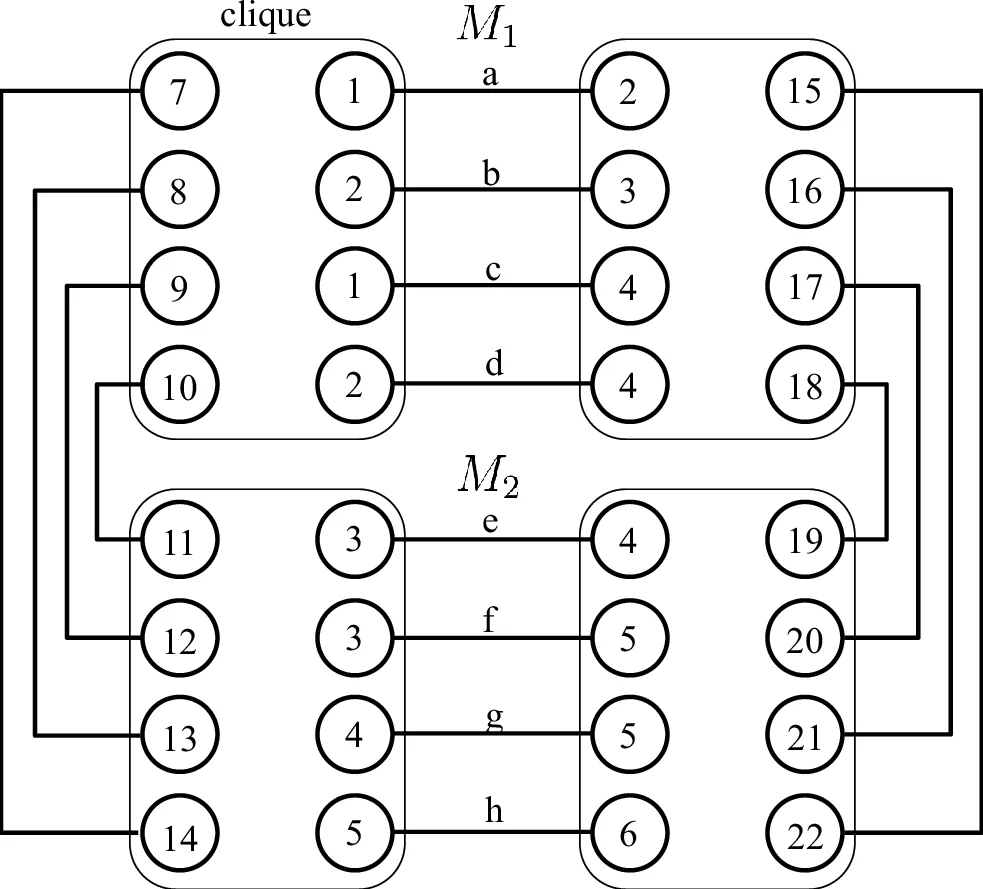
We propose and analyze a graph model to study the connectivity of interdependent networks. Two interdependent networks of arbitrary topologies are modeled as two graphs, where every node in one graph is supported by supply nodes in the other graph, and a node fails if all of its supply nodes fail. Such interdependence arises in cyber-physical systems and layered network architectures. We study the \emph{supply node connectivity} of a network: namely, the minimum number of supply node removals that would disconnect the network. We develop algorithms to evaluate the supply node connectivity given arbitrary network topologies and interdependence between two networks. Moreover, we develop interdependence assignment algorithms that maximize the supply node connectivity. We prove that a random assignment algorithm yields a supply node connectivity within a constant factor from the optimal for most networks.
💡 Research Summary
The paper introduces a deterministic graph‑theoretic framework for analyzing the robustness of two interdependent networks, a demand network and a supply network, which may represent, for example, a communication layer that depends on a power‑grid layer. Each node in the demand graph G₁(V₁,E₁) is linked to one or more nodes in the supply graph G₂(V₂,E₂) via directed dependency edges. A demand node remains functional as long as at least one of its supporting supply nodes is alive; it fails when all its supply nodes fail.
To capture the effect of supply‑node failures on the connectivity of the demand network, the authors define supply node cut and supply node connectivity. A supply node cut is a set of supply vertices whose removal induces a vertex cut in the demand graph, i.e., it forces a subset of demand vertices to fail and thereby disconnects the demand graph (or reduces it to a single vertex). The size of the smallest such set is the supply node connectivity; larger values indicate higher resilience against correlated supply failures.
The central technical contribution is a reduction of this problem to a colored‑node cut problem on a transformed graph. For each demand vertex v with nₛ(v) supply neighbors, the algorithm creates nₛ(v) copies of v, each colored by one of its supply nodes. No edges are placed among copies of the same original vertex, while edges of the original demand graph are replicated across all copies, producing a colored graph ˜G₁. In this representation, removing a color corresponds exactly to removing the associated supply node, and a color node cut is a set of colors whose associated vertices contain a vertex cut of ˜G₁. The authors prove a one‑to‑one correspondence between supply node cuts in the original interdependent system and color node cuts in ˜G₁ (Theorem 1). Consequently, the minimum number of colors in a color node cut equals the supply node connectivity.
Armed with this equivalence, the paper tackles two algorithmic problems. First, it formulates an integer programming model that computes the exact supply node connectivity for a given pair of networks, both for the global case and for a specific source‑destination (s‑t) pair. For the special case where each demand node has exactly one supply node, the authors devise a polynomial‑time algorithm based on standard min‑cut techniques. They also establish NP‑hardness for the general problem.
Second, the paper addresses the design problem: how to assign supply nodes to demand nodes so as to maximize the resulting supply node connectivity. Three assignment strategies are proposed:
- Node‑disjoint path assignment – construct multiple node‑disjoint paths between critical nodes, each using distinct supply nodes, ensuring that failure of any single supply node cannot break all paths.
- Disjoint connected dominating set (CDS) assignment – partition the demand graph into several connected dominating sets and allocate a separate supply node to each set, thereby guaranteeing that at least one CDS remains functional after any limited number of supply failures.
- Random assignment – assign supply nodes uniformly at random. Using probabilistic analysis (vertex sampling and graph partitioning), the authors show that with high probability the resulting supply node connectivity is within a constant factor of the optimal for most realistic topologies, and never worse than a logarithmic factor.
Complexity analysis shows that the color‑node‑cut problem inherits the hardness of the classical vertex‑cut problem, but the proposed approximation algorithms achieve provable bounds. The paper also provides a detailed discussion of how the colored‑graph model relates to the shared‑risk node group (SRNG) model used in layered optical networks, highlighting that the present work extends SRNG from edge‑centric to node‑centric risk modeling.
Simulation results on synthetic and realistic topologies (including a power‑communication interdependency model and an IP‑over‑WDM layered network) validate the theoretical findings. The random assignment strategy consistently attains 30‑50 % higher supply node connectivity compared with naïve mappings, while the CDS‑based algorithm approaches the optimal connectivity within a polylogarithmic factor.
In summary, the paper delivers a unified analytical framework that (i) precisely quantifies the robustness of interdependent networks via supply node connectivity, (ii) provides exact and approximation algorithms for evaluating this metric, and (iii) offers practical assignment schemes that substantially improve resilience. By translating interdependency into a colored‑graph formulation, the work bridges concepts from percolation theory, network reliability, and graph algorithms, delivering tools directly applicable to the design of robust cyber‑physical infrastructures such as smart grids, autonomous transportation systems, and multi‑layer communication networks.
Comments & Academic Discussion
Loading comments...
Leave a Comment