K_0-theory of n-potents in rings and algebras
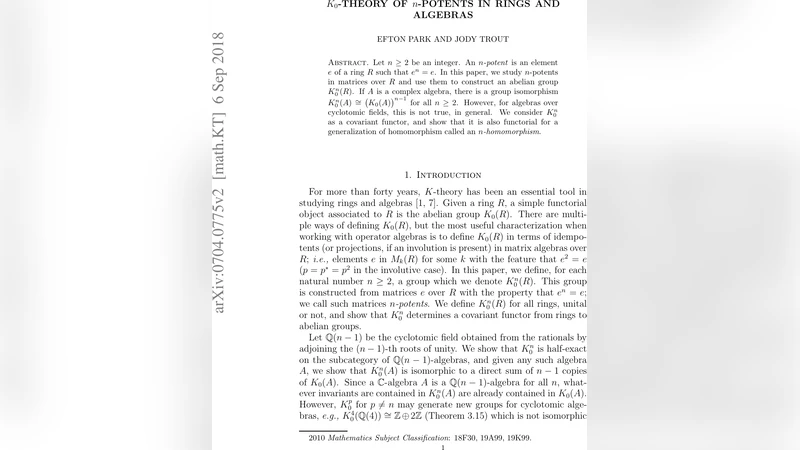
Let $n \geq 2$ be an integer. An \emph{$n$-potent} is an element $e$ of a ring $R$ such that $e^n = e$. In this paper, we study $n$-potents in matrices over $R$ and use them to construct an abelian group $K_0^n(R)$. If $A$ is a complex algebra, there is a group isomorphism $K_0^n(A) \cong \bigl(K_0(A)\bigr)^{n-1}$ for all $n \geq 2$. However, for algebras over cyclotomic fields, this is not true in general. We consider $K_0^n$ as a covariant functor, and show that it is also functorial for a generalization of homomorphism called an \emph{$n$-homomorphism}.
💡 Research Summary
The paper introduces a novel variant of algebraic K‑theory built from n‑potents, elements (e) of a ring (R) satisfying the polynomial equation (e^{,n}=e) for a fixed integer (n\ge 2). An n‑potent generalises the familiar idempotent ((n=2)) and, over a complex algebra, its minimal polynomial is (x(x^{,n-1}-1)). Consequently every n‑potent can be decomposed into a sum of (n-1) mutually orthogonal projections together with a possible zero‑part. The authors first develop the elementary algebraic properties of n‑potents, showing how they behave under direct sums, differences and similarity transformations, and how they can be put into a canonical block‑diagonal form in matrix algebras (M_k(R)).
Using these structural results they define an abelian group (K_0^{,n}(R)). The construction mirrors the classical definition of (K_0(R)) but replaces idempotents by n‑potents. One considers the set of equivalence classes of n‑potents in the stabilized matrix algebra (M_\infty(R)); the equivalence relation is generated by unitary similarity and addition of a trivial n‑potent. The group operation is induced by block‑diagonal direct sum, and the inverse of a class (
Comments & Academic Discussion
Loading comments...
Leave a Comment