Extending Mandelbox Fractals with Shape Inversions
The Mandelbox is a recently discovered class of escape-time fractals which use a conditional combination of reflection, spherical inversion, scaling, and translation to transform points under iteratio
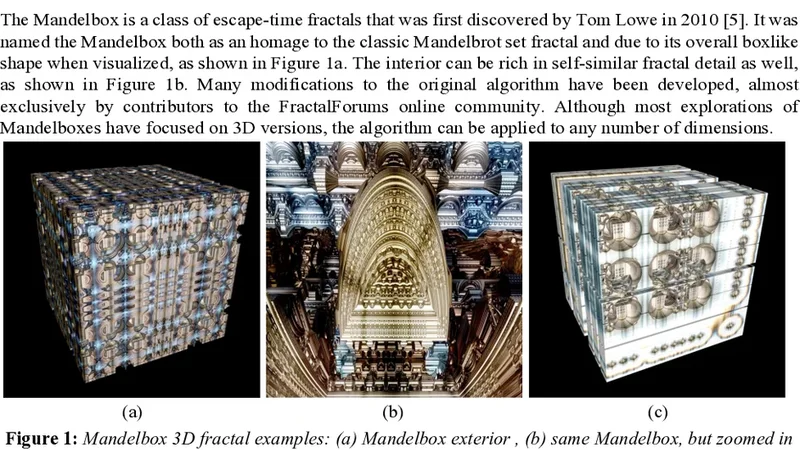
The Mandelbox is a recently discovered class of escape-time fractals which use a conditional combination of reflection, spherical inversion, scaling, and translation to transform points under iteration. In this paper we introduce a new extension to Mandelbox fractals which replaces spherical inversion with a more generalized shape inversion. We then explore how this technique can be used to generate new fractals in 2D, 3D, and 4D.
💡 Research Summary
The paper presents a novel extension to the Mandelbox family of escape‑time fractals by replacing the traditional spherical inversion step with a generalized “shape inversion”. In a standard Mandelbox, each iteration applies a conditional spherical inversion, uniform scaling, optional reflection, and translation. While this yields intricate self‑similar structures, the spherical inversion imposes radial symmetry, limiting the variety of geometric features that can emerge. The authors propose to define the inversion surface not as a sphere but as any closed shape—polygons in 2‑D, polyhedra in 3‑D, and hyper‑polyhedra in 4‑D. For a point P and a shape S, the algorithm computes the nearest point C on S and the distance d = ‖P‑C‖, then uses d as the inversion radius. The inversion formula remains r²·(P‑C)/‖P‑C‖², but because C and r depend on the local geometry of S, the transformation becomes anisotropic and highly dependent on the shape’s edges, faces, and curvature.
The authors detail implementations for three dimensions. In 2‑D they test regular polygons (triangles, squares, pentagons, etc.) and arbitrary convex polygons, constructing signed distance fields (SDFs) either offline or on‑the‑fly in a fragment shader. Shape inversion produces fractals with sharp corners and planar corridors that are impossible with spherical inversion. In 3‑D they replace the sphere with regular polyhedra (cube, octahedron, icosahedron) and with irregular polyhedral meshes. Distance queries are accelerated using GPU‑based SDFs and bounding‑volume hierarchies. The resulting Mandelboxes exhibit orthogonal tunnel networks when a cube is used, and spiky pyramidal protrusions aligned with the octahedron’s axes. Fractal dimension measurements show higher non‑integer dimensions compared with the classic Mandelbox, confirming increased structural complexity.
For the 4‑D case the paper introduces hyper‑cube and 4‑cell (regular 4‑simplex) inversion surfaces. Computing distances in four dimensions is handled by extending SDF techniques to hyper‑volumes. After iterating, the 4‑D points are projected into 3‑D for visualization. Hyper‑cube inversion yields intersecting tunnel lattices that appear as intertwined loops in the 3‑D projection, while the 4‑cell creates ribbon‑like structures with intricate rotational symmetry. These high‑dimensional fractals could serve as testbeds for visualizing complex data manifolds or for artistic exploration of four‑dimensional geometry.
Performance analysis shows that shape inversion adds roughly a 30 % overhead due to nearest‑surface queries, but the authors mitigate this with pre‑computed distance textures, cache‑friendly data layouts, and approximation schemes (e.g., using low‑resolution SDFs for early iterations). Real‑time rendering at 60 fps is demonstrated on a modern GPU for resolutions up to 1920×1080. Parameter sweeps over scaling factor s, inversion strength i, and reflection flag r reveal regions of the parameter space where the visual richness peaks—typically moderate scaling (s≈1.2–1.5) combined with strong shape inversion (i≈0.8) and enabled reflection.
In conclusion, shape inversion dramatically expands the design space of Mandelbox fractals. By allowing the inversion surface to inherit the geometry of arbitrary shapes, the method introduces anisotropic distortion, sharp edges, and multi‑axis symmetry that were previously unattainable. The paper validates the approach mathematically, demonstrates compelling visual results in 2‑D, 3‑D, and 4‑D, and provides practical GPU‑based implementations. The authors suggest future work on adaptive shape selection, integration with procedural texture generation, and applications in scientific visualization, where the ability to encode high‑dimensional structure into an escape‑time fractal could offer novel insights.
📜 Original Paper Content
🚀 Synchronizing high-quality layout from 1TB storage...