Optimal Energy-Aware Epidemic Routing in DTNs
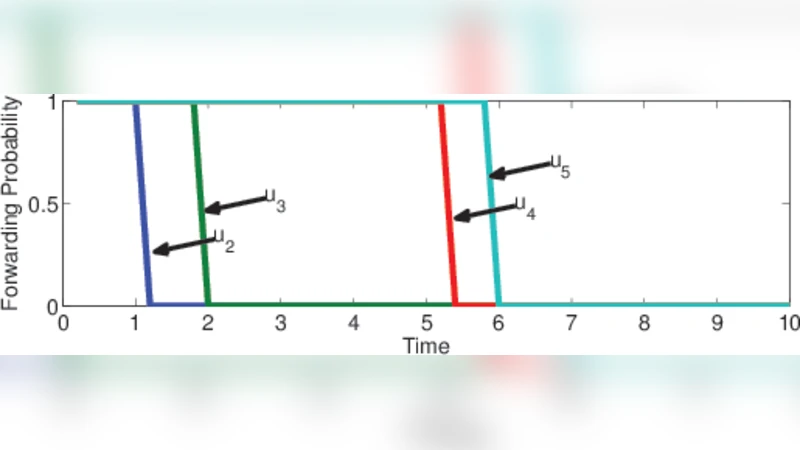
In this work, we investigate the use of epidemic routing in energy constrained Delay Tolerant Networks (DTNs). In epidemic routing, messages are relayed by intermediate nodes at contact opportunities, i.e., when pairs of nodes come within the transmission range of each other. Each node needs to decide whether to forward its message upon contact with a new node based on its own residual energy level and the age of that message. We mathematically characterize the fundamental trade-off between energy conservation and a measure of Quality of Service as a dynamic energy-dependent optimal control problem. We prove that in the mean-field regime, the optimal dynamic forwarding decisions follow simple threshold-based structures in which the forwarding threshold for each node depends on its current remaining energy. We then characterize the nature of this dependence. Our simulations reveal that the optimal dynamic policy significantly outperforms heuristics.
💡 Research Summary
This paper addresses the fundamental trade‑off between energy consumption and quality‑of‑service (QoS) in delay‑tolerant networks (DTNs) that employ epidemic routing. In epidemic routing every contact between a node that carries a copy of a message (an “infective”) and a node that does not (a “susceptible”) may result in a new copy being created. While this maximizes delivery probability, it also rapidly drains the limited batteries of mobile nodes. The authors therefore formulate a dynamic, energy‑aware forwarding problem as an optimal control problem that explicitly balances energy depletion against a delivery‑time guarantee.
The system model assumes a large population of homogeneous nodes (mean‑field regime) with a discrete energy budget of B units. Transmitting a message consumes s units of energy for the sender and r units (r ≤ s) for the receiver. Node contacts occur as a Poisson process with rate β̂ per pair, leading to a total contact rate β = N β̂ for a network of N nodes. The state of the network at time t is described by the fractions S_i(t) of susceptibles and I_i(t) of infectives that have exactly i units of residual energy (i = 0,…,B). Using the mean‑field approximation, the authors derive a set of 2(B + 1) ordinary differential equations (ODEs) that capture the evolution of these fractions under a generic forwarding policy u_j(t), where u_j(t)∈
Comments & Academic Discussion
Loading comments...
Leave a Comment