Game Design with Pocket Code: Providing a Constructionist Environment for Girls in the School Context
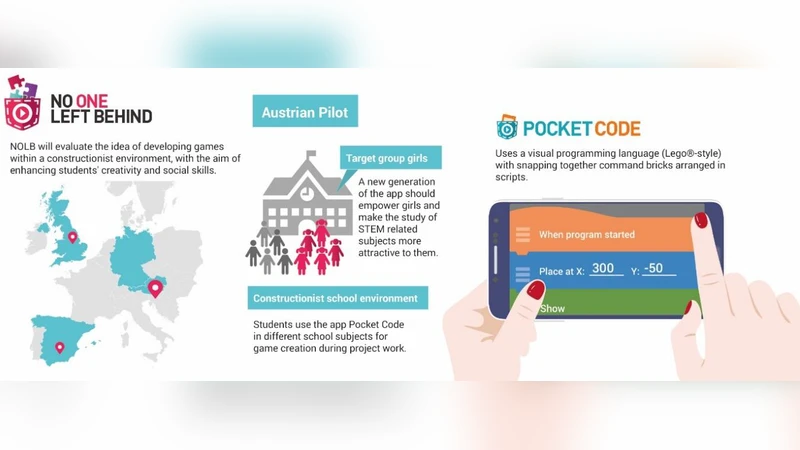
The widespread use of mobile phones is changing how learning takes place in many disciplines and contexts. As a scenario in a constructionist learning environment, students are given powerful tools to create games using their own ideas. In the “No One Left Behind” (NOLB) project we will study through experimental cycles whether the use of mobile game design has an impact on learning, understanding, and retention of knowledge for students at risk of social exclusion. We will use the mobile learning app Pocket Code with partner schools in three countries: Austria, Spain, and the UK. This paper focuses on the Austrian pilot, which is exploring gender inclusion in game creation within an educational environment. We first study differences in game creation between girls and boys. This study that started in September 2015, will help teachers to integrate Pocket Code effectively into their courses. For future studies an enhanced school version of Pocket Code will be designed using the results and insights gathered at schools with pupils and teachers.
💡 Research Summary
The paper reports on the Austrian pilot of the EU‑funded “No One Left Behind” (NOLB) project, which investigates whether mobile game creation with the Pocket Code app can improve learning outcomes, knowledge retention, and especially gender inclusion for students at risk of social exclusion. Pocket Code is a visual, Lego‑style programming environment for Android smartphones that lets learners build games, animations, and interactive media directly on their devices, thereby bypassing the need for expensive school computers.
Grounded in constructivist and constructionist theory, the project treats game development as an artefact‑making activity that integrates cognitive (problem solving, abstraction) and social (collaboration, peer feedback) dimensions of learning. The authors focus on gender differences: prior research shows that girls tend to spend more time on visual customization and narrative, while boys gravitate toward logical puzzles and variable manipulation. The pilot therefore aims to discover how these preferences manifest in a classroom setting and how the tool can be adapted to support girls’ interests.
The Austrian study involved three secondary schools around Graz (Akademisches Gymnasium Graz, Graz International Bilingual School, and BORG Birkfeld) with 190 participants aged 11‑16 (122 girls). The research design comprised two main phases.
-
Student Workshops (July 2015) – A four‑hour, hands‑on session introduced Pocket Code through the theme “150 years of Alice in Wonderland.” Students formed small groups, pitched game ideas, created storyboards, and programmed without direct coding instruction, receiving only scaffolded support from facilitators. A pre‑installed “Shape of a Game” taxonomy (title screen, instruction screen, gameplay screen, end screen) provided a structural template. Over 30 games (mazes, quizzes, platformers, racing, adventure) were produced. Post‑workshop surveys showed 98 % rated the workshop as good or very good, 90 % were satisfied with their results, and 89 % liked teamwork. However, observers noted recurring difficulties with collision detection, background movement, and variable handling.
-
Teacher Training and Feasibility Study (September 2015 onward) – Teachers first completed an online questionnaire to assess digital skills. Two‑hour training sessions then familiarized them with Pocket Code’s brick library, tutorial cards, and the “Shape of a Game” framework. Teachers co‑designed lesson plans for subjects such as Arts (vocabulary‑learning game using phone tilt), Physics (density‑based game), and Computer Science (open‑ended creative coding). In the feasibility study, students worked in at least three units per subject, with girls often grouped together to foster a supportive environment.
Data collection includes pre‑ and post‑surveys, classroom observations, and game analytics (e.g., number of bricks used, types of game mechanics). The analysis focuses on:
- Gender‑specific design patterns – Girls favored richer graphics, story elements, and customization; boys emphasized logical flow and variable‑driven mechanics.
- Learning barriers – The three technical functions repeatedly cited as problematic (collision, background motion, variables) indicate where additional scaffolding or instructional videos are needed.
- Teacher needs – Differentiated resources (step‑by‑step tutorials, video guides, subject‑specific frameworks) were essential for teachers with varying digital proficiency.
Key findings: Pocket Code successfully engages students in constructionist learning and is technically feasible on standard smartphones. Gender differences are evident both in design choices and in the types of obstacles encountered, suggesting that a one‑size‑fits‑all curriculum is insufficient. Tailored tutorial cards and example games that highlight visual storytelling can increase girls’ motivation, while more advanced logic‑focused challenges can keep boys engaged. Teacher empowerment through targeted professional development is critical; without adequate support, integration into existing curricula stalls.
The authors propose developing a school‑specific version of Pocket Code that incorporates gender‑responsive UI elements, richer media libraries, and built‑in analytics to monitor progress. Future work will compare the Austrian results with pilots in Spain and the UK, perform longitudinal assessments of knowledge retention, and refine the “Shape of a Game” framework based on cross‑cultural feedback. Ultimately, the project aims to lower barriers to STEM participation for socially excluded learners, particularly girls, by making coding a creative, collaborative, and personally meaningful activity.
Comments & Academic Discussion
Loading comments...
Leave a Comment