Mining (maximal) span-cores from temporal networks
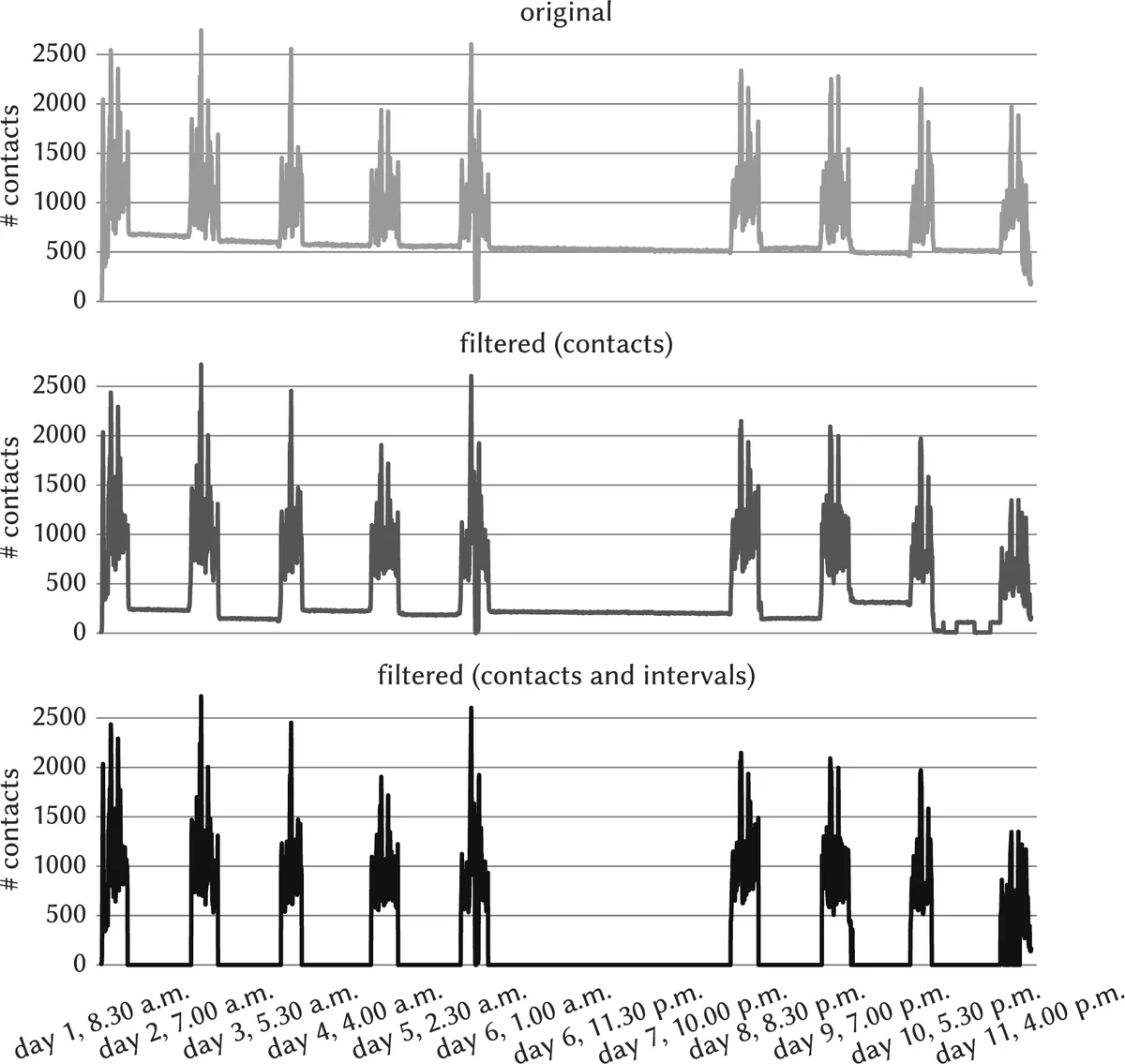
When analyzing temporal networks, a fundamental task is the identification of dense structures (i.e., groups of vertices that exhibit a large number of links), together with their temporal span (i.e., the period of time for which the high density holds). We tackle this task by introducing a notion of temporal core decomposition where each core is associated with its span: we call such cores span-cores. As the total number of time intervals is quadratic in the size of the temporal domain $T$ under analysis, the total number of span-cores is quadratic in $|T|$ as well. Our first contribution is an algorithm that, by exploiting containment properties among span-cores, computes all the span-cores efficiently. Then, we focus on the problem of finding only the maximal span-cores, i.e., span-cores that are not dominated by any other span-core by both the coreness property and the span. We devise a very efficient algorithm that exploits theoretical findings on the maximality condition to directly compute the maximal ones without computing all span-cores. Experimentation on several real-world temporal networks confirms the efficiency and scalability of our methods. Applications on temporal networks, gathered by a proximity-sensing infrastructure recording face-to-face interactions in schools, highlight the relevance of the notion of (maximal) span-core in analyzing social dynamics and detecting/correcting anomalies in the data.
💡 Research Summary
The paper introduces a novel concept called “span‑core” for temporal networks, extending the classic k‑core notion by coupling each dense subgraph with a contiguous time interval during which the density condition holds. Formally, given a temporal graph G = (V, T, τ) and an interval Δ ⊆ T, a (k, Δ)‑core is the maximal set of vertices C such that every vertex in C has at least k neighbors in the subgraph induced by edges that exist throughout the whole interval Δ. This definition captures both structural cohesiveness (through k) and temporal persistence (through Δ).
The authors first address the problem of computing the full span‑core decomposition, i.e., all (k, Δ)‑cores for every possible interval. A naïve approach would run a standard core‑decomposition algorithm on the static graph G_Δ for each of the O(|T|²) intervals, leading to O(|T|²·|E|) time. The paper observes that span‑cores obey a two‑dimensional containment property: if k′ ≤ k and Δ′ ⊑ Δ (Δ′ is a superset interval), then C_{k,Δ} ⊆ C_{k′,Δ′}. Leveraging this, the authors design Algorithm 1, which processes intervals in increasing length. For an interval Δ =
Comments & Academic Discussion
Loading comments...
Leave a Comment