Field Formulation of Parzen Data Analysis
The Parzen window density is a well-known technique, associating Gaussian kernels with data points. It is a very useful tool in data exploration, with particular importance for clustering schemes and image analysis. This method is presented here within a formalism containing scalar fields, such as the density function and its potential, and their corresponding gradients. The potential is derived from the density through the dependence of the latter on the common scale parameter of all Gaussian kernels. The loci of extrema of the density and potential scalar fields are points of interest which obey a variation condition on a novel indicator function. They serve as focal points of clustering methods depending on maximization of the density, or minimization of the potential, accordingly. The mixed inter-dependencies of the different fields in d-dim data-space and 1-d scale-space, are discussed. They lead to a Schr\H{o}dinger equation in d-dim, and to a diffusion equation in (d+1)-dim
💡 Research Summary
The paper presents a unified field‑theoretic formulation of Parzen‑window density estimation and shows how this formulation naturally leads to several well‑known clustering paradigms. Starting from the classic Parzen estimator, the authors define a scalar density field ρ(x;q) as a sum of Gaussian kernels with a common scale parameter q. By differentiating the logarithm of ρ with respect to ln q they introduce a potential field V(x;q)=−∂ ln ρ/∂ ln q, which captures the scale dependence of the density. The pair (ρ,V) are shown to satisfy a Schrödinger‑type equation in the d‑dimensional data space: −½∇²ψ+Vψ=Eψ, where ψ=√ρ and E is a function of q. This equation reproduces the mathematical structure of Quantum Clustering (QC) without invoking any physical quantum interpretation.
In parallel, the authors treat the Gaussian kernel as the Green’s function of the diffusion equation, thereby establishing a direct link between the Parzen estimator and scale‑space theory. By identifying the scale parameter q with a fictitious time variable, ρ evolves according to a (d+1)‑dimensional diffusion equation, which provides an alternative viewpoint on multi‑scale analysis.
The paper further decomposes the density into a weight‑shape product ρ=W·S, where W represents a global weight (essentially a normalized sum over data points) and S encodes local shape information. An entropy functional H=−∫ρ ln ρ dx is introduced and related to the potential via H=V+ln Z, drawing an explicit analogy to statistical mechanics.
Two vector fields are defined: D=∇ρ (the gradient of the density) and E=∇V (the gradient of the potential). The zeros of D locate local maxima/minima of ρ, while the zeros of E locate extrema of V. When both D and E vanish simultaneously, the point is a stationary point of both fields, which the authors argue corresponds to a natural cluster boundary. The inter‑dependence of D and E is expressed through a set of coupled equations (13‑15), revealing that variations of D with respect to the scale q are directly tied to the behavior of E.
A novel indicator function U(x,q)=|∇ρ·∇V| is introduced, and the condition ∂U/∂q=0 is proposed as a variational principle for selecting an optimal scale. This condition resembles the score function in classical statistics but differs because ρ is not normalized. The authors argue that extrema that remain stable over a wide range of q are the most informative for clustering.
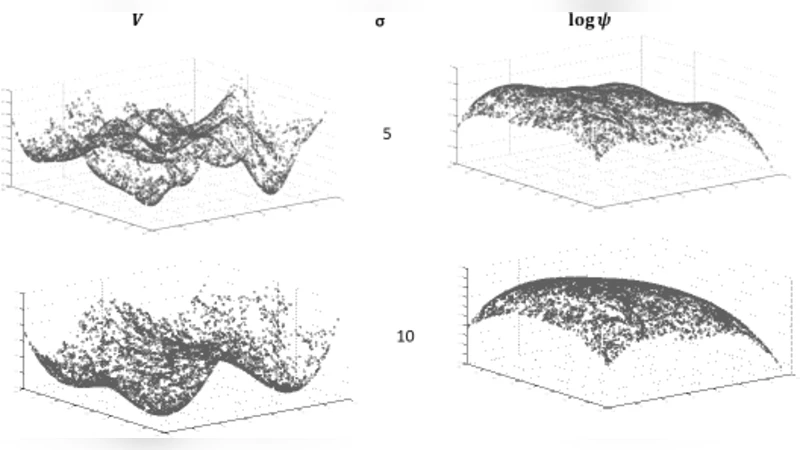
Empirical results on a dataset of 9,000 galaxies illustrate the theory. With small kernel widths (σ≈2) both ρ and V exhibit many local extrema, whereas with larger widths (σ≈10) the potential V retains only a few deep basins while the density smooths out. This demonstrates that mean‑shift clustering (which follows density maxima) and quantum clustering (which follows potential minima) can be understood as two sides of the same field‑theoretic framework. The weight‑shape decomposition further clarifies how global and local information contribute to the clustering process.
In the concluding section the authors summarize three key equations—(7) defining the potential, (13) linking the vector fields, and (16) describing the scale‑stationarity condition—and explain how they together govern the behavior of density, potential, and entropy across data and scale spaces. They highlight that the manifolds separating potential minima are (d‑1)‑dimensional, and that strings or surfaces of minima can serve as natural cluster skeletons. The paper suggests several avenues for future work, including robustness analysis for high‑dimensional noisy data, real‑time adaptive scale selection, and extensions to hierarchical maximum‑shape clustering. Overall, the work offers a mathematically elegant bridge between kernel density estimation, quantum‑inspired clustering, and diffusion‑based multi‑scale analysis, providing a common language for a wide class of unsupervised learning algorithms.
Comments & Academic Discussion
Loading comments...
Leave a Comment