Autonomous decision-making against induced seismicity in deep fluid injections
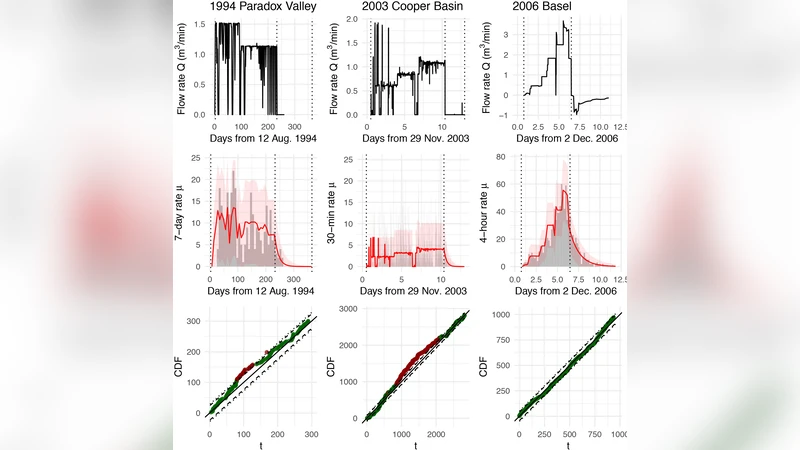
The rise in the frequency of anthropogenic earthquakes due to deep fluid injections is posing serious economic, societal, and legal challenges to geo-energy and waste-disposal projects. We propose an actuarial approach to mitigate this risk, first by defining an autonomous decision-making process based on an adaptive traffic light system (ATLS) to stop risky injections, and second by quantifying a “cost of public safety” based on the probability of an injection-well being abandoned. The ATLS underlying statistical model is first confirmed to be representative of injection-induced seismicity, with examples taken from past reservoir stimulation experiments (mostly from Enhanced Geothermal Systems, EGS). Then the decision strategy is formalized: Being integrable, the model yields a closed-form ATLS solution that maps a risk-based safety standard or norm to an earthquake magnitude not to exceed during stimulation. Finally, the EGS levelized cost of electricity (LCOE) is reformulated in terms of null expectation, with the cost of abandoned injection-well implemented. We find that the price increase to mitigate the increased seismic risk in populated areas can counterbalance the heat credit. However this “public safety cost” disappears if buildings are based on earthquake-resistant designs or if a more relaxed risk safety standard or norm is chosen.
💡 Research Summary
The paper addresses the growing problem of anthropogenic earthquakes triggered by deep fluid injections, which threaten the economic viability, societal acceptance, and regulatory compliance of geo‑energy and waste‑disposal projects. The authors propose an actuarial framework that couples an Adaptive Traffic Light System (ATLS) with a revised Levelized Cost of Electricity (LCOE) that explicitly incorporates a “public safety cost” arising from the probability of abandoning an injection well.
Statistical model of induced seismicity
The ATLS relies on a simple yet physically motivated statistical model linking the instantaneous seismicity rate λ(t) to the injection flow rate V(t). During injection, λ(t) = a · V(t) · 10^{m − b·V(t)} where a is an activation‑feedback parameter (analogous to the seismogenic index) and b governs the magnitude‑flow relationship. After the injection stops (t > t*), λ(t) decays exponentially with a diffusion time constant τ. This formulation captures the linear increase of seismicity with flow during stimulation and the diffusion‑controlled decay afterwards. The model has been validated on four classic case studies (KTB, Paradox Valley, Basel, Garvin, Newberry) and a new dataset from the Cooper Basin (Australia). Kolmogorov‑Smirnov tests reveal occasional local mis‑fits, attributed to missing on‑site information such as non‑linear pressure‑flow coupling or higher‑order processes.
Mapping risk‑based safety standards to magnitude thresholds
Traditional TLS use fixed magnitude or peak ground velocity thresholds. In contrast, ATLS translates a regulatory safety norm—expressed as an individual risk (IR) probability (e.g., IR ≤ 10⁻⁶)—into a probability Y of exceeding a given magnitude m#. This conversion incorporates building typology, seismic attenuation, and distance from the borehole via a macro‑seismic risk model. The resulting relationship (Eq. 2‑3) yields a time‑varying magnitude ceiling m* that must not be exceeded; when the forecasted m* is reached, injection is automatically halted. Because b and τ evolve during stimulation, m* is dynamically updated.
Real‑time Bayesian updating
The authors adopt a hierarchical Bayesian framework (Broccardo et al., 2017) to update the parameters a, b, and τ on‑line as seismic observations accumulate. This enables the ATLS to remain autonomous: once a safety norm is set by authorities, the system continuously recalculates the permissible magnitude and issues stop‑injection commands without human intervention.
Incorporating “public safety cost” into LCOE
If the ATLS forces a well to be shut down, the operator must drill a replacement well, incurring an additional cost Cₚ. The authors embed this cost in the LCOE by treating the outcome of a project as a Bernoulli trial: with probability (1 − π) the well succeeds, with probability π it is abandoned and the extra cost Cₚ is incurred. The expected price P = C/E + π·Cₚ/E (Eq. 4) shows that any non‑zero abandonment probability raises the LCOE.
Illustrative scenario
A hypothetical stimulation injects 40,000 m³, targets a maximum magnitude M# = 7, and considers two safety norms (IR ≤ 10⁻⁶ and IR ≤ 10⁻⁵) for a building located at distance d from a 6 km deep borehole. Using macro‑seismic risk curves for EMS‑98 class C (non‑seismic‑resistant) and class D (seismic‑resistant) structures, the authors compute π as the fraction of risk curves that would trigger the ATLS before the planned volume is reached. Results show that π declines with increasing distance, but the associated LCOE increase (due to the need for a replacement well) can offset the heat credit of geothermal energy. When seismic‑resistant design is assumed, π essentially vanishes, eliminating the public safety cost.
Conclusions and policy implications
The paper delivers a complete, quantitative governance loop: (1) a statistical model linking injection to seismicity, (2) a formal mapping from regulatory risk standards to magnitude thresholds, (3) an autonomous decision engine that updates in real time, and (4) an economic assessment that internalizes the cost of safety‑driven well abandonment into LCOE. This framework can be embedded in smart electricity markets and insurance smart contracts. Limitations include the reliance on a parsimonious two‑parameter model, the need for richer on‑site data to capture non‑linear feedbacks, and the challenge of estimating π robustly across diverse geological settings. Future work should explore more complex physical models, broaden validation datasets, and develop transparent data‑sharing protocols between regulators and operators to enable the practical deployment of ATLS‑guided risk governance.
Comments & Academic Discussion
Loading comments...
Leave a Comment