Library Information System Audit Senayan Library Management System (SLiMS) Using ISO 9126
The library serves as a vehicle for education, research, conservation, information, and recreation to improve the nation’s intelligence and empowerment [1]. The function of the library as a place of education, research, and information provides an opportunity to use the information system of Senayan Library Management System (SLiMS) in the library in order to improve the service to the user, increase the reading interest, and expand the insight and knowledge to educate the nation. The use of ISO 9126 standard is able to know the quality of SLiMS information system which is said to be free of charge of usage and license (because it belongs to Open Source Software category [2]) to assist library management in Indonesia. The implementation of the SLiMS information system audit in several university libraries refers to the ISO 9126 standard by using the Functionality, Reliability, Usability, Efficiency, Maintainability and Portability aspects through distributing questionnaires to university librarians in charge. With the help of the use of Google Forms it turns out that only ten universities librarians in charge who are willing to fill out the questionnaires are IPMI IBS, Bakrie University, Perbanas Institute Jakarta, STMIK & Bina Insani Academy, Prasetya Mulya University, Agung Podomoro University, Indonesian Higher Law School, Matana University, STIKS Tarakanita Jakarta, and STAI-PIQ West Sumatra. From the results of data processing it is known that SLiMS included in the category VERY GOOD for use in the management of libraries in college. This means that the ten universities librarians in charge admitted and have proven that SLiMS is very helpful in library management.
💡 Research Summary
The paper presents an empirical quality assessment of the Senayan Library Management System (SLiMS), an open‑source library automation solution widely deployed in Indonesian higher‑education institutions. Recognizing the library’s pivotal role in education, research, preservation, information dissemination, and recreation, the authors argue that a robust information system is essential for effective library services. SLiMS, released under the GPL v3 license, is built with PHP, MySQL, and Git, offering a comprehensive suite of modules such as OPAC with thumbnail previews, bibliographic management, circulation, membership handling, reporting, multimedia support, multilingual interfaces, and Z39.50/MARC interoperability.
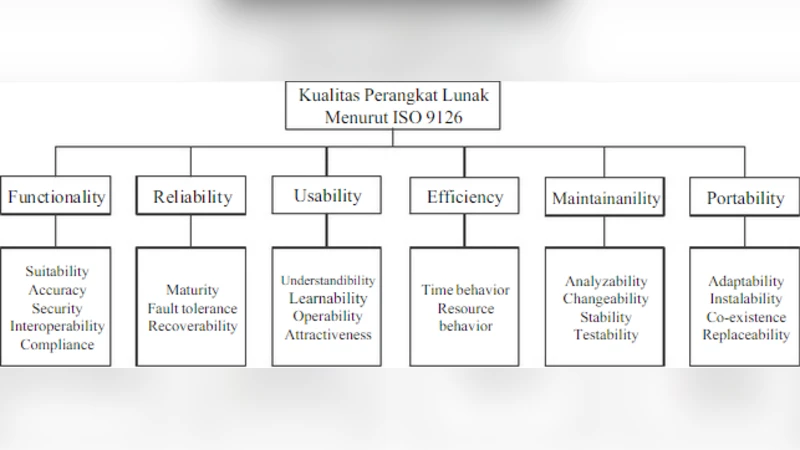
To evaluate SLiMS against the internationally recognized ISO 9126 software quality model, the study adopts a descriptive‑quantitative approach. ISO 9126 defines six quality characteristics—Functionality, Reliability, Usability, Efficiency, Maintainability, and Portability—each further broken down into sub‑characteristics. The authors designed a questionnaire comprising 21 items (four to five items per characteristic) and administered it via Google Forms to librarians-in‑charge from ten universities: IPMI IBS, Bakrie University, Perbanas Institute Jakarta, STMIK & Bina Insani Academy, Prasetya Mulya University, Agung Podomoro University, Indonesian Higher Law School, Matana University, STIKS Tarakanita Jakarta, and STAI‑PIQ West Sumatra.
Responses were captured on a four‑point Likert scale (4 = Strongly Agree, 3 = Agree, 2 = Disagree, 1 = Strongly Disagree). The authors calculated the maximum possible scores for each quality level (Very Good = respondents × 4 × questions, Good = respondents × 3 × questions, etc.) and compared the actual summed scores to these thresholds. The overall total score was 728 out of a possible 840, representing 86.7 % of the “Very Good” ceiling; according to the authors’ classification scheme, this places SLiMS in the “Very Good” category.
When examined per characteristic, the system also achieved “Very Good” or near‑maximum scores: Functionality (148/160), Reliability (…), Usability (…), Efficiency (…), Maintainability (…), and Portability (…). The authors interpret these results as follows:
- Functionality – SLiMS provides all core library functions (cataloguing, circulation, reporting, OPAC, multimedia handling, etc.) and operates consistently across diverse hardware and operating‑system environments.
- Reliability – Users reported infrequent system failures and strong data integrity, indicating stable performance under routine workloads.
- Usability – The interface is considered intuitive, with multilingual support and a shallow learning curve, leading to high user satisfaction.
- Efficiency – The lightweight web architecture (PHP/MySQL) consumes modest server resources, delivering acceptable response times.
- Maintainability – Being open source, SLiMS benefits from an active community, regular updates, and version control via Git, simplifying bug fixes and feature extensions.
- Portability – The web‑based design runs smoothly on various browsers and devices, including mobile platforms, confirming good cross‑environment compatibility.
The study acknowledges several limitations. The sample size (10 institutions) is modest, restricting the generalizability of findings to the broader Indonesian higher‑education sector. The reliance on self‑reported Likert items introduces subjectivity and may not capture objective performance metrics such as transaction throughput or latency. Moreover, ISO 9126 has been superseded by ISO 25010; future work could adopt the newer model to enable more contemporary comparisons.
In conclusion, the research provides concrete evidence that SLiMS, despite being a free open‑source solution, meets or exceeds the quality expectations set by ISO 9126 across all six dimensions. This positions SLiMS as a viable, cost‑effective alternative to proprietary library management systems, not only for Indonesian universities but also for other institutions seeking robust, customizable, and sustainable library automation. The findings support broader adoption and encourage further development, including performance benchmarking and alignment with the latest ISO software quality standards.
Comments & Academic Discussion
Loading comments...
Leave a Comment