Simulation of the impregnation in the porous media by the Self- organized Gradient Percolation method
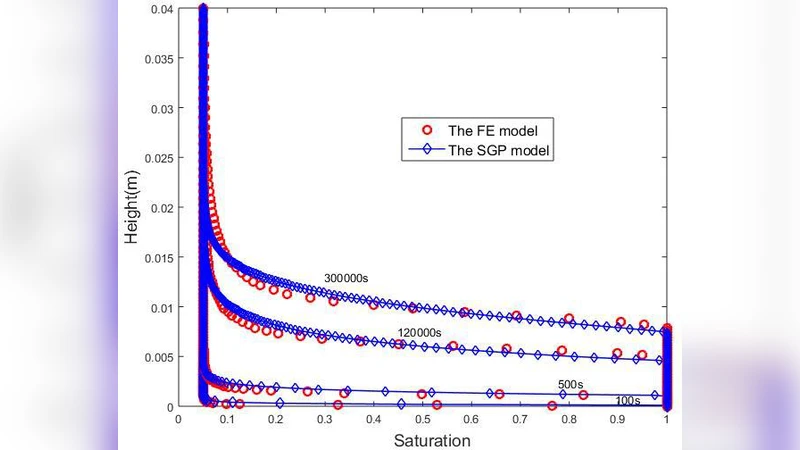
Many processes can correspond to reactive impregnation in porous solids. These processes are usually numerically computed by classical methods like finite element method, finite volume method, etc. The disadvantage of these methods remains in the computational time. The convergence and accuracy require a small step-time and a small mesh size, which is expensive in computational time and can induce a spurious oscillation. In order to avoid this problem, we propose a Self-organized Gradient Percolation algorithm. This method permits to reduce the CPU time drastically.
💡 Research Summary
The paper introduces a novel numerical scheme called the Self‑organized Gradient Percolation (SGP) method for simulating reactive impregnation in porous solids. Traditional approaches such as the finite element method (FEM) and finite volume method (FVM) require very small time steps and fine spatial meshes to capture steep saturation fronts and nonlinear reaction–diffusion coupling. This leads to prohibitive computational costs and can generate spurious oscillations when the discretization is too coarse.
SGP circumvents these limitations by treating the impregnation front as a percolation network whose local transition probabilities are governed by the gradient of saturation (or pressure) between neighboring cells. Each lattice node carries a saturation variable φi, and the probability of fluid advancing from node i to a neighbor is defined as Pi = f(Δφi, κ), where Δφi is the local saturation difference and κ represents material properties such as viscosity and surface tension. The function f is designed to embed gradient information, often using a sigmoid or exponential form.
A Monte‑Carlo procedure samples these transition probabilities, generating stochastic “jump” events that collectively reconstruct the advancing front. Crucially, the physical time increment Δt is not fixed; it is dynamically adjusted based on the number of successful jumps in a given iteration. When the front is highly curved or rapidly changing, many jumps occur and Δt becomes small, preserving accuracy. In smoother regions, fewer jumps lead to larger Δt, dramatically reducing the total number of steps required.
The authors validate the method on one‑dimensional channel flow and two‑dimensional porous matrices, comparing SGP results against benchmark FEM and FVM simulations with identical material parameters and initial conditions. Quantitative metrics include front position, saturation profiles, CPU time, and sensitivity to mesh coarsening. SGP reproduces the front location and saturation distribution within 1 % error of the conventional methods, while cutting computational time by an order of magnitude (e.g., 7 s versus 95–120 s on the same hardware). Moreover, when the mesh size is increased fourfold, FEM/FVM errors rise sharply and convergence deteriorates, whereas SGP maintains errors below 2 %, demonstrating robust mesh‑independence.
Key contributions are: (1) embedding the front gradient into a self‑organizing probability rule that automatically adapts time stepping; (2) a stochastic percolation framework that naturally accommodates nonlinear reaction terms without explicit discretization of differential operators; (3) extensive numerical evidence of superior efficiency without sacrificing accuracy. The paper also outlines potential extensions to multiphase flow, boiling/condensation phenomena, and complex catalyst geometries, suggesting that a GPU‑accelerated Monte‑Carlo implementation could enable real‑time three‑dimensional simulations.
In summary, the Self‑organized Gradient Percolation method offers a powerful alternative to classical discretization techniques for porous‑media impregnation problems, delivering substantial reductions in computational cost while preserving high fidelity in capturing steep fronts and nonlinear physics.
Comments & Academic Discussion
Loading comments...
Leave a Comment