Mapping the efficiency of international scientific collaboration between cities worldwide
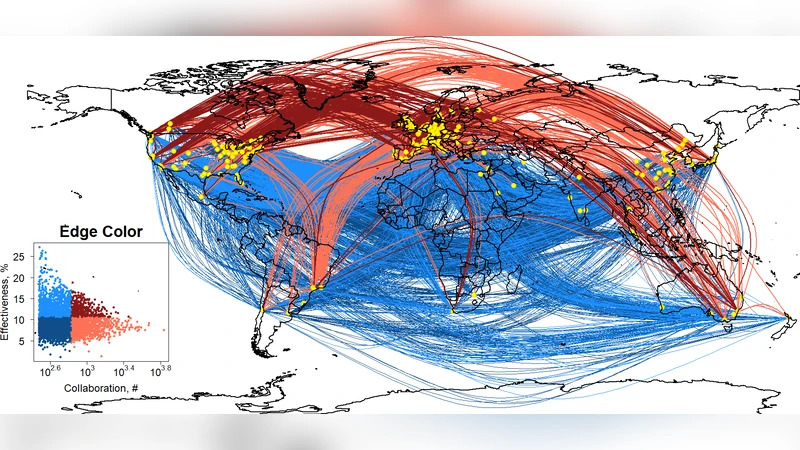
International scientific collaboration, a fundamental phenomenon of science, has been studied from several perspectives for decades. In the spatial aspect of science of science, cities have been considered by their publication output or by their citation impact. In this visualization, we go beyond these well-known approaches and map international scientific collaboration patterns of the most prominent science hubs considering both the quantity and the impact of papers produced in the collaboration. The analysis involves 245 cities and the collaboration matrix contains a total number of 7,718 international collaboration links. Results show that US-Europe co-publication links are more efficient in terms of producing highly cited papers than those international links that Asian cities have built in scientific collaboration.
💡 Research Summary
This paper investigates the efficiency of international scientific collaboration at the city level, moving beyond the traditional country‑ or region‑based analyses that dominate spatial scientometrics. The authors selected 245 cities that each produced at least 10,000 publications between 2014 and 2016, using author affiliation addresses from the Web of Science (SCI‑Expanded, SSCI, and A&HCI). Only city‑to‑city pairs that generated a minimum of 300 co‑authored papers over the three‑year period (an average of 100 papers per year) were retained, resulting in a collaboration matrix of 7,718 international links that satisfy this threshold.
Collaboration efficiency is defined as the proportion of highly cited papers among all joint publications for a given city dyad. “Highly cited” refers to papers that fall within the top citation percentiles (typically the top 10 % or 1 %). This metric captures not just the volume of cooperation but its capacity to generate breakthrough research. To explore patterns, the authors split both the number of collaborations and the efficiency values at the 80th percentile, creating four quadrants: low collaboration/low efficiency (4,997 links), low collaboration/high efficiency (1,180 links), high collaboration/low efficiency (1,178 links), and high collaboration/high efficiency (363 links). In the visualisation, edge colour denotes the quadrant, while edge curvature direction (clockwise for links above the 80th percentile of collaboration volume, counter‑clockwise otherwise) adds a second visual cue.
The analysis yields several key findings. First, collaborations between North‑American, Western‑European, and Australian cities tend to be both prolific and relatively efficient; the average efficiency of these high‑volume links hovers around the overall mean (≈9 %). The London‑Paris link, the most productive pair with over 6,800 joint papers, exemplifies this trend, showing an efficiency close to the average. Second, links involving major Asian cities (Beijing, Shanghai, Tokyo, Seoul, Hong Kong, etc.) and Western partners, while numerous, generally display efficiencies below the global average. This suggests that sheer quantity does not guarantee high impact in these cross‑regional partnerships. Third, a small set of low‑volume yet high‑efficiency links stands out. The Toulouse‑Copenhagen pair achieves an efficiency of 27.2, more than three times the average, despite only 300–400 joint papers. Similar patterns appear for Warsaw‑Nijmegen, Padua‑Toronto, and Helsinki‑Montreal. In each case, the dominant discipline is astronomy/astrophysics, a field known for a high share of highly cited work. The authors argue that when collaborations are concentrated in a few elite researchers or niche fields, the probability of producing breakthrough, highly cited results increases dramatically. Fourth, the traditional explanatory variables—geographic proximity, historical/cultural/linguistic ties, and overall output size—account for the efficiency of many high‑volume links but fail to explain the outliers in the high‑efficiency/low‑volume quadrant. Discipline‑specific productivity and the presence of star researchers appear to be decisive.
Methodologically, the study relies on R for network visualisation and mapping, and all processed data are deposited in the Harvard Dataverse. The authors acknowledge limitations: city boundaries are not uniformly defined across datasets; the Web of Science address field may miss or misclassify some affiliations; and using a single citation‑based indicator may not capture other dimensions of scientific impact (e.g., patents, policy influence). They suggest future work should incorporate multiple performance metrics, longitudinal dynamics, and richer contextual variables such as funding levels and institutional policies to better understand what drives efficient international collaboration at the urban scale.
Comments & Academic Discussion
Loading comments...
Leave a Comment