Multi-scale seismic envelope inversion using a direct envelope Frechet derivative for strong-nonlinear full waveform inversion
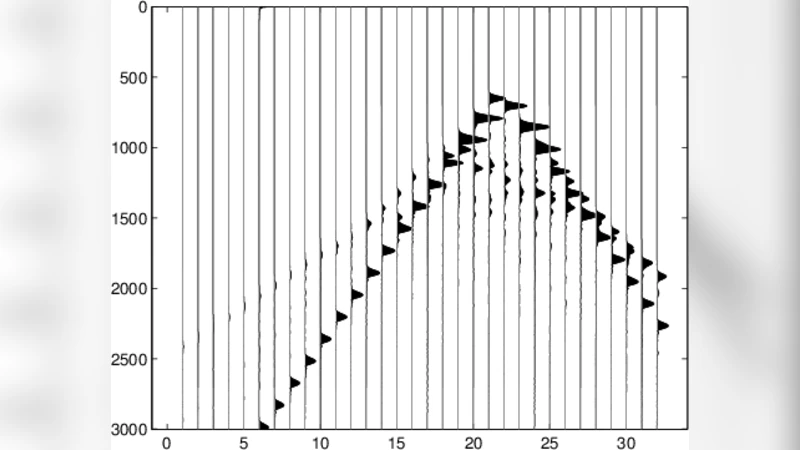
Traditional seismic envelope inversion takes use of a nonlinear misfit functional which relates the envelope of seismogram to the observed wavefield records, and then derive the sensitivity kernel of envelope to velocity through the use of waveform Frechet derivative by linearizing the nonlinear functional. We know that the waveform Frechet derivative is based on the Born approximation of wave scattering and can only work for the case of weak scattering. Therefore, the traditional envelope inversion using waveform Frechet derivative has severe limitation in the case of strong-scattering for large-scale, strong-contrast inclusions. In this paper, we derive a new direct envelope Frechet derivative (sensitivity operator) based on energy scattering physics without using the chain rule of differentiation. This new envelope Frechet derivative does not have the weak scattering assumption for the wavefield and can be applied to the case of strong-nonlinear inversion involving salt structures. We also extend the envelope data into multi-scale window-averaged envelope (WAE), which contains much rich low-frequency components corresponding to the long-wavelength velocity structure of the media. Then we develop a joint inversion which combines the new multi-scale direct envelope inversion (MS-DEI) with standard FWI to recover large-scale strong-contrast velocity structure of complex models. Finally, we show some numerical examples of its successful application to the inversion of a 1-D thick salt-layer model and the 2D SEG/EAGE salt model.
💡 Research Summary
Traditional full‑waveform inversion (FWI) relies on the Born approximation, assuming weak scattering so that the waveform Fréchet derivative can be used as a linear sensitivity operator. When the subsurface contains strong‑contrast bodies such as salt, this assumption breaks down: the scattered wavefield becomes highly nonlinear, leading to cycle‑skipping and convergence to local minima. Seismic envelope inversion was introduced to extract ultra‑low‑frequency information, but existing implementations still depend on the chain‑rule linearization of the envelope functional with respect to the waveform, inheriting the same weak‑scattering limitation.
In this paper Wu and Chen propose a fundamentally different approach. They treat the envelope as an energy quantity (the square of the instantaneous amplitude) and derive a direct envelope Fréchet derivative (DEFD) from energy‑scattering theory, completely bypassing the chain rule. The derivation introduces an energy Green’s operator and an energy virtual source operator (VSO). For weak volume scattering the VSO resembles the conventional Born term, but for strong boundary scattering (e.g., reflections from salt flanks) the VSO is obtained from a Kirchhoff surface‑integral formulation and contains a frequency‑independent reflection coefficient. Consequently, the DEFD captures the correct sensitivity of the envelope to velocity perturbations even in the presence of strong contrasts; its magnitude scales with the inverse sixth power of the background velocity, reflecting the quadratic dependence of energy on wave amplitude.
To exploit the rich low‑frequency content of the envelope, the authors introduce a multi‑scale window‑averaged envelope (WAE). By sliding a temporal window of varying width τ, the WAE isolates different frequency bands: large τ emphasizes ultra‑low frequencies, while small τ retains higher‑frequency details. This multi‑scale representation provides a suite of data that jointly constrain the model.
The inversion framework combines the WAE misfit with the conventional waveform misfit in a joint objective: \
Comments & Academic Discussion
Loading comments...
Leave a Comment