Geoneutrinos from the rock overburden at SNO+
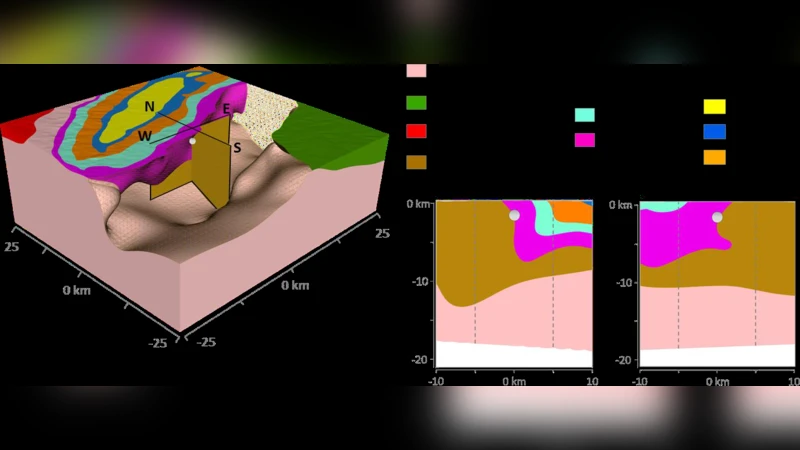
SNOLAB is one of the deepest underground laboratories in the world with an overburden of 2092 m. The SNO+ detector is designed to achieve several fundamental physics goals as a low-background experiment, particularly measuring the Earth’s geoneutrino flux. Here we evaluate the effect of the 2 km overburden on the predicted crustal geoneutrino signal at SNO+. A refined 3D model of the 50 x 50 km upper crust surrounding the detector and a full calculation of survival probability are used to model the U and Th geoneutrino signal. Comparing this signal with that obtained by placing SNO+ at sea level, we highlight a $1.4^{+1.8}_{-0.9}$ TNU signal difference, corresponding to the ~5% of the total crustal contribution. Finally, the impact of the additional crust extending from sea level up to ~300 m was estimated.
💡 Research Summary
The paper investigates how the massive rock overburden above the SNO+ detector at SNOLAB influences the geoneutrino signal that the experiment aims to measure. SNOLAB is situated 2,092 m underground, making it one of the deepest underground laboratories worldwide. Because SNO+ is a low‑background detector designed to capture electron‑antineutrinos produced by the decay of uranium (U) and thorium (Th) in the Earth’s crust and mantle, any additional source of such neutrinos in the immediate vicinity of the detector can bias the inferred mantle contribution and, consequently, the interpretation of Earth’s radiogenic heat budget.
Methodology
The authors construct a high‑resolution three‑dimensional (3‑D) geological model covering a 50 × 50 km area around the detector. The model integrates borehole logs, surface geological maps, gravity and seismic data, and assigns each voxel a rock type, density, and measured U and Th concentrations. The overburden (0–2 km depth) is dominated by granitic and basaltic rocks with average U ≈ 1.2 ppm and Th ≈ 4.5 ppm, slightly richer in radioactive elements than the continental average.
To translate the elemental abundances into an observable neutrino flux, the authors compute the full neutrino survival probability, (P_{ee}(E, L)), for each voxel. They use the latest global neutrino‑oscillation parameters (θ₁₂ ≈ 33.44°, Δm²₁₂ ≈ 7.42 × 10⁻⁵ eV², etc.) and perform an energy‑dependent line‑of‑sight integration over the entire model volume. This approach captures the distance‑dependent oscillation effects that are often approximated or neglected in simpler crustal models.
Two scenarios are compared: (i) the realistic configuration with the detector at 2 km depth (including the overburden), and (ii) a hypothetical configuration with the detector placed at sea level (i.e., the overburden removed). By keeping all other model components identical, the difference isolates the contribution of the 2 km thick rock column directly above the detector.
Results
The calculation yields a geoneutrino signal difference of 1.4 TNU (Terrestrial Neutrino Units) between the two scenarios. The quoted uncertainty, derived from propagation of geological sampling errors, model discretization, and oscillation‑parameter uncertainties, is +1.8 /‑0.9 TNU. The total crustal contribution at SNO+ is about 30 TNU, so the overburden accounts for roughly 5 % of the crustal signal.
The authors also evaluate the effect of the shallow crustal layer extending from sea level up to ~300 m, which is primarily composed of sedimentary rocks with low U and Th contents. This layer adds less than 0.1 TNU, a negligible amount compared with the overburden effect but still relevant for background budgeting in ultra‑low‑background experiments.
Uncertainty Analysis
The dominant source of uncertainty is the spatial variability of U and Th concentrations within the overburden. Borehole samples show a ±10 % spread, which translates directly into the ±0.9 TNU error on the overburden contribution. Model discretization (≈ 1 km³ voxels) introduces a smaller systematic bias, while the current uncertainties on the neutrino‑oscillation parameters contribute less than 0.2 TNU to the total error budget.
Implications
- Experimental Design – The finding that a deep rock column can contribute a non‑negligible fraction of the measured geoneutrino signal underscores the need to model local geology with high fidelity for any deep‑underground neutrino experiment.
- Geophysical Interpretation – When extracting the mantle geoneutrino component (the primary goal for probing Earth’s radiogenic heat), the 5 % overburden contribution must be subtracted, otherwise the mantle signal would be overestimated.
- Methodological Advancement – The combination of a detailed 3‑D geological model with a full oscillation‑probability integration sets a new standard for crustal neutrino flux calculations. This framework can be readily adapted to other sites such as JUNO (China), DUNE (USA), or future ocean‑floor detectors.
- Future Work – Reducing the uncertainty on the overburden contribution will require additional drilling, high‑precision geochemical assays, and possibly in‑situ gamma‑ray spectroscopy to map the U/Th distribution more accurately.
Conclusion
The paper delivers the first quantitative assessment of how the 2 km thick rock overburden at SNOLAB modifies the geoneutrino signal observed by SNO+. The overburden adds 1.4 TNU (≈ 5 % of the total crustal signal) with an uncertainty range of +1.8/‑0.9 TNU. While modest in absolute terms, this contribution is comparable to the precision goals of SNO+ and must be accounted for in any rigorous analysis of Earth’s interior. The study also demonstrates that shallow crustal layers above sea level have a negligible effect (< 0.1 TNU). Overall, the work provides a robust methodological template for incorporating local geological structures into geoneutrino flux predictions, thereby improving the reliability of neutrino‑based geophysical investigations.
Comments & Academic Discussion
Loading comments...
Leave a Comment