Robust Power Flow and Three-Phase Power Flow Analyses
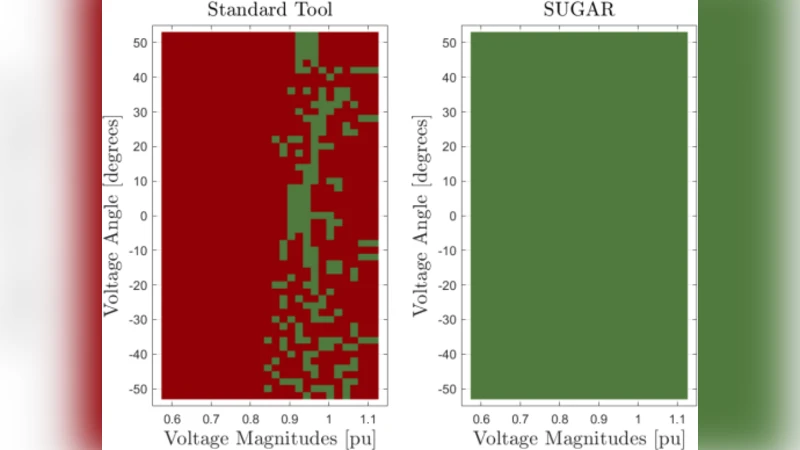
Robust simulation is essential for reliable operation and planning of transmission and distribution power grids. At present, disparate methods exist for steady-state analysis of the transmission (power flow) and distribution power grid (three-phase power flow). Due to the non-linear nature of the problem, it is difficult for alternating current (AC) power flow and three-phase power flow analyses to ensure convergence to the correct physical solution, particularly from arbitrary initial conditions, or when evaluating a change (e.g. contingency) in the grid. In this paper, we describe our equivalent circuit formulation approach with current and voltage variables that models both the positive sequence network of the transmission grid and three-phase network of the distribution grid without loss of generality. The proposed circuit models and formalism enable the extension and application of circuit simulation techniques to solve for the steady-state solution with excellent robustness of convergence. Examples for positive sequence transmission and three-phase distribution systems, including actual 75k+ nodes Eastern Interconnection transmission test cases and 8k+ nodes taxonomy distribution test cases, are solved from arbitrary initial guesses to demonstrate the efficacy of our approach.
💡 Research Summary
The paper addresses the long‑standing challenge of achieving robust convergence for both transmission‑level positive‑sequence power flow and distribution‑level three‑phase power flow analyses. Traditional methods—PQV (Newton‑Raphson on power mismatch equations) for transmission and backward‑forward sweep or Current Injection Method (CIM) for distribution—rely on non‑physical formulations and nonlinear power mismatch equations that often diverge, converge to low‑voltage non‑physical solutions, or fail altogether when applied to large, ill‑conditioned, or highly meshed networks with many PV buses.
To overcome these limitations, the authors propose a two‑pronged approach based on an equivalent circuit formulation (ECF) and the application of circuit‑simulation convergence techniques. In the ECF, every power‑system component (generators, loads, lines, transformers, shunts, FACTS devices, etc.) is represented by an equivalent circuit element expressed directly in terms of the true state variables: currents and voltages. A PV bus, for example, becomes a complex current source split into real and imaginary parts, while voltage‑control devices are modeled as dedicated control circuits. This representation preserves the underlying physics across the full operating range and yields a Jacobian that is the direct derivative of current‑voltage relationships, maintaining sparsity and numerical stability.
The second pillar adapts continuation (homotopy) methods from electronic circuit simulation, specifically the “Tx‑stepping” technique. The algorithm starts from a simplified network where all lines are replaced by high‑value resistances/inductances and voltages are fixed, guaranteeing an easy initial solution. System parameters are then gradually morphed back to their true values while Newton‑Raphson iterations are performed at each step. This homotopic path ensures that the solver remains within the basin of attraction of the physical solution, dramatically expanding the convergence region and eliminating dependence on the initial guess.
The methodology is validated on two large‑scale test cases: (1) a 75 k‑bus Eastern Interconnection transmission model and (2) an 8 k‑bus distribution taxonomy model featuring unbalanced loading, high R/X ratios, multiple PV generators, and meshed topology. In both cases, random initial voltage guesses (0–1.5 p.u.) lead to convergence within 10–15 NR iterations to a physically meaningful operating point (voltage magnitudes typically 0.95–1.05 p.u.). Scenarios that cause divergence or low‑voltage convergence in conventional PQV or CIM approaches are resolved without difficulty.
Key contributions of the paper include:
- A unified, physics‑based equivalent circuit representation for both positive‑sequence and three‑phase networks, eliminating the need for non‑linear power‑mismatch formulations.
- Integration of circuit‑simulation continuation methods (Tx‑stepping) to achieve robust, initialization‑independent convergence for systems of any size or topology.
- Demonstration of scalability and reliability on real‑world large test systems, showing superior performance over industry‑standard methods.
The authors suggest future work extending the framework to dynamic (time‑domain) simulations, coupling with optimal power flow (OPF) formulations, and hardware‑in‑the‑loop validation for real‑time operation. By bridging power‑system analysis with mature circuit‑simulation techniques, the paper offers a promising pathway toward more reliable grid planning and operation in the era of high renewable penetration and increasingly complex distribution networks.
Comments & Academic Discussion
Loading comments...
Leave a Comment