Probability boxes on totally preordered spaces for multivariate modelling
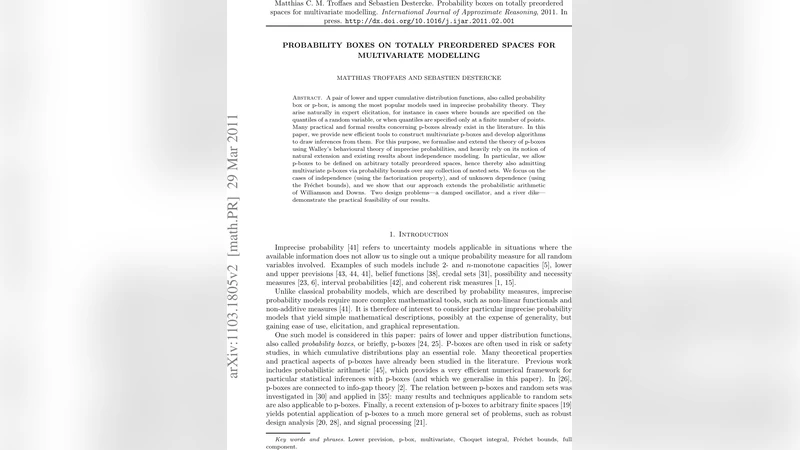
A pair of lower and upper cumulative distribution functions, also called probability box or p-box, is among the most popular models used in imprecise probability theory. They arise naturally in expert elicitation, for instance in cases where bounds are specified on the quantiles of a random variable, or when quantiles are specified only at a finite number of points. Many practical and formal results concerning p-boxes already exist in the literature. In this paper, we provide new efficient tools to construct multivariate p-boxes and develop algorithms to draw inferences from them. For this purpose, we formalise and extend the theory of p-boxes using Walley’s behavioural theory of imprecise probabilities, and heavily rely on its notion of natural extension and existing results about independence modeling. In particular, we allow p-boxes to be defined on arbitrary totally preordered spaces, hence thereby also admitting multivariate p-boxes via probability bounds over any collection of nested sets. We focus on the cases of independence (using the factorization property), and of unknown dependence (using the Fr'echet bounds), and we show that our approach extends the probabilistic arithmetic of Williamson and Downs. Two design problems—a damped oscillator, and a river dike—demonstrate the practical feasibility of our results.
💡 Research Summary
The paper presents a comprehensive theoretical and algorithmic framework for constructing and using probability boxes (p‑boxes) on arbitrary totally pre‑ordered spaces, thereby extending the traditional real‑line based p‑box methodology to truly multivariate settings. Starting from Walley’s behavioural theory of imprecise probabilities, the authors treat a p‑box as a coherent lower prevision defined on a set of events generated by nested intervals of the preorder. They show that such lower previsions are always coherent and that their natural extension – the least‑committal coherent extension to all bounded gambles – can be expressed as the lower envelope of the expectations of all precise distribution functions lying between the lower and upper cumulative distribution functions (CDFs) of the p‑box.
Key technical contributions include: (1) a rigorous definition of p‑boxes on any totally pre‑ordered space, allowing the space to be finite, continuous, or a product of several spaces; (2) a derivation of the natural extension for p‑boxes using the partition induced by the preorder’s equivalence classes, and a proof that this extension coincides with the infimum over all admissible CDFs; (3) an explicit representation of the natural extension for all gambles via the Choquet integral, which holds for completely monotone lower previsions; (4) a specialization to the case where the preorder is induced by a real‑valued mapping, which provides a convenient way to specify multivariate p‑boxes directly on product spaces; (5) methods for building joint p‑boxes from marginal p‑boxes under two dependence models: epistemic independence (using the factorisation property) and complete ignorance (using Fréchet bounds). In both cases, closed‑form expressions for lower and upper expectations of arbitrary gambles are obtained, and the authors demonstrate that the classic probabilistic arithmetic of Williamson and Downs emerges as a special case of their independence construction.
The practical relevance of the theory is illustrated through two engineering design problems. The first concerns a damped harmonic oscillator whose parameters are modelled by a multivariate p‑box; the authors compute bounds on the expected damping ratio under both independence and Fréchet assumptions. The second example evaluates the expected overtopping height of a river dike, again using a multivariate p‑box to capture uncertainties in hydraulic and structural parameters. In both cases the algorithms deliver exact bounds efficiently, confirming the feasibility of the approach for real‑world risk and safety assessments.
Overall, the paper significantly broadens the applicability of p‑boxes by removing the restriction to one‑dimensional real intervals, integrating them seamlessly with coherent lower prevision theory, and providing computational tools that retain the desirable properties of natural extension and complete monotonicity. It opens the door to robust multivariate uncertainty quantification in domains where only partial, interval‑type information on joint distributions is available.
Comments & Academic Discussion
Loading comments...
Leave a Comment